
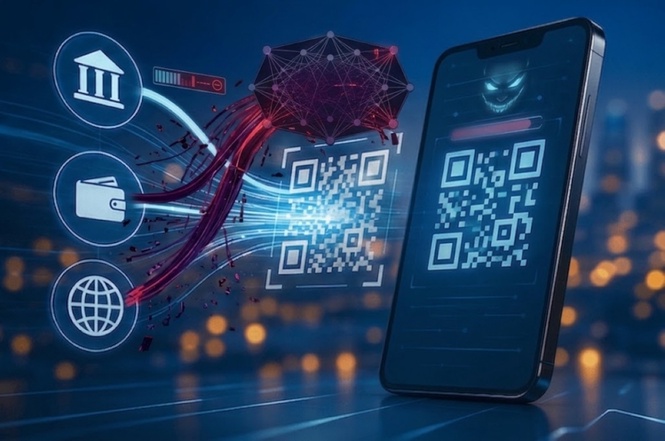
TWENTY years ago, fraudulent messages were easy to identify. Poor grammar, suspicious senders and implausible requests were the telltale signs. And defenses were equally straightforward: blocking the number and flagging the keyword were enough to stay ahead.
Things have changed significantly since then, and the tools available to fraudsters have advanced more in the last five years than in the previous 15. Cybercriminals are now using artificial intelligence to automate attacks at scale, personalize phishing messages to the point where they are nearly indistinguishable from legitimate communications, and adapt to blocking measures faster than static defenses can respond.
Infobip’s Fraud and Security Trends 2026 report analyzed billions of interactions globally. It found that harmful message detections grew 77 percent year-on-year in 2025, with phishing as the most dominant threat, now accounting for 49 percent of all blocked harmful content. That means nearly one in every two blocked messages is a phishing attempt.
The question for Philippine businesses is no longer whether this threat is real. It is whether their defenses are keeping pace.
AI fraud requires an AI response
The businesses best positioned against AI-powered fraud are not necessarily the ones with the largest security budgets. They are the ones that treat security as infrastructure built directly into how they communicate with customers.
In practice, this means several things. It means moving beyond single-channel SMS dependency for authentication and deploying AI-powered detection that catches threats static, rule-based systems miss entirely — new phishing patterns, image-based evasion, bot-driven traffic that only reveals itself in aggregate.
PLDT Enterprise showed what this looks like in practice. After deploying Infobip’s Anam Protect Firewall across Smart’s network, the company was able to significantly strengthen its SMS security by reducing spam, smishing and fraudulent messaging attempts at scale. In just six months, the firewall blocked more than 1.3 billion spam and fraud attempts while simultaneously improving SMS delivery and overall network security for subscribers.
For Philippine banks and financial institutions, fraud prevention is now also a compliance requirement. While most banks already have detection in place, a circular issued by Bangko Sentral ng Pilipinas (BSP) mandates all financial institutions with aggregate monthly transaction values of P75 million or above to go further.
BSP Circular 1213, issued in June 2025 under the Anti-Financial Account Scamming Act, directs financial institutions to adopt stronger authentication methods that reduce reliance on OTP-based verification alone. It also requires banks to have adequate risk management systems and strong authentication because banks without adequate controls will now be required to reimburse customers directly.
And when a situation requires more than automation can handle, the path to a live agent must be built in from the start, with full conversation context transferred automatically so the customer never has to repeat themselves.
Building security into communication infrastructure
The encouraging finding in Infobip’s report is that the defense is catching up. Adoption of AI-powered fraud detection also grew 71 percent year-on-year in 2025, while pattern-based detection grew 105 percent.
Organizations that have deployed AI-powered detection are catching threats that static, rule-based systems miss entirely, including image-based evasion techniques, where fraudsters hide harmful content inside images to bypass text-based filters, and cross-brand bot campaigns that no single organization’s dataset would detect alone.
This is a meaningful shift. Traditional fraud defenses operate on fixed rules of blocking the keyword, flagging the pattern and rejecting the sender. AI-powered detection operates on behavior, identifying the aggregate signals that indicate artificial or malicious activity even when no single message trips a rule.
Infobip Signals, for instance, monitors OTP message flows in real time, flagging sudden volume spikes, unusual geographic concentrations and low conversion rates that indicate bot-driven traffic rather than genuine authentication attempts. Artificially inflated traffic — also known as SMS pumping fraud — is now estimated to cost enterprises $8.5 billion annually. Real-time detection stops those charges before they accrue.
The most resilient businesses take a layered approach. Moving beyond single-channel SMS dependency for authentication is one step. Adding network-level signals like SIM Swap detection and Number Verification is another. These tools query the mobile operator’s infrastructure directly to confirm whether a SIM card was recently changed or whether a user genuinely owns the number they are claiming. No application layer can replicate that. Globally, Network API interactions grew 91 percent in 2025, with banks and fintechs leading adoption. Philippine financial institutions need to be moving in the same direction.
So, is the Philippines ready? The answer depends on the organization. The tools exist, the regulatory signal is clear and some enterprises are already ahead. But for many, the gap between awareness and action remains. Fraudsters are not waiting, and neither should Philippine businesses.
Guray Ozturk is the head of Customer Growth for Asia-Pacific at Infobip, a global communications technology company that provides businesses with platforms for communicating with customers through channels such as SMS, messaging apps, email and voice.