
Is Religion the biggest cult of all times?
Here’s a clear, neutral definition of cult.
A cult is a group or movement with excessive devotion to a particular person, idea, or object, often characterized by:
· Authoritarian control by a charismatic leader.
· Isolation from family, friends, or mainstream society.
· Manipulation (e.g., thought reform, mind control, shame, or fear).
· Exploitation of members for money, labor, sex, or power.
· Absolutist beliefs that claim ultimate truth or exclusive salvation.
In academic sociology, “cult” is sometimes used neutrally for any new or fringe religious movement, but in common usage it has strongly negative connotations. The boundary between cult and mainstream religion can be blurry and is often defined by behavior (e.g., abuse, control) rather than just beliefs.
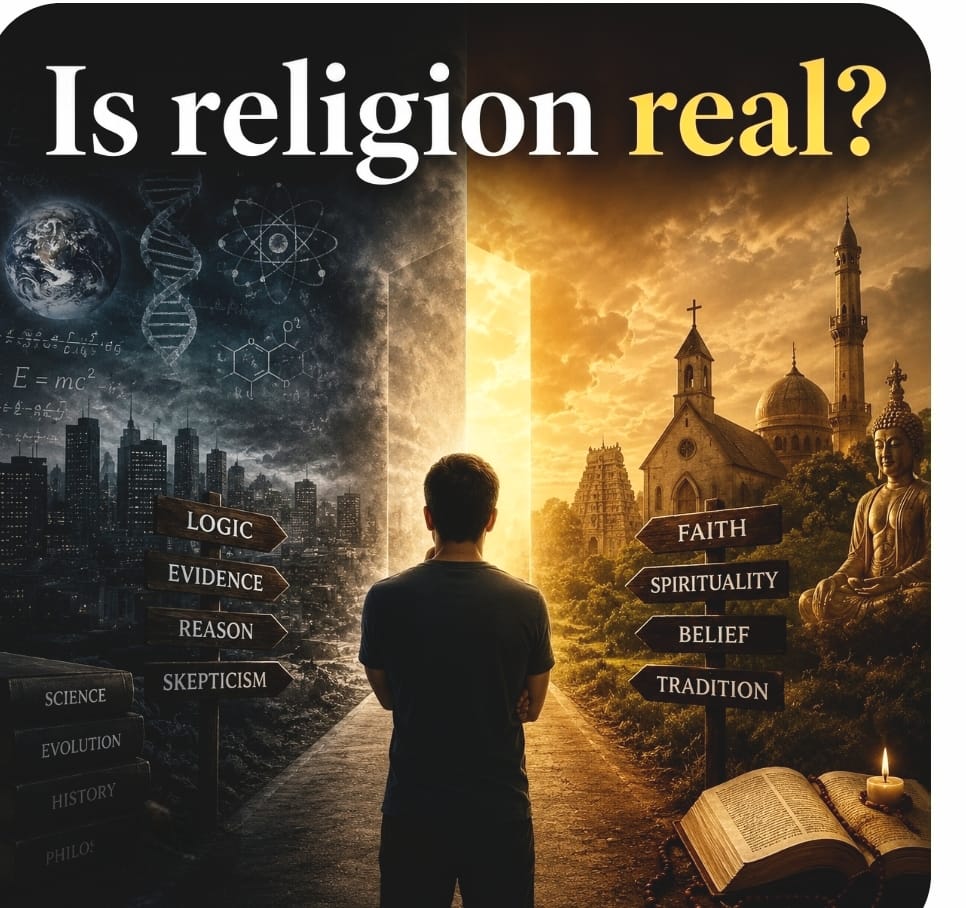
So, Is religion real?
Or is it being used and manipulated to control the minds of people.
Which is better? Spirituality or Religion?
The question “Is religion real?” is less straightforward than it first appears. It depends, in part, on what we mean by real.
Are we asking whether God or the divine objectively exists?
Or whether religion, as a human phenomenon, has tangible effects on individuals and societies?
These are different questions, often entangled, but worth separating if we want a thoughtful answer.
Religion. Psychological perspective.
From a sociological and psychological perspective, religion is undeniably real. Across history and cultures, human beings have constructed systems of belief, ritual, and meaning that we call religion. These systems shape laws, inspire art, justify wars, comfort grief, and guide moral behavior.
Whether one stands in a cathedral, a mosque, a temple, or sits quietly in meditation, the experience of religion is lived and felt.
In that sense, religion is as real as language or money—intangible, yet powerful because people collectively believe in it.
Religious Claims.
However, the deeper question usually concerns the truth claims of religion.
- Does a divine being exist?
- Is there an afterlife?
- Are sacred texts revelations or human creations?
Faith is not merely acceptance of ideas but trust in a reality that may not be visible.
A Christian may see God’s presence in grace and redemption;
a Muslim in submission and divine unity;
a Hindu in the multiplicity of the divine;
a Buddhist in the nature of suffering and liberation.
These are not simply abstract doctrines—they are frameworks through which people interpret existence itself.
Inconsistency in religious interpretations regarding god.
Science.
Science, grounded in observation and experimentation, remains silent on the existence of the supernatural. It can explain how the universe works, but not definitively why it exists or whether there is a transcendent purpose behind it.
Atheists.
For skeptics and non-believers, religion may be understood differently.
It can be seen as a human invention—an attempt to explain the unknown, cope with mortality, and create order in a chaotic world.
From this perspective, religion is “real” as a social construct, but not necessarily as a reflection of an external supernatural truth.
Critics might argue that different religions contradict one another, suggesting they cannot all be literally true, and perhaps none are.
Yet even this divide—belief versus skepticism—does not fully capture the complexity of religion.
Some people approach religion symbolically rather than literally. They may not insist that every story or doctrine is factually true, but still find deep meaning in the narratives, rituals, and ethical teachings.
Religion, in this sense, becomes a language of human experience—expressing awe, fear, hope, and the search for meaning.
Ultimately, asking whether religion is real leads us back to a more personal question:
what counts as reality?
What is reality?
If reality is limited to what can be measured and tested, then religion’s supernatural claims remain uncertain.
If reality also includes subjective experience, meaning, and inner life, then religion occupies a very real space in human existence.
Perhaps the most honest answer is this: religion is real in its impact, undeniable in its presence, but its ultimate truth—whether it points to something beyond human imagination—remains a matter of belief, interpretation, and personal conviction.
Jack Ung (jack.uct1953@gmail.com) is a content creator under the Newswav Creator programme, where you get to express yourself, be a citizen journalist, and at the same time monetize your content & reach millions of users on Newswav. Log in to creator.newswav.com and become a Newswav Creator now!
The User Content (as defined on Newswav Terms of Use) above including the views expressed and media (pictures, videos, citations etc) were submitted & posted by the author. Newswav is solely an aggregation platform that hosts the User Content. If you have any questions about the content, copyright or other issues of the work, please contact creator@newswav.com.