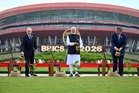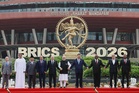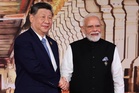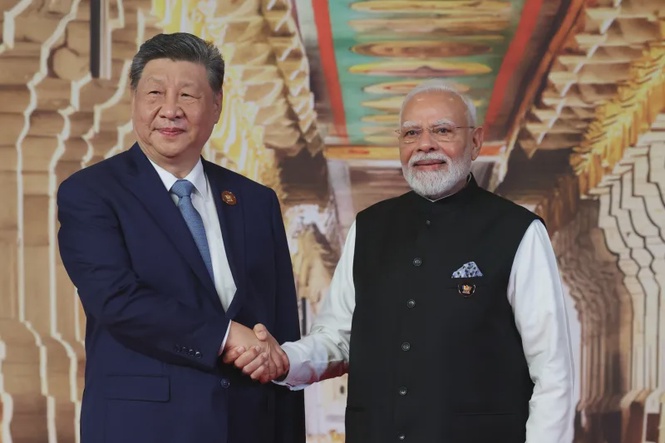
Chinese President Xi Jinping's visit to New Delhi this week marked his first trip to India in seven years, a highly anticipated thaw in one of Asia's most strained relationships. But it was a moment of apparent concern between the two rival leaders, not the diplomacy itself, that ended up overshadowing this year's BRICS summit, after Indian Prime Minister Narendra Modi twice interrupted his own speech to check on Xi, who later skipped Modi's gala dinner for summit leaders altogether.
Modi Asks Xi If He Is Okay During Live BRICS Address
During his address at the Bharat Mandapam convention center on September 12, Modi paused mid-speech after noticing Xi appeared uncomfortable in his seat. Speaking through an interpreter, Modi asked Xi directly, "Is it okay?", repeating the question before continuing, according to the Free Press Journal. Xi nodded in response, and Modi resumed his remarks. Neither leader's office has offered an explanation for what prompted the exchange, and the moment quickly drew attention online given how rarely the Chinese leader's health becomes a public talking point.
Why Xi Skipped The Summit Gala Dinner
The two leaders went on to hold a bilateral meeting lasting more than 50 minutes, covering border tensions and trade. But that evening, Xi was absent from the BRICS leaders' gala dinner Modi hosted on September 13 at the same venue, one of roughly 180 senior officials and dignitaries in attendance, according to the Tribune. Russian President Vladimir Putin and other BRICS leaders did attend, alongside several Indian federal ministers and state chief ministers. Reports said Xi returned to his hotel to rest, though neither Beijing nor Indian officials gave a specific reason for the no-show.
India And China Move To Reset Ties After Years Of Tension
The health chatter aside, the visit itself carried real diplomatic weight. Xi's sit-down with Modi produced a joint commitment to work toward what Indian officials described as a fair, reasonable and mutually acceptable resolution to the countries' long-running border dispute, even as military deployments along the frontier remain heavy, Al Jazeera reported. Xi told Modi the two countries "are fully capable of complementing and supporting each other for mutual benefit," despite their differences, while Modi stressed the importance of honoring existing border agreements and understandings.
Beyond the border question, the two sides agreed to expand cultural, business and transport links and restore institutional exchanges, including direct flights, visas and senior-level contacts that had been curtailed in recent years. Bilateral trade has reportedly hit a record high, and both governments say they want to address trade imbalances and supply chain friction. Analysts caution that a trade deficit favoring China, strategic rivalry and deep mutual distrust are unlikely to disappear quickly, even with warmer optics at the summit.
Wars In Ukraine And Iran Loom Over The Summit
The broader summit agenda was shaped as much by conflicts far from South Asia as by India-China relations. Putin and Iran's president were both in attendance, and the bloc's joint statement called for calm in the Middle East and for keeping global trade routes open, with the wars in Ukraine and Iran emerging as dominant themes of the gathering.
Dozens Of Tibetans Detained In Delhi Ahead Of Xi's Visit
Xi's presence in the Indian capital also drew a pointed rebuke from the Tibetan diaspora. Members of the Tibetan Youth Congress staged a demonstration near Bhairon Marg, close to the Bharat Mandapam venue, on the night of September 12, and at least 64 protesters were detained by police, the Quint reported. Demonstrators were taken to four separate police stations, and some were physically removed from the protest site, though no injuries were reported. A number of detained students remained in custody as of September 14, with the rest expected to be released by the evening of September 13.
The group's general secretary, Tenzin Lobsang, said China "continues to violate the human rights of Tibetans and suppress Tibetan culture and religion," and the organization called for the release of Tibetan political prisoners, an end to infrastructure development on the Tibetan plateau, and a halt to what it described as Chinese Communist Party interference in Tibetan religious affairs. The group argued that the Tibet issue is directly tied to India's national security and regional stability, a framing that has repeatedly complicated New Delhi's efforts to balance its relationship with Beijing against domestic political pressure over Tibet.