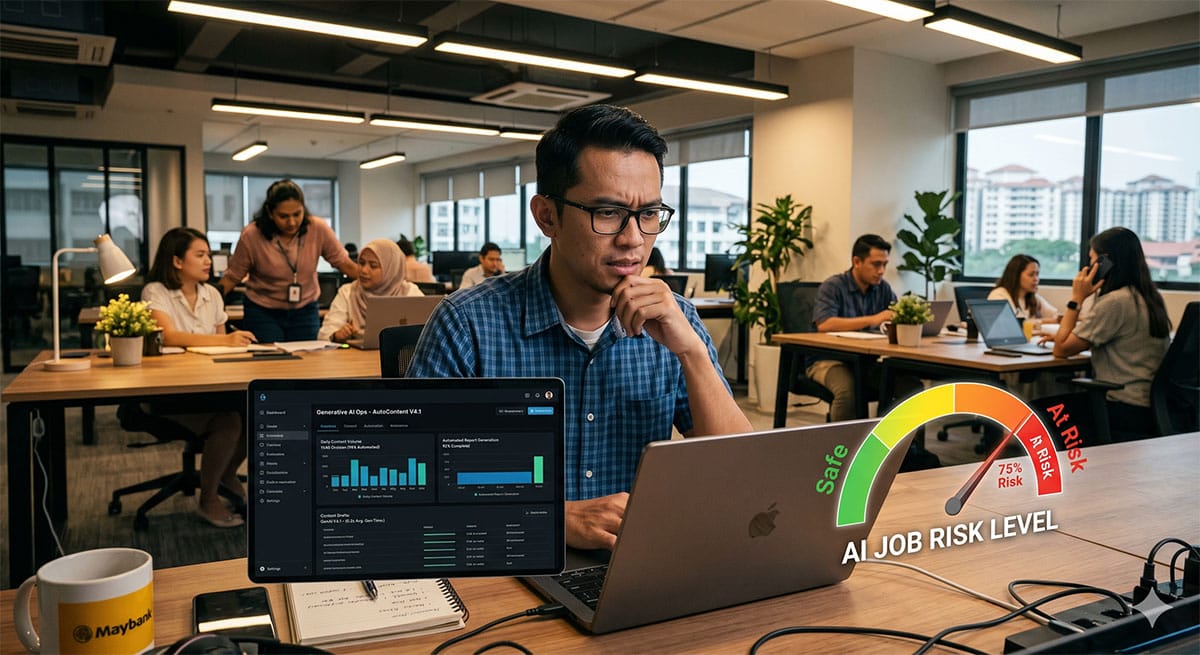
700,000 Malaysian jobs are at risk from AI. The question is whether yours is one of them.
Let me tell you what AI is not.
It is not a robot walking into your office, tapping you on the shoulder, and pointing to the exit while a machine takes your desk. That is the dramatic version. The real version is quieter, more gradual, and in some ways more unsettling precisely because of how slowly it creeps in.
It is the company that quietly stops hiring for the data entry role because the software now handles it automatically. The marketing team that used to have four copywriters, now running with two because AI drafts the first version of everything. The customer service department that once had thirty agents, now running an AI chat system that handles 70% of queries without a single human involved.
This is already happening. The question is whether it is happening to your job.
The Malaysian Numbers That Should Make You Pay Attention
Nearly 700,000 Malaysian workers are at high risk from AI and automation within the next three to five years, according to TalentCorp's own impact study. That is not a global figure. That is Malaysia specifically. 700,000 real people in real jobs across this country whose roles are being directly reshaped by AI right now.
Research by ISIS Malaysia suggests 45% of the Malaysian workforce, approximately 6.7 million workers, have at least 40% of their job tasks potentially substitutable by existing generative AI technologies. Not future AI. Existing tools that anyone can access today.
And yet 93% of Malaysian employees are already using generative AI at work, with 81% reporting significant time savings and 76% noting improved productivity. So the technology is already in the building. The question is whether it is working for you or quietly making the case that your role could be done without you.
Which Jobs Are Actually Most at Risk
Let us be specific, because vague warnings about "AI taking jobs" are less useful than knowing whether your particular job is in the line of fire.
The industries most exposed to AI automation in Malaysia right now include administrative and clerical roles, data entry and processing, basic accounting and bookkeeping, customer service and call centres, basic content writing and copywriting, retail and banking transaction processing, and entry-level legal and financial document review.
What these roles have in common is that they are primarily built around repetitive, rule-based tasks with predictable outputs. If your job largely involves processing information that follows a consistent pattern, generating documents from templates, answering questions with answers that can be found in a database, or moving data from one place to another, AI can do most of that. Often faster. Often more accurately. And without asking for annual leave.
The services sector in Malaysia, which dominates employment, is the most highly exposed to AI adoption precisely because it is built on information processing and knowledge work, the exact territory where AI is advancing fastest.
Which Jobs Are Safer Than You Might Think
Here is where the conversation gets more nuanced, because AI vulnerability is not a straight line from technical complexity to safety.
Jobs that require genuine human judgment, emotional intelligence, physical presence, and contextual decision-making in unpredictable environments are significantly harder to automate. Skilled tradespeople, healthcare workers dealing with complex patient situations, therapists and counsellors, teachers in dynamic classroom environments, and anyone whose work requires navigating genuine ambiguity and human nuance is substantially safer than the headlines suggest.
Jobs that combine human skills with AI tools are the safest of all. The strategist who uses AI to analyse data but applies human judgment to interpret it and build client relationships. The designer who uses AI for initial concept generation but brings creative direction and brand understanding that no tool can replicate. The lawyer who uses AI to review contracts but applies legal reasoning and client understanding to the actual advice.
In marketing and creative strategy specifically, a human who can understand a client's business context, walk into a room and build trust, ask the right questions, and translate all of that into a campaign that actually connects with real people is not easily replaced. AI can generate content. It cannot generate the relationship that makes a client trust your recommendations.
I use AI tools regularly in my work. They make me faster and significantly more informed. But every client meeting, every pitch, every strategic recommendation still requires me in the room. The tools work in the background. The human judgment, the instinct, and the relationship show up at the table.
The Honest Self-Assessment Test
Here is a simple framework to assess your own exposure. Ask yourself these four questions honestly.
First: could someone give a detailed description of my daily tasks to an AI tool and get results that are 80% as good as mine? If yes, your role has meaningful AI exposure.
Second: does my value come primarily from the quality of my relationships, judgment calls, or physical presence rather than information processing? If yes, you are in a stronger position than most.
Third: am I already using AI to help me do my job better? If no, you are behind where you need to be. The workers most at risk are not the ones whose jobs AI can do. They are the ones who refuse to learn how to use AI alongside their existing skills.
Fourth: if my company decided to reduce headcount, would the tasks I perform be easily redistributed to an AI system or absorbed by a colleague using AI tools? The more cleanly the answer is yes, the more urgently you need to be building new skills.
What Malaysia Is Doing About It
The government has not been sitting still on this. The RM110 million Jelajah AI MyMahir programme, led by TalentCorp in partnership with Ernst and Young Malaysia, is rolling out across 60 parliamentary constituencies nationwide, offering free, hands-on AI skills training to workers, students, women, entrepreneurs and small business owners.
The programme focuses on practical, immediately usable AI applications that people can apply in their actual work the same day. Not theory. Not academic frameworks. Actual tools and actual workflows. The Star reported that classes valued at RM5,000 per participant are being offered completely free. If this programme is coming to a constituency near you, attend it.
For those who cannot wait for the programme to reach them, platforms like Google Digital Garage, Microsoft Learn, and Coursera all offer free or low-cost AI literacy courses that can be completed in a weekend.
The Right Way to Think About This
Here is the framing that I have found most useful, both personally and from observing the people around me navigating this shift.
AI is not your enemy. It is the new colleague that every employer is bringing into the office whether individual employees like it or not. The workers who thrive are the ones who figure out how to work alongside it rather than competing against it or pretending it does not exist.
The people who get replaced by AI are not, in most cases, replaced because they were bad at their jobs. They are replaced because their jobs were largely built on tasks that AI can now perform more efficiently. That is a structural shift, not a personal failing. But the response to it is personal. It requires individual workers to actively assess where their value lies, build skills that complement AI rather than duplicate what it already does, and stop waiting for someone else to tell them what to learn next.
The Malaysian workers who will be fine in 2030 are not necessarily the ones with the most impressive qualifications today. They are the ones who started learning how to use AI tools in 2026 while the people around them were still deciding whether to take the threat seriously.
My Take
I will be honest about where I stand on this. AI has made my work significantly better. Tasks that used to take me hours now take a fraction of the time. Research that would have required days of reading can be completed in an afternoon. Content that would have required multiple drafts gets sharper faster. I am more productive, more informed, and more capable as a professional because of these tools.
But I am also aware of something important. The tools help me do the work. They do not replace the understanding that tells me what work needs to be done, which clients to pursue, what strategy actually fits a specific business context, and how to have a conversation that makes someone trust me with their marketing.
That combination, the tool proficiency plus the human judgment that guides it, is what actually matters. One without the other is vulnerable. Together, they are genuinely hard to replace.
The question is not whether AI will affect your job. It already is. The question is whether you are going to be the person who uses it to become more valuable, or the person who discovers too late that they were waiting for a disruption that was already underway.
Kamarul Azwan (k.azwan@gmail.com) is a content creator under the Newswav Creator programme, where you get to express yourself, be a citizen journalist, and at the same time monetize your content & reach millions of users on Newswav. Log in to creator.newswav.com and become a Newswav Creator now!
The User Content (as defined on Newswav Terms of Use) above including the views expressed and media (pictures, videos, citations etc) were submitted & posted by the author. Newswav is solely an aggregation platform that hosts the User Content. If you have any questions about the content, copyright or other issues of the work, please contact creator@newswav.com.