.jpg)
By Mihar Dias 2026
The world has an uOctobernfortunate habit of looking for solutions in all the wrong places.
When pirates hijack ships, we send warships. When criminals demand millions in ransom, we send negotiators. When governments fail, we appoint committees to investigate why they failed, usually followed by more committees to investigate the first committee.
But what happens when someone decides to try something different?
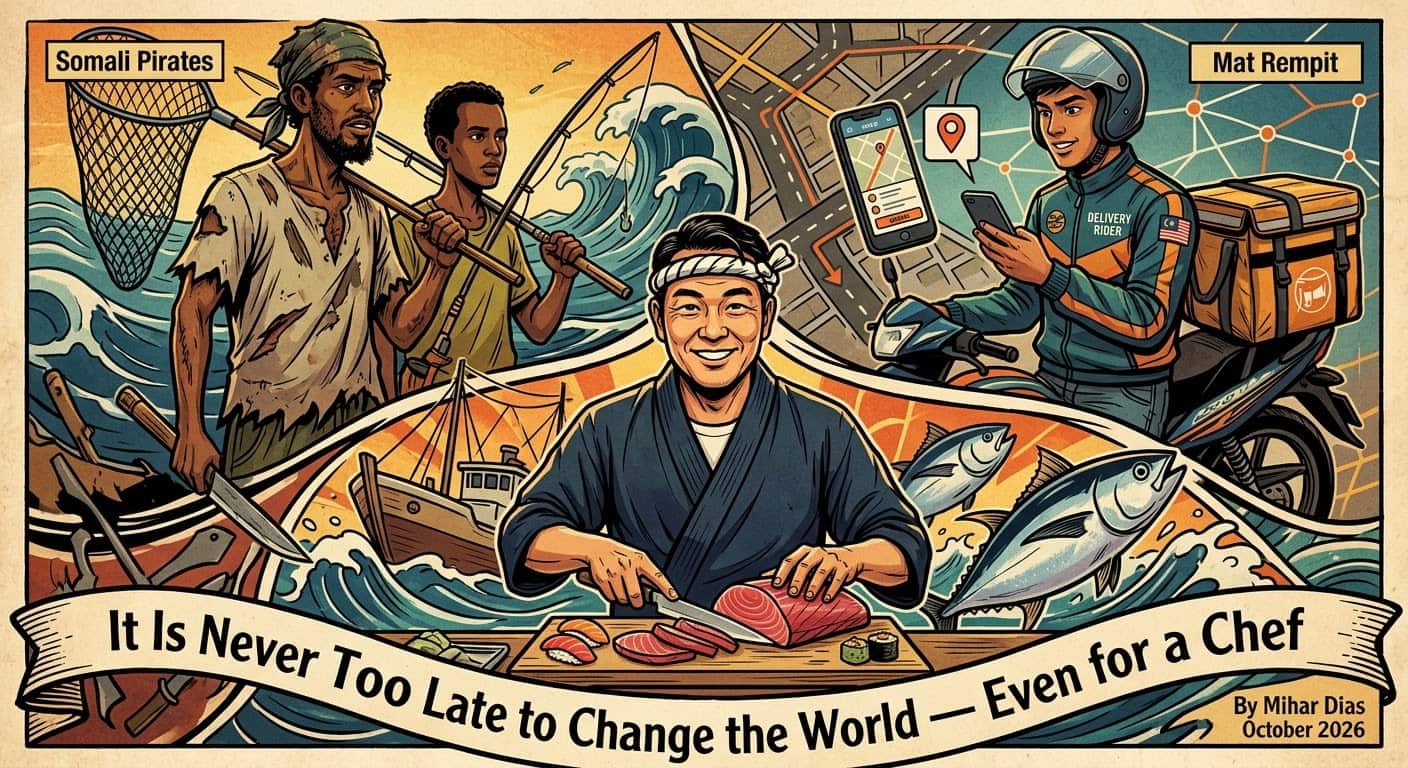
Consider Kiyoshi Kimura, a Japanese sushi restaurant owner better known as the Tuna King. https://www.facebook.com/share/p/1A4DD4N6T5/
His business is selling fish. Yet around 2012, according to his own account, he attempted something that even the world's most powerful navies had struggled to achieve: persuading Somali pirates to abandon their guns and return to fishing.
In 2011, 237 pirate attacks were reported off Somalia. Ships were seized, sailors held hostage and shipping companies confronted with ransom demands running into millions of dollars.
Warships from the United States, Europe, NATO, China, India and Japan patrolled the Gulf of Aden. The international community deployed sophisticated technology, military personnel and considerable resources. Yet piracy remained a serious problem.
Then came a man from Tokyo whose professional expertise was in preparing sushi, not conducting military operations.
Kimura's explanation was that some pirates had once been fishermen whose livelihoods had been undermined by foreign trawlers depleting the waters on which their communities depended. This was his account, not a complete or universally established explanation for Somali piracy, which also involved state collapse, criminal networks and the enormous profits available from kidnapping crews.
But Kimura saw something that military planners could not solve with guns alone: behind at least some of the pirates were men who had once earned their living from the sea.
Instead of asking how to defeat them, he asked a different question: what would persuade them to stop?
According to his account, he provided four fishing boats, helped the fishermen learn to catch yellowfin tuna, arranged facilities to preserve their catch and promised to buy their fish.
His message was simple: abandon piracy and earn an honest living. Feed your families without threatening the lives of others.
He was not offering a lecture on morality. He was offering an alternative.
There is something profoundly human about that distinction.
It is easy to condemn a criminal. It is considerably harder to understand the circumstances that make crime attractive and then create an alternative that allows someone to recover his dignity without excusing his wrongdoing.
Kimura reportedly believed that the pirates could be persuaded to return to fishing if legitimate work became a viable option. He was not asking them to become saints overnight. He was offering them a reason to become fishermen again.
His contribution to the decline of Somali piracy has not been independently established, and it would be an exaggeration to credit four boats with single-handedly solving an international security crisis. Naval patrols, armed guards, better ship protection and developments within Somalia all played important roles.
But the principle behind Kimura's initiative deserves attention, especially here in Malaysia.
Consider our own mat rempit.
For years, Malaysians complained about young motorcyclists roaring through the streets in the middle of the night, weaving dangerously through traffic, staging illegal races and disturbing entire neighbourhoods. They became a familiar subject of public frustration, police operations and newspaper headlines.
The standard response was predictable: more enforcement, more roadblocks, more arrests and more stern warnings.
Law enforcement is necessary. Reckless riding endangers lives, and no society should romanticise behaviour that puts innocent road users at risk.
But is punishment alone enough?
And here is a question worth asking: where are all those young men today?
Have some grown out of their reckless habits? Have others found jobs, started families or discovered that the excitement of youth is less attractive when one has bills to pay? And might some have redirected their knowledge of motorcycles, roads and navigation into legitimate work as e-hailing drivers or food-delivery riders?
We should not pretend to know how many former mat rempit have made that transition without evidence. Nor should we assume that every delivery rider once participated in illegal racing.
Nevertheless, the possibility raises an important question about social policy: what happens when the energy once spent on a public nuisance is redirected towards earning an honest living?
The young man who once raced his motorcycle through traffic may possess mechanical skills, intimate knowledge of local roads, confidence in handling a bike and an appetite for adventure. Those qualities, without the recklessness, could have value in motorcycle repair, logistics, delivery services or other legitimate occupations.
What if we had deliberately created more pathways to make that transition possible?
Imagine programmes that combine motorcycle safety training, technical certification, apprenticeships, entrepreneurship and access to legitimate employment. Imagine former offenders being offered a credible route into work, provided they meet the necessary safety and licensing requirements.
Instead of merely telling young people what they must stop doing, we could help them discover what else they could do.
That is where the sushi man from Tokyo becomes relevant to Malaysia.
Kimura's approach, as he described it, was not to excuse piracy but to change the economic equation. He tried to make catching fish a viable alternative to hijacking ships.
We could apply the same thinking to our social challenges. A young person who sees no attractive route towards financial independence may be tempted by immediate rewards, peer pressure or risky behaviour. Providing skills and legitimate earning opportunities does not guarantee that everyone will change, but it gives people more choices.
And choices matter.
Of course, the mat rempit phenomenon is not identical to Somali piracy. One involves dangerous road behaviour; the other involved organised criminal attacks on ships and the kidnapping of crews. The scale, causes and consequences are entirely different.
The lesson is not that the two should be equated. It is that both invite us to consider whether prevention and practical alternatives can complement enforcement.
Malaysia has no shortage of people who can identify a problem. We have politicians who promise to solve it, officials who devise programmes to address it and experts who can explain why previous efforts have failed.
What we sometimes need is someone prepared to ask a more useful question: what would make the better choice possible, attractive and sustainable?
A job is not merely a salary. It can provide structure, self-respect, responsibility and a sense of belonging. For a young person who has been labelled a troublemaker, the opportunity to earn a legitimate living may offer something else: the chance to become known for what he contributes rather than what he once did wrong.
That is not sentimentalism. It is a practical investment in people.
The greatest lesson in Kimura's story is not that a sushi entrepreneur accomplished what the world's navies could not. It is that the ability to make a difference does not belong exclusively to those with power, military rank or political office.
Sometimes, it belongs to someone who understands a trade, recognises a human need and is prepared to act.
You do not have to be a president to change a nation. You do not have to be a general to help restore peace. You do not have to be a billionaire to give someone a second chance.
And you certainly do not have to be a chef to change the world.
But if you happen to be one, there is no reason why you cannot.
We may never know exactly how much difference Kimura's four boats made off Somalia. We may never establish how many Malaysian youths who once rode recklessly have since found more productive ways to use their skills.
But the questions are worth asking.
How many young people have we written off before discovering what they might become? How many social problems persist because we are better at condemning undesirable behaviour than creating desirable alternatives? And how many lives could be changed if someone took the initiative to turn a problem into an opportunity?
Perhaps the next breakthrough will not come from another summit, another speech or another billion-ringgit programme. Perhaps it will come from a mechanic who trains unemployed youths, an entrepreneur who hires former offenders, a teacher who refuses to give up on a difficult student, or a retired professional who shares a lifetime of experience with the next generation.
The world does not always need another hero with a cape. Sometimes, it needs someone willing to roll up his sleeves and do something useful.
So, the next time we think we are too old, too ordinary, too inexperienced or too insignificant to make a difference, remember the Tuna King.
He was a restaurateur, not an admiral. His business was fish, not foreign policy. Yet he looked at a crisis and imagined a possibility that others might have overlooked.
It is never too late to change the world. You do not need to be a politician, a general, a billionaire or even a particularly famous person. You may be a teacher, a mechanic, a fisherman or a chef.
You simply need to see a problem, believe that something can be done about it, and have the courage to begin.
The world has enough people explaining why things cannot change.
What it needs is more people willing to try.
Mihar Dias (mihardias@gmail.com) is a content creator under the Newswav Creator programme, where you get to express yourself, be a citizen journalist, and at the same time monetize your content & reach millions of users on Newswav. Log in to creator.newswav.com and become a Newswav Creator now!
The User Content (as defined on Newswav Terms of Use) above including the views expressed and media (pictures, videos, citations etc) were submitted & posted by the author. Newswav is solely an aggregation platform that hosts the User Content. If you have any questions about the content, copyright or other issues of the work, please contact creator@newswav.com.