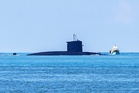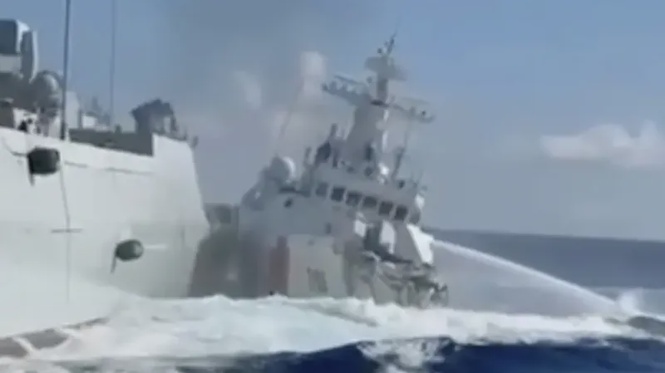
A China Coast Guard ship sailed in formation with three Chinese navy warships through a strait off southern Japan and into the Pacific on October 27, the first time Japan's Ministry of Defense has publicly reported the two Chinese services transiting its surrounding straits together.
The ministry described the voyage as part of China's expanding activities in the region and said it is watching closely. It said the ships did not enter Japanese territorial waters and took no dangerous action.
Four Ships Tracked From Kuchinoerabu To The Pacific
Japan's Maritime Self-Defense Force spotted the group at about 10 a.m. on October 27, sailing east roughly 200 kilometers west of Kuchinoerabu-jima, a small volcanic island in Kagoshima Prefecture, according to a Joint Staff Office release dated October 28.
The flotilla was made up of a Renhai-class guided missile destroyer (hull number 109), a Luyang III-class guided missile destroyer (hull number 133), a Jiangkai II-class frigate (hull number 530), and a China Coast Guard vessel (hull number 2307). The four then continued east through the Osumi Strait and out into the Pacific, the ministry's English summary said.
Japan sent the destroyer Shiranui, the minesweeper Takashima, and a P-1 maritime patrol aircraft from Atsugi air base to monitor the ships and gather intelligence.
The Osumi Strait separates the southern tip of Kyushu from Tanegashima island and is an international waterway. A Japanese defense report updated in June lists it as one of five main routes Chinese warships use to cross the first island chain, the arc of islands running from Japan through Taiwan to the Philippines, Stars and Stripes reported. Chinese navy ships pass through it regularly, and the Joint Staff Office publishes those transits as a matter of routine.
A Law Enforcement Fleet Often Called China's Second Navy
What set this transit apart was the white hull in the formation. The ministry had never before announced that China's navy and coast guard passed through the strait at the same time, NHK reported.
The ministry pointed out that the China Coast Guard is a maritime law enforcement agency, organized separately from the People's Liberation Army Navy. Its capabilities have grown so sharply in recent years that it is often called China's "second navy," Jiji Press reported.
That dual identity is the point of concern for Japan's neighbors. A coast guard cutter sailing with destroyers into the open Pacific blurs the line Beijing usually draws between policing waters it claims and military operations.
The Same Coast Guard Now Patrols Waters East Of Taiwan
The Osumi transit fits a pattern Taiwan has watched closely all year. Since June 1, China has kept coast guard cutters in the Pacific east of Taiwan, beginning with the 5,000-ton Daishan and the 3,000-ton Baita, Bloomberg reported in September. By Bloomberg's count, the patrols covered about 27,100 square nautical miles, more than twice the size of Taiwan.
Taiwan's Coast Guard Administration told Bloomberg that Beijing is trying to use "law enforcement patrols" to establish a new normal for its presence in the waters east of the island.
Analysts see a deliberate choice in sending the coast guard rather than warships. Brian Hioe of the University of Nottingham told Defense News in July that using the coast guard likely lowers the threat profile of the operations, letting Beijing claim restraint. He added that China increasingly blends civilian and military forces, which makes such gray zone activity harder for other countries to answer.
Joshua Arostegui of the U.S. Army War College told the same outlet that China's large coast guard ships are built for longer deployments than navy vessels usually undertake. The October 27 transit showed one of those ships operating not alone but alongside the navy, on the same route into the Pacific.
Tokyo And Beijing Remain At Odds Over Taiwan
The voyage came during a diplomatic freeze between Tokyo and Beijing that has now lasted more than a year. Prime Minister Sanae Takaichi told parliament in November 2025 that the use of force against Taiwan "could constitute a survival-threatening situation" for Japan, a legal threshold that could allow Japan to use its military. Beijing responded with sharp criticism, disrupted political contact, and hit tourism and trade, the Lowy Institute's The Interpreter noted. As recently as November 6, a Chinese foreign ministry spokesperson again told Japan to correct its position on Taiwan.
Takaichi is making her first trip to China as prime minister this week for the Asia-Pacific Economic Cooperation summit in Shenzhen, which opened November 18. She is unlikely to hold formal talks with Chinese President Xi Jinping on the sidelines, diplomatic sources told Kyodo News.
For Taiwan, which sits between the Osumi Strait and the Philippines on the same island chain, the October 27 voyage is another sign that China's coast guard is no longer confined to the waters near its own coast.
You've read it. Now join the conversation — follow us on X, Facebook and IG. Editor: Penny Wang