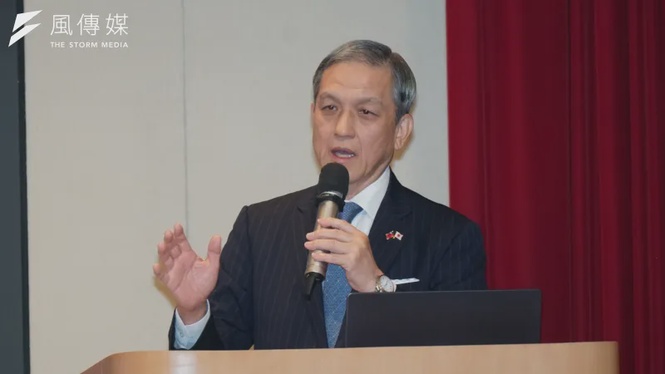
Taiwan and Japan face the same Chinese military threat and the same risk of economic coercion, and the time has come for the two to start cooperating on defense industry, says Kiyofumi Iwata (岩田清文), the former chief of staff of Japan's Ground Self-Defense Force. Under the idea that "a Taiwan contingency is a Japan contingency," he argues, the two are already bound by a shared fate, and drones are where they should begin.
Taiwan's manufacturing muscle and Japan's strength in key components fit neatly together, Iwata said, and beyond drones the partnership could eventually extend to cybersecurity, rare earths and maritime surveillance, including unmanned surface vessels.
Who Kiyofumi Iwata Is
Iwata, 69, became the 34th chief of staff of the Ground Self-Defense Force in 2013, the top post in Japan's army. After retiring in 2016, he served as an adviser to Mitsubishi Electric's defense systems division, and he is now vice president of the Japan Institute for National Fundamentals, a conservative think tank.
A graduate of the electrical engineering department at Japan's National Defense Academy, he also studied at the US Army Command and General Staff College. His career included command of the 71st Tank Regiment and the 7th Division, as well as posts as director of personnel at the Ground Staff Office, vice chief of the Joint Staff and commanding general of the Northern Army.
Since retiring, Iwata has written extensively about the threat China poses to Japan and the risks facing Taiwan. A book he co-wrote with several retired Self-Defense Force generals on how Japan should respond to a Taiwan Strait crisis, built around a full tabletop war game, was published in a Chinese edition in Taiwan earlier this year. He has visited Taiwan many times.
Why A Trusted Supply Chain Matters
Iwata made his case on October 11 in a keynote titled "The Japan Taiwan Community of Shared Destiny and Defense Industry Cooperation" at the Taiwan Japan Technology Future Forum, hosted by the Indo-Pacific Strategy Think Tank in Taipei. Many of the supply chains behind Japan's defense capabilities still depend on China, he noted, and given Beijing's habit of turning trade into a tool of coercion, neither Japan nor Taiwan can afford to rely on it. Building a trustworthy supply chain together, he said, is essential.
Cooperation on fighter jets or missiles would be too sensitive, he acknowledged, and Japanese law does not currently allow military equipment exports to Taiwan. To keep the political temperature down, and drawing on how the international community has supported Ukraine, the two sides could instead explore cooperation in arms production, particularly mutual support on dual use components.
What Japan's Export Rules Allow
Under Japan's Three Principles on the Transfer of Defense Equipment and Technology, revised by the government in the first half of this year, lethal weapons can be exported only to 17 countries that have bilateral agreements with Japan, which rules out Taiwan.
Non lethal equipment, components, technology and services are a different matter. "Parts that are not weapons themselves but are used to make weapons can be exported from Japan to Taiwan," Iwata said. "I believe Japan and Taiwan should cooperate and support each other on equipment and components used in the military field."
Why Drones Are The Natural Starting Point
Within those limits, Iwata sees drones as the most promising area. Their uses now stretch well beyond the military into logistics, agriculture, infrastructure inspection and disaster relief.
Japan also has a dependency problem: about 90 percent of the drones used in the country come from Chinese companies. To change that, Japan's Ministry of Economy, Trade and Industry set a goal last December of building domestic capacity to produce 80,000 drones a year by 2030. "Japan has decided to localize core components such as motors, batteries, communication modules and flight control systems while also valuing cooperation with like-minded countries, including Taiwan," he said.
Taiwan brings strong manufacturing capabilities and deep expertise in information and communications technology, Iwata said. According to Taiwanese government figures, the island's drone industry output rose 2.5 times in 2025 to NT$12.9 billion, while exports of complete drones jumped 21-fold. Another set of figures shows Taiwan exported 180,000 drones in the first four months of this year, more than in all of 2025.
How The Two Sides Complement Each Other
Japan's strengths, in Iwata's assessment, lie in high performance motors, magnetic materials, battery materials and sensors. Taiwan excels at mass production and assembly, flight control systems, communication modules and battery packs.
"The vision of turning Taiwan into the core of Asia's drone supply network is gradually becoming reality," he said. "Japan is strong in components such as electric motors, and Taiwan has the potential to scale up production for export. Combining the strengths of Japan and Taiwan will make both countries stronger."
Four Paths For Drone Cooperation
Iwata proposed four directions for deeper cooperation.
The first is to focus on components. "The point is not finished weapons but cooperation on dual use parts, materials and modules, which carries important political significance," he said.
The second is to keep the private sector in the lead, with industry groups and research institutions at the core rather than relying on direct government involvement. "A model where companies and industry associations are out front and governments support them from behind best fits the reality of Japan Taiwan relations," he said.
The third is to jointly develop markets in third countries. "In the United States, the Philippines, Europe and Ukraine, there are many countries that pursue justice and do not depend on China," he said. Taiwanese drones have already won US certification, he noted, and Taiwan ranks third globally in market share for drone batteries supplied to Ukraine. "Through Japan Taiwan component cooperation and global exports, we can contribute together to the world's security."
The fourth is to remove institutional barriers. Japan and Taiwan differ significantly on drone certification, safety and communication standards, creating major obstacles. In 2025, Taiwan exported only 45 complete drones to Japan, even though its total drone exports that year topped 120,000. "We should draw up corresponding Japanese standards and harmonize drone specifications between Taiwan and Japan," Iwata said. "I hope Japan Taiwan cooperation in drones will move toward a system on the scale of tens of thousands of units."
Beyond drones, he said the two sides could also explore cooperation on rare earth products, a trusted semiconductor supply chain, maritime surveillance including unmanned vessels, and cybersecurity and communications security.
Turning Chinese Pressure Into An Opportunity
Iwata argued that China's economic coercion is not only a threat to Japan and Taiwan but also an opportunity that can unite them and strengthen their resolve to build up their capabilities together.
"In the face of growing external pressure, Japan and Taiwan should make the most of their respective strengths and work together to build a more resilient foundation for industrial cooperation. This is not only something we can do, it is something we should do," he said. "When Taiwan's powerful manufacturing capabilities are combined with Japan's technological strengths, they will become a core force for Japan and Taiwan to defend freedom and democracy together."
"We should build a system that does not depend on great powers and that genuinely safeguards our own security through close cooperation between Japan and Taiwan," he said. "This is an opportunity we should seize."