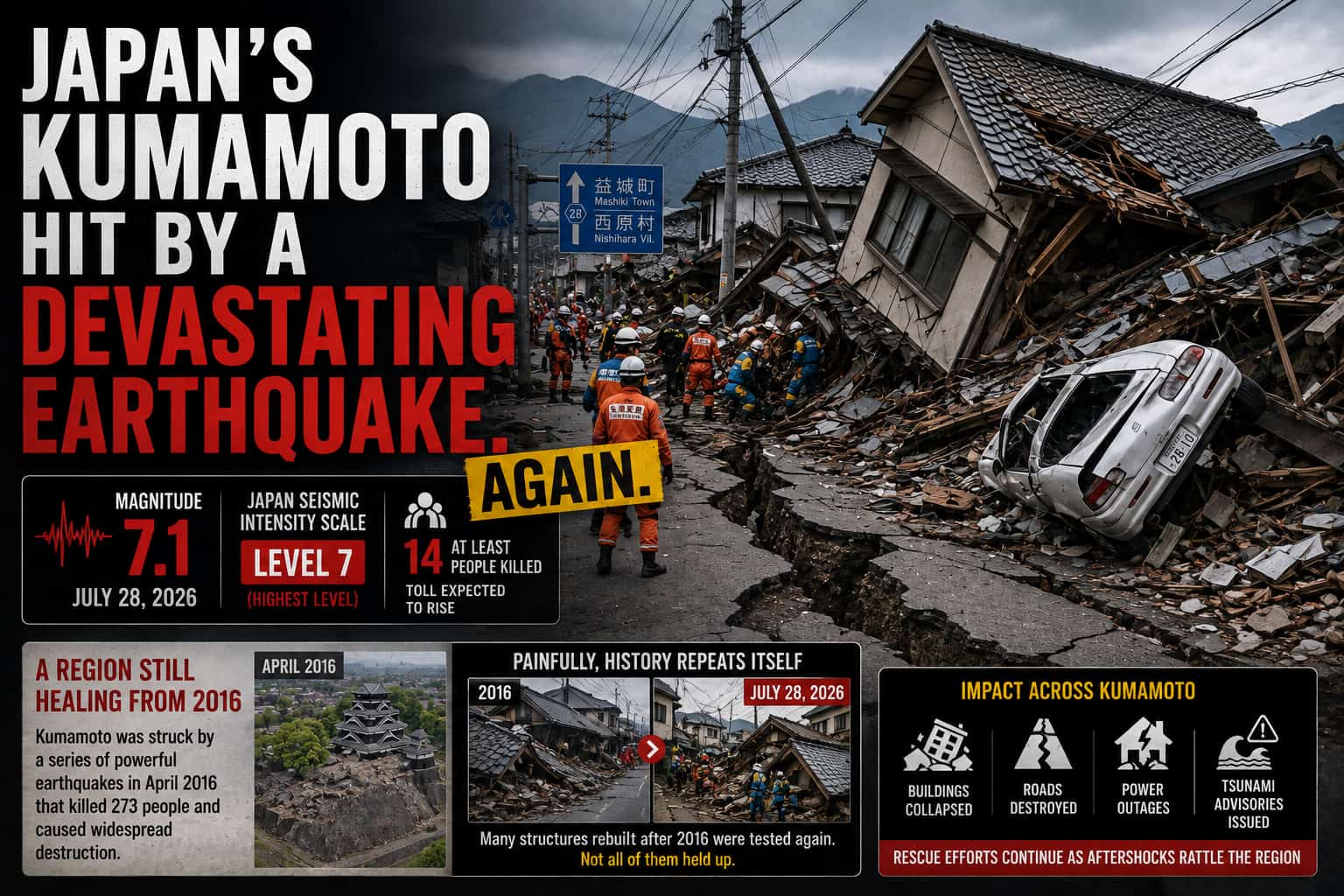
A region still healing from 2016
On July 28, 2026, a magnitude 7.1 earthquake struck Kumamoto Prefecture in southern Japan, registering the highest level on Japan's seismic intensity scale. At least 14 people were killed, with the toll expected to rise as rescue teams searched for survivors trapped under collapsed buildings.
For Kumamoto, this is a painful repeat. The same region was hit by a series of powerful earthquakes in April 2016 that killed 273 people and caused widespread destruction. Many of the structures rebuilt after 2016 were tested again by this quake, and not all of them held up.
The Aeon Mall explosion
The most devastating single incident occurred at Aeon Mall Kumamoto in the town of Kashima. The earthquake triggered what is believed to have been a gas explosion inside the building, causing a large section of it to collapse. At least five people died inside the mall, including three employees confirmed by Aeon's president. Three more were still missing as rescue operations continued.
Dashcam footage captured the moment of the explosion, and the video circulated widely online. The mall had roughly 200 shops and employed around 2,700 staff. Most customers managed to evacuate, but rescue workers reported the smell of gas as they entered the wreckage.
The challenge of earthquake-prone regions
Japan is one of the most earthquake-prepared countries on Earth. Building codes are strict, early warning systems are advanced, and public awareness is high. But no amount of preparation can fully protect against a magnitude 7 quake striking directly beneath populated areas.
The South China Morning Post noted that the mall had been rebuilt after the 2016 earthquake to better withstand seismic events. The fact that it collapsed again raises difficult questions about what "earthquake-proof" actually means when the ground shakes hard enough. The explosion, likely caused by ruptured gas lines, added a secondary disaster that seismic engineering alone cannot prevent.
Prime Minister Sanae Takaichi mobilised thousands of Self-Defence Forces personnel and declared that every second counted in the rescue effort. At least 12 buildings collapsed across the prefecture, with most incidents concentrated in the city of Yatsushiro.
Kumamoto's 2016 earthquake was supposed to be the disaster that reshaped the region's infrastructure for the better. Billions were spent on rebuilding and reinforcement. Ten years later, the rebuilding is being tested again, and the results are sobering.
The quake also disrupted transport across the region. Bullet train services were suspended, stranding thousands of passengers at stations across Kyushu. At least 62 people were injured, six of them seriously, and the numbers kept climbing as assessments continued.
For a country that prides itself on disaster preparedness, the Kumamoto quake is a reminder that preparation reduces damage but cannot eliminate it. When the ground shakes at the highest level on the intensity scale, some buildings will fall. Some gas lines will rupture. And some places that were rebuilt to be stronger will be tested in ways their engineers hoped would never happen again.
Ronny M (ronny76netstuff@gmail.com) is a content creator under the Newswav Creator programme, where you get to express yourself, be a citizen journalist, and at the same time monetize your content & reach millions of users on Newswav. Log in to creator.newswav.com and become a Newswav Creator now!
The User Content (as defined on Newswav Terms of Use) above including the views expressed and media (pictures, videos, citations etc) were submitted & posted by the author. Newswav is solely an aggregation platform that hosts the User Content. If you have any questions about the content, copyright or other issues of the work, please contact creator@newswav.com.