
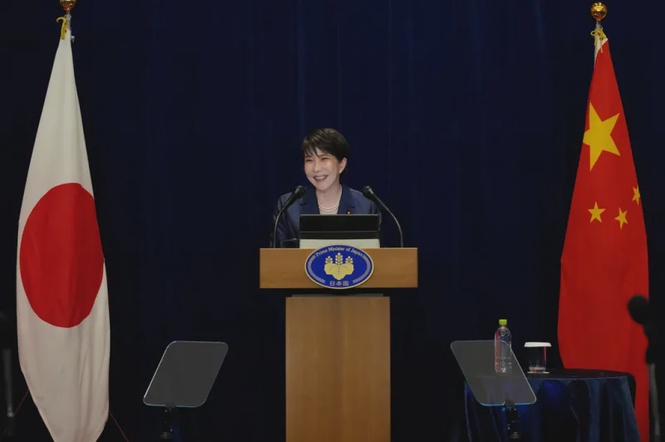
Japanese Prime Minister Sanae Takaichi fell back on the 1972 document that normalized Japan-China relations when she was pressed on Taiwan at the Asia-Pacific Economic Cooperation (APEC) summit in Shenzhen, China, but Beijing made clear on November 20 that words alone will not end a year-long standoff over her remarks about a possible Taiwan conflict.
A reporter from Singapore's Lianhe Zaobao asked Takaichi on November 19 under what circumstances Japan would consider military involvement if conflict broke out in the Taiwan Strait. She said she would not answer hypothetical questions and that Japan's basic position on Taiwan follows the 1972 Japan-China Joint Communique. The next day, Chinese Foreign Ministry spokesperson Guo Jiakun said honoring the four political documents between the two countries is Japan's obligation and must be shown through concrete actions, not just remarks, and urged Tokyo to correct its "erroneous words and deeds" on Taiwan as soon as possible, according to the ministry's transcript.
The Remark That Started The Standoff
The dispute dates back to November 7, 2025. Asked in parliament about a scenario in which China blockades Taiwan, Takaichi said that if warships were deployed and force was used, some cases could amount to a "survival-threatening situation" under Japanese law. She gave the example of US forces moving to lift a blockade and China using further force to stop them, saying the government would judge based on the actual circumstances.
Under Japan's security laws, that label applies when a country closely tied to Japan comes under armed attack and Japan's survival and its people's safety are seriously threatened as a result. It is the threshold at which Japan may use force alongside an ally. Beijing read her answer as a signal that Japan could intervene militarily over Taiwan, the self-governed island it claims, and demanded that she take it back.
What The 1972 Joint Communique Says About Taiwan
The communique Takaichi cited set out each side's diplomatic position when the two countries established relations. In Article 2, Japan recognizes the government of the People's Republic of China as the sole legal government of China. In Article 3, Beijing reaffirms that Taiwan is an inalienable part of its territory, and Japan says it "fully understands and respects" that stand and firmly maintains its position under Article 8 of the Potsdam Proclamation, according to the text published by Japan's Foreign Ministry.
Beijing has pressed Tokyo to spell out that position in full, rather than simply cite the document, and has kept demanding that Takaichi withdraw her parliamentary answer.
Wang Yi Told Tokyo To Fix Its Own Problem
A possible way out was floated in September. Former Japanese Foreign Minister Takeshi Iwaya met Chinese Foreign Minister Wang Yi in Beijing on September 28, the first official meeting between Wang and a Japanese politician since the row began, Jiji Press reported.
Iwaya later told Japanese media that a public retraction would face a very high political bar at home, so he proposed that the two governments jointly reaffirm the 1972 communique instead. According to Iwaya, Wang found the idea too vague and maintained that Takaichi should resolve the issue herself, The Yomiuri Shimbun reported.
China's official readout of the meeting said only that Japan must "correct" the remarks, and some in Japan took that as a sign Beijing was softening. But Wang had privately insisted on a retraction, Kyodo News reported, citing several sources familiar with Japan-China relations. After the Shenzhen summit, Guo again used the word "correct." Takaichi has still not withdrawn her answer.
Former Envoy Warns Backing Down Would Invite More Pressure
Hideo Tarumi, Japan's ambassador to China from 2020 to 2023, said on TV Asahi's Saturday Station program on November 21 that if Takaichi retracted her remarks under pressure from Beijing, China could conclude that Japan will give in whenever it is pressed.
That leaves the standoff where it started. From Iwaya's proposal in September to the APEC summit in November, Tokyo has offered the 1972 communique as common ground, while Beijing keeps pointing back to the answer Takaichi gave in parliament a year ago.
Taiwan Contingency: The Full Timeline
From Takaichi's November 2025 remarks in parliament to the latest developments, Storm Media tracks every turn in the Japan-China standoff, updated regularly.
