Japan and the United States launched Keen Sword 27, their largest joint field exercise to date, on October 19, deploying anti-ship missiles to islands about 110 kilometers from Taiwan in what is widely seen as a rehearsal for defending Japan's southwestern frontier.
Some 45,000 Self-Defense Forces (SDF) personnel and 12,000 U.S. troops are taking part through October 29. Centered on Kyushu and the Nansei Islands, which stretch from southern Kyushu to the east of Taiwan, the drills simulate a joint response to an enemy landing, SBS News reported, citing the Mainichi Shimbun. This year's exercise also expands into space, cyber, and electromagnetic operations. Seven other countries are joining, including first-time partners France, Germany, the Netherlands, New Zealand, and the Philippines.
US Missile System Heads To Island Near Taiwan
Washington is sending its Navy-Marine Expeditionary Ship Interdiction System (NMESIS), unmanned launchers carrying anti-ship missiles with a range of more than 180 kilometers, to Yonaguni, Japan's westernmost inhabited island. From there, the system can cover much of the sea north and east of Taiwan, waters central to any Chinese blockade of the island, which Beijing claims as its own, The Japan Times reported.
Japan is temporarily placing Type 88 anti-ship missiles and Type 03 air defense systems on Yonaguni and sending Type 88 units to Ishigaki, which already hosts Type 03 and Type 12 batteries. U.S. HIMARS rocket launchers and MADIS low-altitude air defense systems also feature in the drills.
Japan's Type 25 Missiles Leave Kumamoto For The First Time
On October 18, launchers for the domestically developed Type 25 surface-to-ship missile left Camp Kengun in Kumamoto Prefecture for a training area spanning Nagasaki and Saga prefectures, the weapon's first deployment off base since entering service in March. With a range of about 1,000 kilometers, enough to reach parts of China's coast, it anchors the counterstrike capability Japan adopted in 2022, a break from its postwar, strictly defensive posture.
No missiles will be fired. Crews will rehearse launch procedures, and U.S. and Japanese forces are expected to share targeting data, Japanese media reported.
"By utilizing various standoff missiles with different characteristics, we can enable a multilayered response on our part," said Gen. Hiroaki Uchikura, chief of staff of the SDF Joint Staff.
Uchikura Calls The Exercise's Scale A Sign Of Crisis
It is the first Keen Sword since Japan created its Joint Operations Command (JJOC) in March 2025 to direct all three SDF branches. Speaking on October 16, Uchikura said the drills would sharpen the allies' response to gray-zone situations and armed attacks. He also described the exercise's "near-maximum scale" as "an expression of our sense of crisis," according to SBS News.
"Given the various geographical and operational characteristics of the southwestern region, it is essential to operate forces swiftly and flexibly in various contingencies and to deploy the necessary capabilities to the necessary locations," he said, insisting the training is "not aimed at any specific country."
Chinese Analyst Calls Missile Deployment A Provocation
Beijing sees it differently. Lü Chao, a professor at the Liaoning Academy of Social Sciences, told China's state-run Global Times that deploying the Type 25 while stressing its reach toward China's coast is a clear provocation, and that the involvement of NATO members makes the drills more dangerous.
The drills also follow the Liaoning carrier group's training in the western Pacific days earlier.
Carrier Arrives As Host Communities Push Back
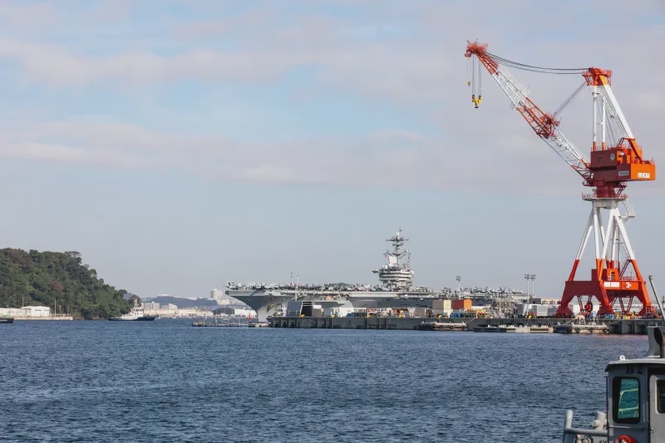
The carrier USS Theodore Roosevelt docked at Yokosuka on October 16 with the cruiser USS Chosin and the destroyer USS Decatur, U.S. Indo-Pacific Command said, and the allies are coordinating on its participation. The Yokosuka-based USS George Washington remains in the Middle East amid the U.S. war with Iran, The Japan Times reported.
Rear Adm. Marcos Jasso, commander of Carrier Strike Group 9, called the alliance "the cornerstone of peace and security across the region." Commanders also reminded crews to keep discipline and respect their hosts, a pointed message after a U.S. Marine was arrested this month on suspicion of robbing and murdering an Okinawan woman.
The case has fueled opposition in host communities. On October 13, a residents' group asked Tsuiki Air Base in Fukuoka Prefecture and the Defense Ministry to cancel the drills. In Oita Prefecture, activists and assembly members urged the prefectural government to press Tokyo for the same. At an October 17 public meeting in Miyakojima, residents raised fears over Osprey flights, crimes by U.S. personnel, and electromagnetic emissions.
"Strengthening deterrence will only fuel an arms race, provoke other countries and increase the risk of conflict," one resident said, according to the Miyako Shinpo.
Japanese and U.S. Ospreys, aircraft with a troubled safety record in Japan, will fly into civilian airports on Miyako and Ishigaki. Officials say safety remains their top priority.