
Even the godfather of artificial intelligence, it turns out, is not immune to temptation. Nvidia chief executive Jensen Huang has admitted to an extramarital affair, and what might have stayed a Silicon Valley gossip item has become something far larger. The woman involved, Alice Huang, is suspected by US officials of being a Chinese spy. Almost overnight, a private scandal has turned into a national security storm reaching from Washington to Beijing to Wall Street.
How A Private Affair Became A National Security Story
Alice Huang is reported to have worked in Chinese media, including at Hunan TV and state broadcaster CCTV, before moving into finance and becoming a senior executive at Megaspeed, a Singapore based company. That one person with such a résumé could put the world's most powerful technology executive in jeopardy is remarkable in itself.
If she was a spy, it is hard to say whether she was gathering commercial or political intelligence. Spies rarely operate so openly or show so little concern about being seen. Her conduct looked less like tradecraft and more like an ordinary affair.
Wall Street does not care whose marriage is in trouble. What it cares about is whether the man holding up trillions of dollars in market value can withstand the fallout. Huang has access not only to Nvidia's trade secrets but to the most sensitive chip technology in the world, to global supply chain plans and to the inner workings of US technology policy toward China. The question is whether a personal scandal could become the first domino to fall across an entire industry.
Why Nvidia Has Become The Central Bank Of AI
Nvidia is usually described as a chip company. In practice it has become something closer to the central bank of AI. Over the past three years it has provided about US$300 billion in financial support to customers and invested billions more in start ups. New cloud providers such as CoreWeave, along with AI data centers across Asia, depend on that flow of money.
The model is circular. Nvidia sells chips to customers, then lends to or invests in those same customers so they can buy more chips. If that loop breaks, the consequences could be severe.
A Company That Rests On One Man
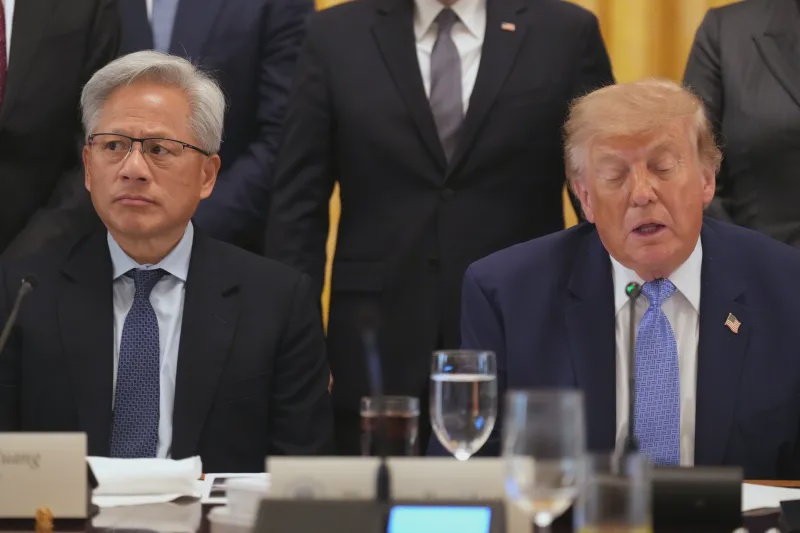
The power structure is even more troubling. Huang owns only about 3.4% of Nvidia, yet he designs nearly all of its strategy, and there is no clear successor. It resembles Caesar's Rome: the Senate still sat, but only one man made the decisions. When Caesar fell, Rome did not get reform. It got civil war.
Investors buying Nvidia stock should ask what they are actually paying for. Is it the GPUs, the CUDA software ecosystem and the enormous profits, or is it the personal charisma of the man known as the godfather of AI?
If Nvidia is the central bank of AI, its governor is now in trouble. Will the money keep flowing? What happens to the new cloud providers and to the AI infrastructure being built across Asia?
Warren Buffett famously said that only when the tide goes out do you find out who has been swimming naked. The AI boom has risen this far on the market's faith in one person. Huang sold the world a dream of AI. Once that faith cracks, valuing the company stops being only a math problem and becomes a question of psychology. Investors should ask themselves whether they are betting on the future of AI or on one man's private life.
What Washington's China Hawks Are Likely To Do Next
Huang has long been a dove on China. He has publicly opposed US restrictions on exporting advanced chips there and has called China "a competitor, not an enemy." The scandal will put those positions under fresh scrutiny. Nvidia has launched an independent investigation, the US House of Representatives has asked him to attend a closed door briefing, and the State Department drafted a classified memo on the matter as early as this spring.
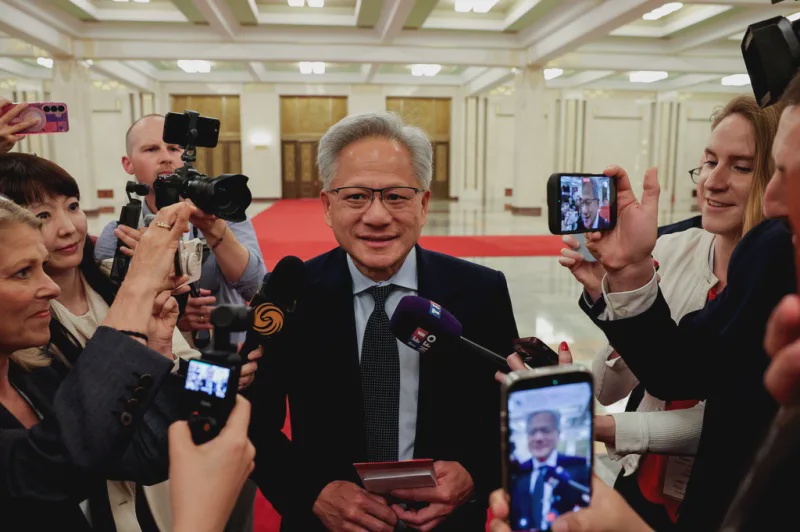
Politics has no room for sentiment. Once "suspected spy" and "opposes export controls" are attached to the same person, Washington's hawks do not need conclusive evidence. They only need a story that holds together. Export reviews for Blackwell and the next generation of Nvidia chips will almost certainly get tougher, and the practice of supplying computing power to restricted users through data centers in third countries is likely to become a prime enforcement target.
Why Taiwan's Chip Industry Has The Most At Stake
When the city gate burns, the fish in the moat suffer too. Taiwan has the most reason to worry. From TSMC's wafer fabrication and ASE's packaging and testing to MediaTek's chip design, and on to the big electronics assemblers that build complete servers and the printed circuit board makers that supply them, Taiwan is deeply embedded in Nvidia's AI ecosystem.
Huang is not just a customer. He is the bridge between Taiwan's semiconductor industry and AI customers around the world. A night market snack, a lavish banquet, a hug with a supplier's chief executive: behind each is a working relationship built up over many years.

If the board's investigation leads to a change at the top, the bridge will still stand, but the way people cross it will change. New decision makers may not understand Taiwan, and may not be willing to trade "Taiwan speed" for "Taiwan trust." Any shift in development timelines, purchasing schedules or mass production plans will hit Taiwanese suppliers' capacity planning and capital spending directly.
The legal pressure could be even harder. If Washington tightens controls, Taiwanese companies will face stricter know your customer checks, end use verification and tracking of where their products go. When chips end up in a third country data center and are sold as cloud computing, suppliers will need to know exactly who is using them and for what. Rising compliance costs will eat into margins, and there will be no way around it.
Nvidia Week Could Overshadow The Trump Xi Summit
The facts still need to be established by investigators, but the story is already dramatic enough. There is an irony here: a technology leader who constantly warns the world about AI safety may have fallen for the most basic form of social engineering. Firewalls can stop hackers. They cannot stop a smile across a glass of whiskey.
Next week will be Nvidia week, with the company's earnings call and the closed door House briefing both on the calendar. Together they may draw attention away from the upcoming meeting between President Trump and Chinese leader Xi Jinping. Concerns raised by US intelligence have now reached Huang and Nvidia, and what began as a story about a secret affair could grow into a crisis of corporate governance and national security.
The scandal also feeds into the rivalry between the AI superpowers. It may push the United States to tighten its technology blockade, and it may speed up China's drive to build a self reliant AI industry.
A Governance Warning, Not Yet Proof Of A Bubble
Huang built the AI dream. Now his halo is tarnished, and the industry's outlook is growing harder to read.
Still, the scandal is more likely to be a catalyst for investors to reassess governance risk at Nvidia than proof that the global AI bubble is about to burst. What decides the fate of any bubble is whether AI investment can generate enough cash flow to justify the capital spending behind it, and whether companies around the world can turn expensive computing power into real gains in productivity.