
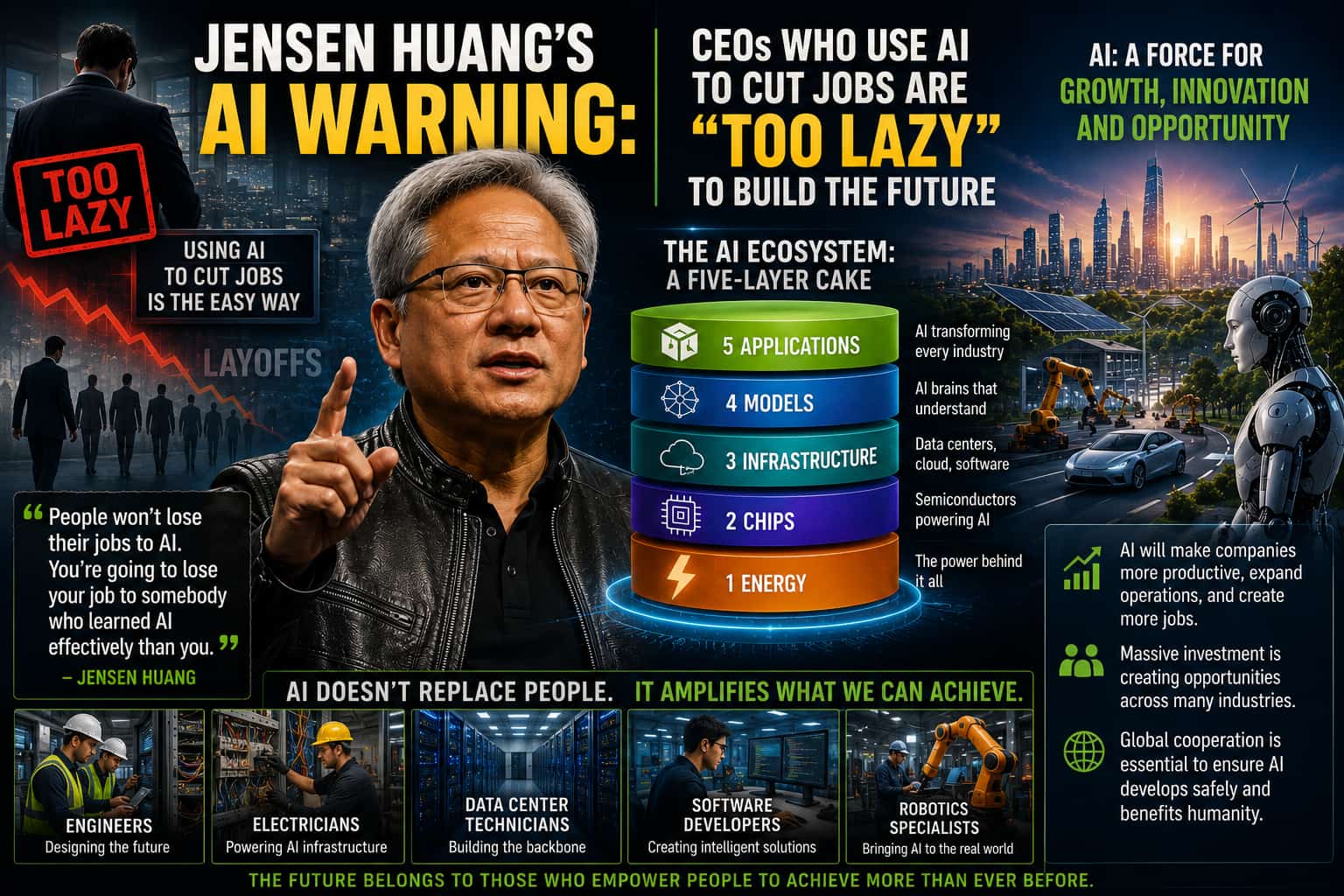
The rapid rise of artificial intelligence has sparked widespread fears of mass unemployment, with companies around the world increasingly citing automation as a reason to reduce their workforce.
However, Nvidia founder and CEO Jensen Huang has delivered a strikingly different message: business leaders who rely on AI primarily to eliminate jobs are simply being “too lazy” to unlock the technology’s true potential.
Speaking about the future of AI, Huang painted a picture not of economic decline and job destruction, but of unprecedented growth, innovation, and opportunity. AI revolution represents a technological advancement on par with the personal computer, the internet, and mobile computing. Rather than replacing people, it has the potential to reinvent entire industries and create new forms of work that do not yet exist.
Huang explained that AI is far more than just chatbots and language models. He described the AI ecosystem as a “five-layer cake” consisting of energy, chips, infrastructure, models, and applications. Every layer generates economic activity, investment, and employment opportunities.
At the foundation of AI ecosystem is energy, which powers the enormous computing demands of AI systems. Above that sits the semiconductor industry, where Nvidia and its partners supply the advanced chips necessary for AI development. Infrastructure follows, including data centres, cloud computing networks, and software platforms. Then come AI models such as ChatGPT and Claude, which process and understand information. Finally, applications sit at the top, where AI is transforming sectors ranging from healthcare and manufacturing to robotics and autonomous vehicles.
For Huang, this layered structure demonstrates why AI is unlikely to be a job-killing force. Instead, he believes it will create job demand across multiple industries simultaneously.
One of the most significant developments, according to Huang, is the emergence of “agentic AI” - AI systems capable of acting autonomously with minimal human supervision. These digital and physical agents can understand objectives, make plans, use tools, execute tasks, evaluate outcomes, and continuously improve their performance.
While such capabilities naturally raise concerns about automation, Huang argues that history tells a different story. Previous technological breakthroughs, including computers and the internet, did not make people less productive or less ambitious. Instead, they expanded what individuals and organisations could accomplish.
Huang noted that jobs are made up of many tasks. AI may automate certain repetitive activities efficiently, but this allows workers to focus on more valuable, creative, and complex responsibilities. A radiologist, for example, can use AI to analyse medical images more efficiently while spending more time diagnosing patients and improving healthcare outcomes.
This belief also shapes Huang’s advice to workers concerned about the future. Rather than fearing AI, he encourages people to learn how to use it effectively.
“People won’t lose their jobs to AI,” he remarked. “You’re going to lose your job to somebody who learned AI effectively than you.”
The Nvidia chief believes companies that embrace AI intelligently will become more productive, expand their operations, and ultimately hire more workers. Nvidia itself continues to grow its workforce while integrating AI into virtually every aspect of its business.
Beyond individual companies, AI is generating demand across entire economic sectors. Massive investments in energy infrastructure, semiconductor manufacturing, data centre construction, and AI startups are creating opportunities for engineers, electricians, architects, software developers, and skilled tradespeople. Venture capital investment in AI-related businesses has also surged, fuelling innovation and entrepreneurship.
On the global stage, Huang acknowledged the growing competition between the United States and China. He described China as a formidable technological rival due to its large domestic market, highly educated workforce, and powerful technology companies. Yet despite geopolitical tensions and export restrictions, Huang argued that cooperation remains essential to ensure AI develops safely and benefits humanity as a whole.
He also highlighted Taiwan’s crucial role in the global AI supply chain, particularly through its world-leading semiconductor manufacturing capabilities. The island continues to serve as a critical hub for AI production and innovation, benefiting from enormous investments linked to the sector’s growth.
At the heart of Huang’s message is a challenge to political leaders, corporate executives, and workers alike. AI should not be viewed as a shortcut to reducing payrolls or boosting short-term profits. Leaders who use AI solely as a cost-cutting tool, he argues, are missing the larger opportunity.
Instead, AI should be seen as a force that amplifies human capability, accelerates economic growth, and creates entirely new industries. The future, Huang believes, belongs not to those who eliminate workers, but to those who empower them to achieve more than ever before.
In a world increasingly worried about technological disruption, Jensen Huang’s vision offers a powerful counter-argument: AI’s greatest contribution may not be replacing human labour, but expanding human potential.
By: Kpost
Information Source:
Kpost (ckhorsk@gmail.com) is a content creator under the Newswav Creator programme, where you get to express yourself, be a citizen journalist, and at the same time monetize your content & reach millions of users on Newswav. Log in to creator.newswav.com and become a Newswav Creator now!
The User Content (as defined on Newswav Terms of Use) above including the views expressed and media (pictures, videos, citations etc) were submitted & posted by the author. Newswav is solely an aggregation platform that hosts the User Content. If you have any questions about the content, copyright or other issues of the work, please contact creator@newswav.com.