
As Johor inches closer to its next state election, the political landscape is becoming increasingly volatile, with internal turmoil in major parties and the emergence of new political players threatening to reshape the electoral battlefield.
What was once expected to be a straightforward contest between established coalitions is now evolving into a complex and unpredictable struggle, with fragmentation within both Parti Pribumi Bersatu Malaysia (Bersatu) and Parti Keadilan Rakyat (PKR) potentially reshaping the electoral landscape and giving Barisan Nasional (BN), the incumbent state government, a crucial advantage.
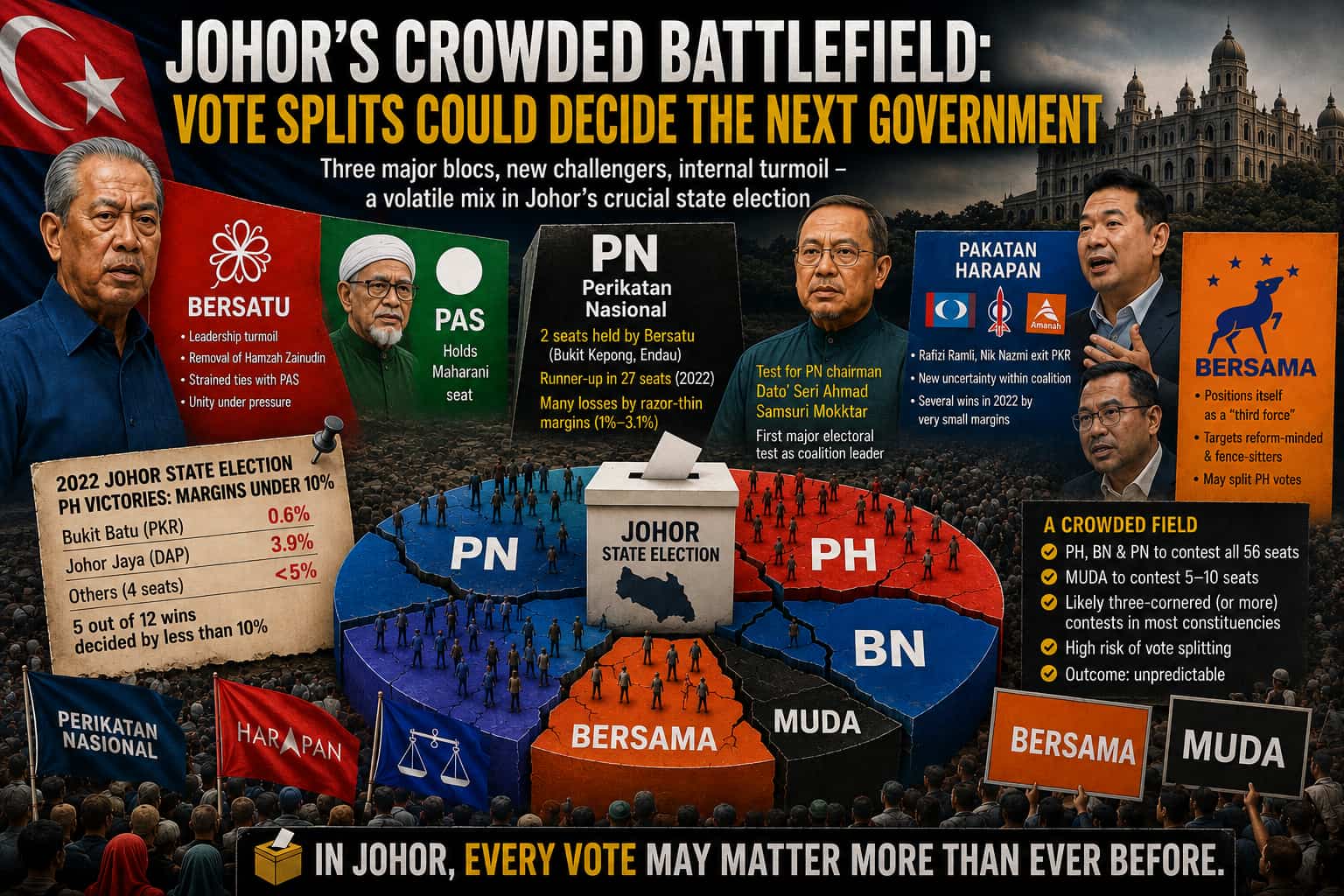
For Bersatu, the stakes could hardly be higher. Johor is not only the home state of party president Tan Sri Muhyiddin Yassin but also a crucial battleground where the party seeks to strengthen its influence among Malay voters. Yet recent leadership turmoil, strained relations with PAS within the Perikatan Nasional (PN) coalition, and the removal of former deputy president Dato' Seri Hamzah Zainudin have reportedly fuelled internal dissatisfaction, division dissolutions, and growing concerns over party unity in the state.
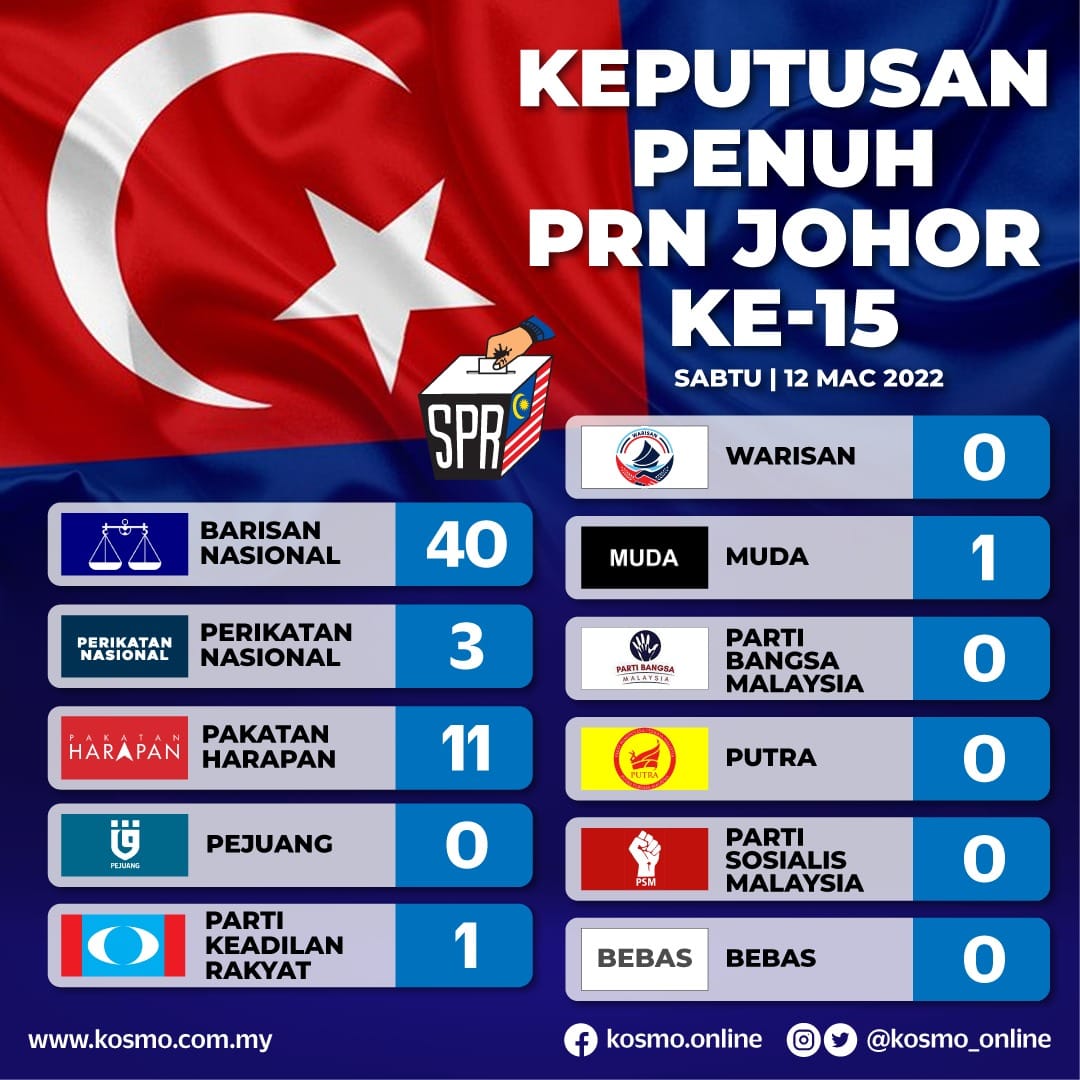
Such instability comes at a critical time. Bersatu currently holds only two state seats - Bukit Kepong and Endau - while its Perikatan Nasional (PN) ally PAS controls Maharani. Although PN finished as runner-up in 27 constituencies during the 2022 Johor election, several defeats were by razor-thin margins. Seats such as Bukit Pasir and Serom slipped away by approximately 1% and 3.1% respectively, suggesting that even minor disruptions in party machinery or voter turnout could have major consequences.
The coming election will also serve as a significant test for PN chairman Dato' Seri Ahmad Samsuri Mokhtar. As the coalition's new leader, Johor will be his first major electoral challenge. A strong performance could strengthen confidence in his leadership and reinforce PN's national ambitions. Conversely, disappointing results may fuel doubts about the coalition's future direction ahead of the next general election.
Meanwhile, Pakatan Harapan (PH) faces a different but equally troubling challenge. The departure of former ministers Dato' Seri Rafizi Ramli and Nik Nazmi Nik Ahmad from PKR has created fresh uncertainty within the coalition. Their decision to take over Parti Bersama Malaysia and build what they describe as a "third force" introduces a new variable into an already crowded political arena.
While Bersama has yet to prove its electoral strength, its appeal appears directed at reform-minded voters, political fence-sitters, and those disillusioned with the pace of institutional reforms under the current administration. These are voter groups that traditionally leaned towards PH.
The danger for PH lies not necessarily in Bersama winning seats, but in its ability to siphon crucial votes away from existing coalition candidates. The numbers illustrate the vulnerability. In the 2022 Johor state election, five of PH's 12 victories were achieved with margins below 10%. Four were won by less than 5%, including Bukit Batu, PKR's sole seat in Johor, where victory was secured by a razor-thin 0.6% margin. Even DAP's Johor Jaya seat was won by only 3.9%.
With Bersama seeking support from voters who previously backed PH, even a modest shift in voting patterns could prove decisive.
Adding another layer of uncertainty is the likelihood of widespread three-cornered and even four-cornered contests. PH, Barisan Nasional (BN), and PN have all indicated their intention to contest all 56 state seats. At the same time, the Malaysian United Democratic Alliance (Muda) has signalled plans to contest between five and 10 constituencies.
Such a crowded field increases the probability of vote splitting across the board, creating opportunities for unexpected victories and making electoral forecasting increasingly difficult.
Despite these challenges, PH leaders remain publicly confident. Johor DAP vice-chairman Sheikh Umar Bagharib Ali has acknowledged the inevitability of multi-cornered contests, arguing that surrendering seats would effectively hand opponents an easy path to victory.
Ultimately, Johor is shaping up to be more than just another state election. It may become a crucial indicator of Malaysia's evolving political landscape, testing whether established coalitions can maintain their dominance or whether emerging parties and internal divisions will usher in a new era of fragmented politics.
As the election noise grows louder, the significance of this state election becomes increasingly crucial: in Johor, every vote may matter more than ever before.
By: Kpost
Information Source:
Kpost (ckhorsk@gmail.com) is a content creator under the Newswav Creator programme, where you get to express yourself, be a citizen journalist, and at the same time monetize your content & reach millions of users on Newswav. Log in to creator.newswav.com and become a Newswav Creator now!
The User Content (as defined on Newswav Terms of Use) above including the views expressed and media (pictures, videos, citations etc) were submitted & posted by the author. Newswav is solely an aggregation platform that hosts the User Content. If you have any questions about the content, copyright or other issues of the work, please contact creator@newswav.com.
