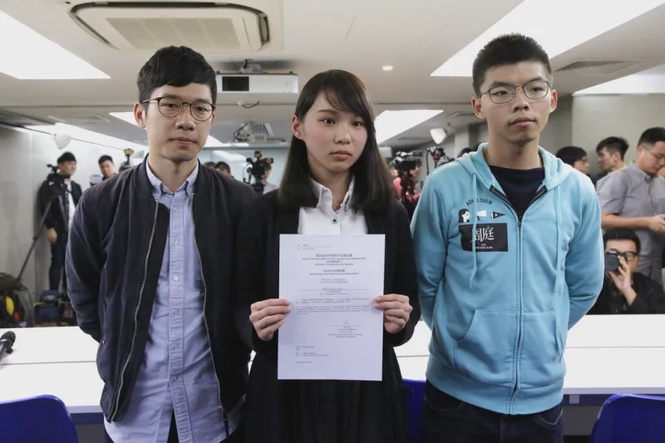
Joshua Wong (黃之鋒), the 29 year old activist who has spent nearly six years in and out of Hong Kong courtrooms since the city's protest movement peaked in 2019, pleaded guilty on September 2 to conspiring to collude with foreign forces to endanger national security, opening him up to a second prison term under the security law Beijing imposed on the city in 2020. According to the Associated Press, Wong is already serving a four year and eight month sentence handed down in a separate national security case tied to an unofficial legislative primary election, and had been expected to walk free in January 2027 before this second case was brought against him. According to the Collective HK, Wong entered his plea at the High Court, where the judge began hearing mitigation before deciding on a sentence.
A Guilty Plea In A Case The Judge Called A Matter Of Public Interest
According to HK01, Wong entered his plea at the High Court in a proceeding designated HCCC 181/2026, where Judge Tam Yiu-ho described the case as one of public interest and directed prosecutors to read out the full facts before the court. The charge accuses Wong of conspiring with Nathan Law, the founding chairman of the pro democracy party Demosisto, and other unidentified individuals to request that foreign countries or overseas institutions impose sanctions, blockades or other hostile action against Hong Kong or China, covering a period from July 1 to November 23, 2020. According to the Witness, the offense carries a sentence ranging from three to ten years under the national security law, or up to life imprisonment if a court deems the conduct especially serious. Wong has now been detained continuously since November 23, 2020, nearly six years, after being arrested in this second case on June 6, 2025 while already serving his earlier sentence.
An Understanding With Nathan Law That Predates The Security Law
Prosecutors say Demosisto, founded in 2016 with Law as chairman and Wong as secretary general, had democratic self determination for Hong Kong as one of its founding political goals, and that the two men agreed early on to pursue that goal through an international lobbying strategy aimed at drawing foreign attention and support. As early as November 2016, Wong and Law were pushing for the passage of the United States Hong Kong Human Rights and Democracy Act, meeting then House Speaker Nancy Pelosi and Senator Marco Rubio as part of that campaign. By September 2019, as protests over an extradition bill convulsed the city, the pair testified together before a congressional hearing in Washington on the same human rights legislation, and Wong went on to lobby Germany, Italy and the United States to stop selling weapons and crowd control equipment to the Hong Kong police, giving interviews to foreign media and writing newspaper columns calling for sanctions against Hong Kong and Beijing.
Splitting The Work After Demosisto's Dissolution
Demosisto disbanded on the eve of the national security law's enactment on June 30, 2020, and Law left Hong Kong around the same time. According to HK01, Wong wrote on Facebook the following month that he would not delete his old posts or abandon his positions, and that he and Law would continue their international front, arguing that people who stayed in Hong Kong needed to keep protesting to hold foreign media attention on the city. On July 10, 2020, Wong said on a local radio program that he intended to keep seeking international attention and remained in contact with Law, telling listeners that people overseas needed to keep the city's protest movement in the international conversation to complement the movement at home. Law, in a BBC interview that same month, said he and Wong had discussed dividing their roles after the security law took effect, with Wong and others continuing the movement's work inside Hong Kong while Law used his public profile abroad to keep lobbying foreign governments for sanctions against the Hong Kong police.
In the months that followed, Wong gave a string of interviews and wrote commentary for foreign outlets that prosecutors have cited as part of the alleged scheme: an August 2020 piece in the Guardian titled "Forms of resistance need to be fluid and flexible," a September 2020 interview with Germany's Deutsche Welle, a Financial Times column that same month headlined "Joshua Wong: Business must keep pushing for freedom in Hong Kong," and an October 2020 interview with the George W. Bush Presidential Center. Wong stayed in Hong Kong and attempted to run in the city's Legislative Council election, but an election officer ruled him ineligible and invalidated his nomination.
A Campaign That Helped Push Out A Surveillance Technology Supplier
Hong Kong police had relied on digital forensic tools made by the Israeli company Cellebrite to investigate a number of cases, including earlier prosecutions against Wong himself. On July 17, 2020, Law launched an online petition calling on Cellebrite and other digital forensics firms to cut ties with the Hong Kong police, and Wong posted the petition link on Facebook and Twitter the very next day. Wong later wrote on Facebook that the Israeli human rights lawyer Eitay Mack and others had written to Israel's government demanding a halt to Cellebrite exports to the Hong Kong police; Cellebrite announced on October 7, 2020 that it would stop supplying products to customers in China and Hong Kong, a move Law later credited to the petition campaign while urging other forensics companies to follow suit.
On November 22, 2020, the day before he was remanded into custody in a separate case, Wong published what he called a pre-sentencing work report on Facebook and Patreon detailing the political work he had carried out since the national security law's enactment, including writing warning letters to foreign companies doing business with China, among them Japan's Sony and America's Apple, and pressing Cellebrite to stop supplying investigative software to the Hong Kong police. Prosecutors have pointed to the report as further evidence of the alleged conspiracy. Foreign governments took a series of actions against Hong Kong and Beijing over that same period, according to HK01: the United States passed the Hong Kong Autonomy Act on July 14, 2020, sanctioned 15 Hong Kong and Chinese officials between August and November of that year, and unilaterally suspended three bilateral agreements with Hong Kong covering fugitive extradition, the transfer of sentenced persons and a shipping tax exemption; Britain, Germany and France separately suspended their own extradition treaties with the city between July and October 2020.
A Life That Has Been Defined By Hong Kong's Courts Since His Teens
Wong first drew national attention as a teenager leading protests against a proposed national education curriculum in 2012, before becoming one of the most recognizable faces of the 2014 Umbrella Movement occupation protests and later co-founding Demosisto in 2016 alongside Law and fellow activist Agnes Chow. Since Hong Kong's 2019 protests gave way to the national security law crackdown that followed, Wong has moved between bail, remand and prison largely without interruption, making this guilty plea just the latest chapter in a legal saga that has already kept him off the streets for the better part of six years. A sentencing date following the mitigation hearing had not been announced at the time of publication.