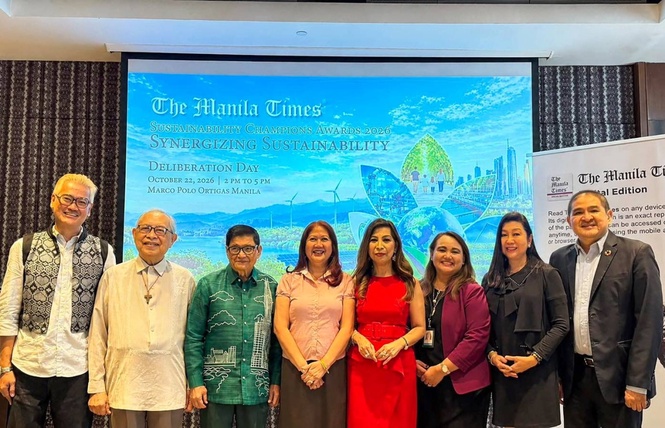
DELIBERATIONS to select The Manila Times Sustainability Champions for 2026 brought together a panel of judges to assess how 15 organizations translate sustainability commitments into concrete action, examining their initiatives, results and potential to create lasting value.
“We want to highlight practical approaches that demonstrate how responsible business practices can become part of everyday operations, produce measurable value and contribute to lasting progress,” The Manila Times CEO Anna Marie Ang-Thompson told the panel in her opening remarks.
“We also recognize that sustainability does not look the same in every industry. An energy company faces different challenges from a food manufacturer, a financial institution or a transportation company,” TMT President and Chief Operating Officer Blanca Calilung-Mercado said as she welcomed the judges and underscored the diversity of the candidate organizations.
“I expect the judging to be very difficult again,” said Santiago Dumlao, secretary-general of the Association of Credit Rating Agencies in Asia and head of the Sustainability Champions program.
“When we started the program last year, I realized that the task was not simply to identify organizations with sustainability programs, but to examine the thinking, commitment and evidence behind those programs,” Dumlao said.
He also serves as editor of the Sustainability Champions magazine, published following the awards ceremony to document the participating organizations’ initiatives and recognize their sustainability efforts.
The judging process centers on The Manila Times’ four “I” criteria: initiative, impact, inclusiveness and integration, Denise Calnea, TMT director of marketing communications and head of the team responsible for executing the sustainability event, said.
The framework considers what organizations are doing, the results of their initiatives, the people who benefit and the extent to which sustainability is integrated into regular business operations.
The judges examined the candidates’ programs and supporting evidence, looking beyond stated commitments and environmental claims to determine whether sustainability was reflected in organizational decisions, daily operations and responsibilities to communities. Their task also required accounting for differences in the industries in which the candidates operate.
“The scoring was very close, showing how these candidate companies have seriously put ESG (environmental, social and governance) into their corporate affairs, from execution and implementation to reporting,” said Allan Cao, chairman of the board of judges and assurance and markets executive director at PwC Philippines.
The close scores highlighted the difficulty of distinguishing among organizations that have made substantial efforts to incorporate environmental, social and governance (ESG) considerations into their business practices. They also underscored the importance of examining implementation and reporting alongside stated commitments.
Ludwig Federigan, founder and chief strategic adviser of the Young Environmental Forum, a director of Climate Tracker Asia and a columnist for The Manila Times, stressed the need to distinguish meaningful, measurable initiatives from activities that may look impressive but offer limited evidence of lasting impact.
The distinction, he said, lies in whether an organization can demonstrate that its programs are achieving their intended objectives and delivering benefits beyond the immediate reporting period.
“We have to look at the long-term consequences of what we build, how we use resources, how we manage our environment and whether our development decisions make communities safer, more resilient and more livable,” Federigan said.
His observations brought the discussion to the consequences of business and development decisions, particularly those affecting natural resources, the built environment and community resilience.
Felino “Jun” Palafox Jr., founder of Palafox Associates, architect and urban planner, likewise pointed to the broader challenge facing businesses and institutions as sustainability becomes an increasingly important consideration in economic development.
From an urban planning perspective, decisions involving land use, infrastructure, resource consumption and community development can shape the lives of future generations. Their effects may persist for decades, making long-term planning and resilience essential considerations in evaluating sustainability efforts.
Flor Tarriela, a board adviser at Philippine National Bank (PNB), was represented during the deliberations by Jean Baruelo, senior vice president and head of PNB’s Corporate Sustainability and Social Responsibility Division. Baruelo emphasized the importance of evaluating sustainability through metrics and reporting.
“Determining which initiatives produce tangible results, which can be sustained over time offer models that others can adopt,” Baruelo said, describing the considerations that should guide the assessment of sustainability programs.
Baruelo, a sustainability expert and advocate, said credible metrics allow organizations to track progress, identify gaps and demonstrate whether their initiatives are delivering results. Reporting also helps establish which approaches can be sustained and replicated by other organizations.
Cathy Saldaña, partner, principal and managing director of pdp + Architecture, emphasized the need to consider the lasting benefits of sustainability decisions.
“Sustainability is not just about what an organization does today. It is about whether its decisions will continue to benefit people and communities decades from now,” Saldaña told the panel during the deliberations.
The panel brought together perspectives spanning corporate governance, financial accountability, environmental advocacy, urban planning and architecture. These disciplines offered different ways of examining the candidates’ initiatives while reinforcing the need to consider sustainability across environmental, social and organizational concerns.
The challenge was to apply consistent standards while recognizing that organizations face different risks and have varying capacities to implement sustainability programs. The Four I’s provided a common framework for assessing their efforts without assuming that every industry should pursue identical solutions.
Cherrie Atilano, president and chief executive officer of AGREA Agricultural Systems International Inc., was unable to attend the deliberations but submitted her scores and rankings ahead of the session.
Also joining the afternoon’s signing was Catherine Lipana-Gomez, corporate finance and environmental, social and governance partner at Isla Lipana & Co./PwC Philippines.
The deliberations form a central part of The Manila Times Sustainability Champions initiative, which seeks to recognize organizations making meaningful progress in incorporating sustainability into their operations and decision-making.
Beyond recognizing individual achievements, the program aims to highlight practices that other organizations can learn from and potentially replicate. The Four I’s offer a framework for identifying initiatives that demonstrate not only commitment, but also implementation, measurable impact and integration into organizational strategy.