IS it inevitable that the Supreme Court should rule on the voting threshold issue in the impeachment trial of the vice president? I venture an answer in the negative — knowing that it shall once more be asked by those who take issue with my position why I, a non-lawyer, should venture a legal opinion. Let me put the matter more simply: Legal scholarship is a field open to all — and the fact is that while all lawyers are legal practitioners, not all lawyers are necessarily legal scholars. While representing clients in court, drawing up documents and proffering legal advice needs the license to practice law, researching on the law, studying it and writing on it do not. What is needed for the latter is intellectual acumen and scholastic aptitude.
The range of judicial power is carefully — if narrowly — circumscribed by the Constitution: First, to settle actual controversies over legally due and demandable rights; second, to determine whether the acts of any branch, office, agency or instrumentality of government are tainted with grave abuse of discretion “amounting to lack or excess of jurisdiction.”
At the moment, no actual controversy exists. The matter is, at this stage, purely academic, purely hypothetical. When, however, the Senate shall vote, whether to convict or to acquit, then the proper party claiming direct detriment may allege that there is an actual controversy. But that there is an actual controversy does not mean that the Supreme Court must assume and exercise jurisdiction. Article XI gives the Senate the “sole power to try and decide all cases of impeachment.” Were a judgment, whether for conviction or acquittal, subject to reversal by the Supreme Court, “sole” would be an empty word. It may be asked why I am being literal about “sole” when I did not subscribe to a fixed-number determination of “two-thirds of all its Members.” The difference is clear: “Sole” admits of no other interpretation, no other understanding; “two-thirds of all its Members” opens the question of reckoning the threshold to a consideration of what a “member” is in an impeachment trial.
True, Francisco v. House of Representatives (2003) was persuaded by the argument that what the Constitution entrusted to the Supreme Court was a “duty,” and that shirking from it was not a constitutional possibility. That position must now be revisited, for when the Constitution entrusts the power to decide to some other co-equal branch of government, then the Supreme Court would not be evading a duty but recognizing that the burden lies elsewhere, and that taking cognizance and deciding would in fact be usurpation of power not granted to it.
Then there is the argument from “grave abuse of discretion” that Chief Justice Reynato Puno correctly pointed out at the sittings of the 2016 Committee to Study the 1987 Constitution as one of the most gravely abused provisions of the Constitution. Our Supreme Court has wisely taught: Grave abuse of discretion is not mistake, not even abuse of discretion. To be “grave abuse,” the exercise of discretion must be whimsical, arbitrary, despotic. Should the Senate vote on an interpretation of “two-thirds of all its members,” it would be advancing its reading, its construal of the Constitution, after having seriously considered the matter. If the members of the Supreme Court have a different reading, then it becomes a contest of interpretations — one not necessarily superior over the other. Then the question is reduced to where the Constitution vests the power, and Article XI leaves no doubt that the “sole power” lies with the Senate.
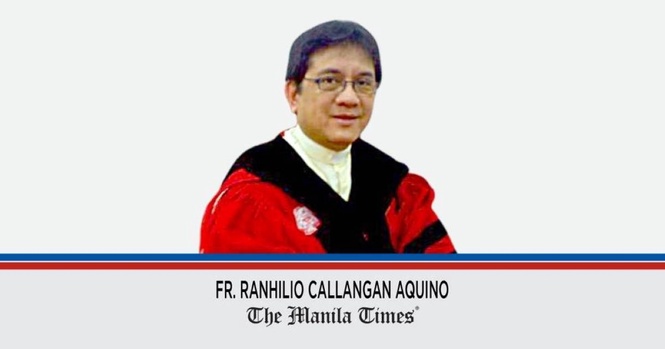
Fr. Rannie Aquino is dean of the Graduate School of Law at San Beda College-Mendiola.
rannie_aquino@sanbeda.edu.ph
rannie_aquino@csu.edu.ph