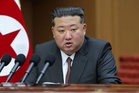
SEOUL: North Korea has test-fired attack drones, missiles and a multiple rocket launcher during a weapons demonstration, state media reported on Friday, as leader Kim Jong Un called for faster development of drone and artificial intelligence (AI) technology for military use.
The event came a day after Seoul said Pyongyang had fired “around a dozen” short-range ballistic missiles off its east coast, although it was not immediately clear whether the launches were linked to the demonstration.
At the event, Kim stressed that the “aim to seize absolute superiority in drone technology is an indispensable option in the light of the ever-changing patterns of modern warfare”, according to the Korean Central News Agency (KCNA).
He added: “Strength precisely means peace and peace is guaranteed only by strength.”
The demonstration featured suicide attack drones, multipurpose drones firing air-to-surface missiles, cruise missiles and 600mm multiple rocket launchers. KCNA said the drones and cruise missiles hit an island target with 100 per cent accuracy.
The event follows a series of recent weapons tests by Pyongyang, including a new precision-guided torpedo system and an intermediate-range hypersonic missile, both of which were said to employ AI technology.
South Korea’s Joint Chiefs of Staff said its military had detected “around a dozen short-range ballistic missiles fired from the Wonsan area of North Korea towards the East Sea”, also known as the Sea of Japan.
The missiles travelled about 250 kilometres (155 miles), and “South Korea and the United States are conducting a detailed analysis of their exact specifications”, Seoul’s military said, adding that it had stepped up surveillance for possible further launches.
Seoul’s National Security Office, meanwhile, said the launches violated United Nations Security Council resolutions, describing them as “serious acts that do nothing to help manage the current situation”.
Thursday’s missile launches came amid growing tensions over a landmine explosion along the heavily fortified border between the two Koreas that left three South Korean soldiers wounded.
A joint Seoul-United Nations investigation earlier this month concluded that North Korea had planted the landmines more than a year ago.
Seoul accused Pyongyang of “a clear violation of the Armistice Agreement” and demanded an apology, a call the North has mockingly dismissed.
Show of force
Last week, Kim Yo Jong, the powerful sister of North Korean leader Kim Jong Un, said the North would put loudspeakers along the border on standby “within days” and had placed unspecified “new counter means” on alert.
Both countries have occasionally used loudspeakers to broadcast propaganda across their shared border, alongside other psychological warfare methods.
South Korea proposed military talks with the North days later to “mutually confirm the precise location” of their border and discuss restoring communication channels, but Pyongyang has yet to respond.
The Demilitarised Zone (DMZ) is one of the world’s most heavily fortified frontiers, and landmine incidents have previously heightened tensions.
Seoul and Pyongyang remain technically at war, as the Korean conflict ended in 1953 with an armistice rather than a peace treaty.
The rising tensions come as recent overtures by US President Donald Trump towards North Korea have raised concerns that Seoul, a Washington ally, could be sidelined in potential nuclear talks involving Pyongyang.
In his most recent comments, Trump appeared to play down the possibility of a summit while insisting that his relationship with Kim Jong Un was “very good”.