
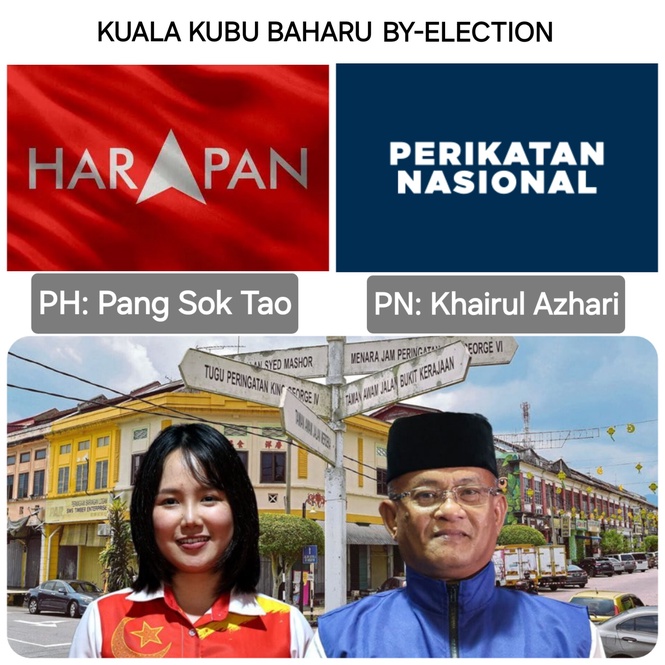
As the Kuala Kubu Baharu (KKB) by-election kicks off with early voting on May 7, 2024 and by-election day on May 11, 2024, the clash between the main contenders representing PAKATAN HARAPAN (PH) and PERIKATAN NASIONAL (PN) have been nominated on April 27, 2024 with much anticipation. Pang Sok Tao from PH, Khairul Azhari Saut from PN are facing off against Hafizah Zainuddin from Parti Rakyat Malaysia (PRM), and Nyau Ke Xin, the sole independent candidate.
The upcoming KKB by-election presents a micro scale of Malaysia's political landscape, with intricate dynamics at play that could shape the future trajectory of the nation's governance. Central to this electoral battleground is the role of Malay voters, regarded as the fixed deposit of the Perikatan Nasional (PN) coalition.
Regardless of whether PN fields a Malay or Non-Malay candidate, the bulk of its support seems assured from the Malay electorate, which constitutes a significant 46% of the voting populace. However, if PN had fielded a Non-Malay candidate, the party could have siphoned off some "protest votes" from disgruntled Non-Malay voters who previously supported the Pakatan Harapan (PH) coalition. For this reason, PN might have made a slight blunder in fielding a Malay candidate.
PN will need to actively court Non-Malay votes, while PH and its Unity Component Parties must mount vigorous campaigns to attract Malay voters. A strategic approach for PN may involve minimizing the use of racial rhetoric (the 3Rs) and reducing the presence of the Malaysian Islamic Party (PAS) in the campaign, aiming to broaden its appeal beyond ethnic lines.
The Chinese electorate, comprising 30% of voters, appears to be leaning towards PH-DAP, posing a formidable challenge for PN. However, low turnout and protest votes remain potential hurdles for both coalitions to overcome.
Despite being a smaller segment at 18%, Indian voters wield considerable influence in determining the by-election's outcome, earning them the moniker of "kingmakers." The Unity Government's Indian leaders must actively engage with the community to secure their support for PH-DAP, thereby maintaining their crucial backing.
With PH-DAP having held the seat for three consecutive terms since 2013, the incumbent party enjoys a slight advantage, bolstered by strong support from Chinese and Indian voters in the semi-urban constituency.
Ultimately, the result of the KKB by-election goes beyond just numbers, offering insight into public opinion on the Unity Government's performance. As Malaysians vote, their choices will reflect the hopes and worries of a nation at a pivotal moment in its political path.
By: Kpost
Information Source: FreeMalaysiaToday
Kpost is a content creator under the Newswav Creator programme, where you get to express yourself, be a citizen journalist, and at the same time monetize your content & reach millions of users on Newswav. Log in to creator.newswav.com and become a Newswav Creator now!
The User Content (as defined on Newswav Terms of Use) above including the views expressed and media (pictures, videos, citations etc) were submitted & posted by the author. Newswav is solely an aggregation platform that hosts the User Content. If you have any questions about the content, copyright or other issues of the work, please contact Newswav.
