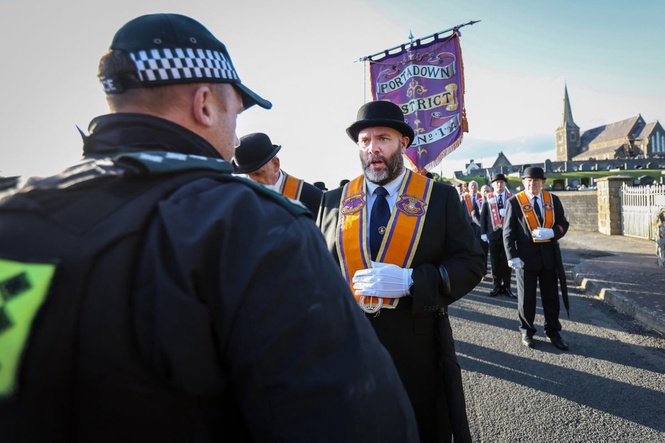
It is now almost three decades since the Good Friday Agreement effectively ended the Troubles in Northern Ireland, a cycle of violence that itself lasted for a similar span of time after the first British troops were deployed in the province in 1969. Yet still, as recent events on the Garvaghy Road in Portadown demonstrate, the peace process is not over.
It is fragile, and the resentments and tensions that tore communities apart for decades, if not centuries, remain not so far from the surface. Some of the most potent of these concern the legacy of the Troubles, and the search for justice, or at least a measure of what is usually termed “closure” for the many families who lost loved ones during the long years of violence.
This is, and always has been, as true for those connected to the Crown forces operating in Northern Ireland as for the terrorists and the civilians who found themselves dragged into a conflict that permeated every corner of people’s existence. The task for the authorities – in Westminster, at Stormont and in Dublin – has always been to try and find a way to balance the legitimate demands of every group and every human being who lost relatives and friends during the conflict.
Now, a new secretary of state, Chris Bryant, is seeking to ensure that the rights and the reputations of former British service personnel are properly protected, and that they should not be subjected to vexatious or disproportionate treatment so long after the actions they were involved in occurred. Speaking to The Independent about the government’s latest amendments to the law governing this process, Mr Bryant says that he is going to try and respond to “every one of the key questions that people have asked us for…We’re trying to make sure it is a fair process for everybody”.
That is not to say British veterans – or Republican or Loyalist terrorists, for that matter – should be offered blanket immunity from prosecution for any and all crimes committed against civilians during Operation Banner, as the military operation was called. Indeed, Mr Bryant is clearer than some of his predecessors in rejecting the easy but facile approach of treating “both sides” in the violence as if they were like two armies at war and operating under the Geneva Conventions.
There is no moral equivalence between the IRA, UDA and other terrorists on the one hand, and the security services on the other, who were at least nominally operating within the law and with some democratic accountability, albeit in too many cases not enough regard for either.
Mr Bryant apparently wishes to recognise that as a matter of law, even if it only carries symbolic force: “What we are going to say in the bill is that there is no equivalence between the lawful action of brave British security forces and the deliberate acts of terrorists”. What some have called, pejoratively, “lawfare” will thus be restricted, but there will not be – or should not be – a return to a complete state of criminal immunity, which would represent an unlawful abrogation of the human rights of victims and their families. It is, as ever, a matter of balance; in practice, a never-ending series of rebalancing, in which British governments have to carry disparate groups and the Irish government with them.
There will be further revisions to the Northern Ireland Troubles Bill now making its way through Parliament. It is already an improvement on (and replacement for) the Legacy Act passed under the Conservatives in 2023.
In the end, the new law will come into force and will no doubt have flaws of its own, because there is no way a perfect mechanism to deliver justice and achieve reconciliation will be able to satisfy people who’ve been bereaved because of violence born out of a political conflict.
For now, the task is to ensure that as many families as possible can use the confidential machinery available to find out how, why and where their loved ones perished, who may have been responsible, and to find some solace in that knowledge. Even in another 30 years there will be open wounds and deep grievances, but in the meantime, the process of securing the peace has to go on. The alternative will always be worse.
Read MoreBurnham faces a stark choice: Call an election or be a lame duck
Andy Burnham has fired the starting gun for the next general election
Kemi Badenoch has shown that she is not afraid of a fight for the right