FEMALE lawmakers and health experts on Tuesday pushed for HPV vaccination of boys and better use of Gender and Development (GAD) funds for cervical cancer prevention as the Philippines continues to lag behind several Southeast Asian neighbors.
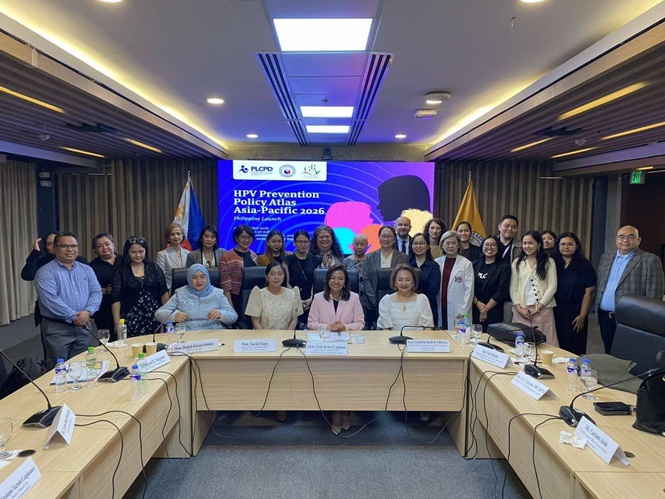
The calls were made during the launch of the HPV Prevention Policy Atlas Asia-Pacific 2026 at the House of Representatives, which brought together lawmakers, health advocates, civil society groups and cervical cancer survivors to examine gaps in the country’s HPV prevention policies and their implementation.
The Philippines received an overall score of 71.6 percent, rated “Good,” in the Atlas, but it continued to trail several Southeast Asian neighbors in the assessment of national HPV prevention policies.
The findings also showed a gap between policy and actual uptake, with HPV vaccination coverage among females remaining below 30 percent and participation in cervical cancer screening below 15 percent.
Human papillomavirus (HPV) is a common virus that can cause cervical cancer and other cancers. Vaccination and early detection are among the key measures to prevent HPV-related disease.
Gender-neutral HPV vaccination
One of the key issues raised during the forum was the need to expand HPV vaccination beyond girls and consider a gender-neutral approach that would also protect boys.
European Parliamentary Forum for Sexual and Reproductive Rights Executive Director Neil Datta, whose organization was among those behind Atlas, said boys can contract HPV and develop HPV-related cancers.
“You can only achieve the elimination of HPV if you also vaccinate boys. That's the first thing to consider,” Datta said.
HPV is associated with cancers affecting both men and women, including cancers of the mouth and throat and penile cancer.
Vaccinating boys would provide them direct protection while also helping reduce transmission of the virus.
The Philippines provides the four-valent HPV vaccine through the Department of Health’s program to public school girls aged 9 to 14.
Budgetary and other constraints limit the program’s reach to less than 30 percent of the target public school female population, according to figures presented during the forum.
Philippine Statistics Authority data cited at the event placed the population of girls aged 9 to 14 at about 6.7 million.
The limited coverage underscored the need to examine not only who is eligible for vaccination but also how existing programs can reach more people.
Albay 1st District Rep. Cielo Krisel Lagman, chairman of the Philippine Legislators’ Committee on Population and Development Foundation and a member of the House Committee on Health, said Congress has consistently supported funding for vaccines through government health and education programs.
“But funding alone is not enough. We need people’s initiatives to avail of the package,” Lagman said.
She stressed that lawmakers must look beyond appropriations and examine whether programs are reaching their intended beneficiaries and what barriers continue to prevent families from accessing vaccination, screening and accurate health information.
“The policy is only as good as the implementation. Even if it is good on paper, but it is not implemented, even if there is funding but it is not used in the right and appropriate way, nothing will happen,” Lagman told The Manila Times in an exclusive interview.
Lagman also called for better use of GAD funds for cervical cancer prevention and early detection, saying government resources could be directed toward programs addressing women’s health needs.
She also pushed for measures that would make HPV vaccination, cervical cancer screening and related treatment more accessible through health financing mechanisms, including PhilHealth, particularly for families in far-flung communities who face additional transportation and out-of-pocket costs.
Closing the policy-to-protection gap
Datta said the challenge for countries such as the Philippines has increasingly shifted from adopting policies to ensuring that those policies work on the ground.
“In a number of countries, including in the Philippines, policies are there. We then, as legislators, PLCPD, and other legislators, will start to look at how it is being implemented,” Datta said.
Rep. Sarah Jane Elago stressed the importance of using data and the lived experiences of constituents in crafting legislation, resolutions and other policy measures.
“Data-driven and data-informed policy decision-making are really at the core of our advocacies as legislators,” Elago said.
The forum’s objective, Lagman said, was to move the discussion beyond recognizing the importance of HPV vaccination and cervical cancer prevention toward identifying specific measures that could close the gaps identified by the Atlas.
“Our goal is for the launch to move the conversation from simply recognizing the importance of HPV vaccination and cervical cancer prevention to identifying specific actions that different sectors can take,” she said.
The Atlas launch was organized by the European Parliamentary Forum for Sexual and Reproductive Rights, the Global Parliamentary Alliance for Health, Rights and Development, and the Philippine Legislators’ Committee on Population and Development Foundation.