This is the fifth article on how Malaysia can leapfrog in its holistic development and technology advancement. The focus is on practicality.
Innovative Public Governance will provide practical solutions on how Malaysia can leapfrog its holistic development and economic advancement, thereby saving time, money and resources.
The National Science, Technology and Innovation Policy (NSTIP) 2021-2030 was formulated to tackle the following three key challenges:
- Lack of coordination in governing STI
- Incomprehensive talent development
- Insufficient public-private collaboration and international engagement
Malaysia’s poor ranking in mathematics, science and reading in the triennial Programme for International Student Assessment 2022 (PISA) is a cause for concern.
Malaysia is ranked 47th and 48th in the evaluations, while Singapore, Japan, South Korea and even Vietnam have been impressive and occupied top slots among the 78 countries assessed consistently.
Every country dream of being an advanced STEM nation. STEM stands for Science, Technology, Engineering & Mathematics. Later, it evolved into STEAM, where “A” stands for Arts. As Albert Einstein once said “the greatest scientist are artists as well.”
Finally, STEAM evolved into STREAM, where “R” represents Research.
National Science Centre (NSC)
The NSC was established in Bukit Kiara, Kuala Lumpur, to tackle the fundamental issue of “Inspiring love and igniting a passion for science,” to the younger generation.
In other words, Malaysia needs to cultivate a love of science so that the desire to study science comes from within. Great scientists and innovators come through this route.
Unlike traditional science teaching, student visitors discover science through interacting with exhibits at the NSC.
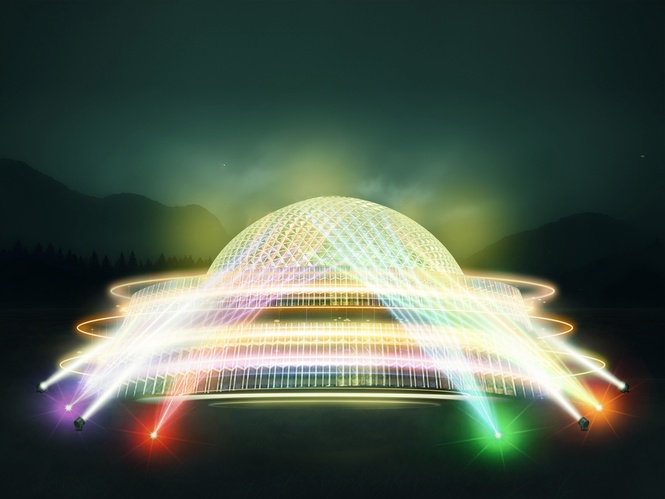
That was why, the NSC was designed like a spaceship. In fact, it was launched in space in 1991 with the help of NASA (National Aeronautics and Space Administration, USA). Royal Selangor Pewter sponsored this project, by bearing all the expenses and minting a special space medallion for the NASA astronaut, James Buchli, to take it onboard the Space Shuttle “Discovery”. After orbiting the Earth, Buchli brought the medallion back from space and presented it to our then Prime Minister, Tun Dr. Mahathir Mohamad at his office in 1991. The medallion was then mounted on a trophy and exhibited at the NSC foyer.
The Director of the NSC at that time, Yew Kam Keong, had a vision of simulating a spectacular landing and taking off of the NSC Spaceship through the imaginative use of fibre optics and other computer-generated lighting effects. The viability of this idea had been checked with an international lighting specialist. Sponsorship from local listed companies, could also be organised.
Of course, science activities, both at the centre itself or through education programs as well as through travelling exhibitions are important.
Volunteer explainers, including teachers, will deepen their knowledge of science through participating in such activities.
Great scientific geniuses like Albert Einstein and Sir Isaac Newton obtained their inspirations by playing with basic gadgets like the compass and the lever.
It’s perhaps time for more science centres to be set up, at least in every state.
Makers Space
Once the students are excited about science and technology, they would want to create their own inventions or a new gadget.
But where could they go to give tangible form to their ideas? They would want to build prototypes to test out their ideas.
The answer is an Invention Workshop, commonly referred to as “Maker Space”.
They are adequately equipped workshops with the necessary tools and equipment. However, unlike Western societies, Malaysia does not have a DIY (Do-It-Yourself) culture.
The founder of IDEAS (Invention and Design Association of Sarawak) initiated The Whizz Kids Workshop, an invention competition for secondary school students. This competition is about building invention prototypes by teams of five students within six hours. The results were so good, that some of the invention ideas were stolen and commercialised!
When the first National Schools Invention competition was organised, Sarawak schools had more entries than the rest of Malaysia combined!
Subsequently, an Invention Workshop (Makers Space) was set up in a host school with tools for creating prototypes. Until today, Sarawak still retains its invention culture.
There are several Makers Space in the Klang Valley and some in Penang. A local university, Sunway University has established two such Makers Space.
Currently, Makers Space refers to those who work closely together in a collaborative space to foster entrepreneurship and stimulate market-driven innovations.
Perhaps, Mr.DIY chain stores could sponsor at least one Makers Space in every state. It is a win-win proposition for Mr.DIY could contribute to the development of STEM whilst at the same time, boost the sales of its tools for hobbyists.
Conclusion
Science centres have proven its worth in promoting STEM education for our school students so as to contribute to increasing enrolments in science and technology course at our local universities. A basic science centre, focusing on basic scientific principles are simple to set up by the institutions of higher education themselves.
Communities with Makers Space, are ideal for fabricating the interactive science exhibits.
Once this science and technology culture is established, Malaysia would have lay the foundation to leapfrog into an advanced technological nation.
At the same time, it would also help to resolve three key challenges of the The National Science, Technology and Innovation Policy (NSTIP) 2021-2030.
Please email the author at mindwrite@outlook.com, if you have come across any other issues from other countries which have been innovatively resolved.
Freelance Writer Yew Kam Keong (Dr.YKK) is a former government official with over 24 years of service. He is a professional writer and speaker. Besides this, his passion is on creativity and innovation. He has been acknowledged as a Distinguished Talent on Creativity and Innovation by the Australian Government and a former international creativity adviser to Lego. Dr.YKK is a member of AWAI (American Writers and Artists Inc.) and currently practising as a copywriter. He is also a bestselling author and his book: “You Are Creative-Let Your Creativity Bloom” is now in its 7th Edition and published in 7 languages. You may contact him at mindwrite@outlook.com
Dr. YKK is a content creator under the Newswav Creator programme, where you get to express yourself, be a citizen journalist, and at the same time monetize your content & reach millions of users on Newswav. Log in to creator.newswav.com and become a Newswav Creator now!
The User Content (as defined on Newswav Terms of Use) above including the views expressed and media (pictures, videos, citations etc) were submitted & posted by the author. Newswav is solely an aggregation platform that hosts the User Content. If you have any questions about the content, copyright or other issues of the work, please contact Newswav.