
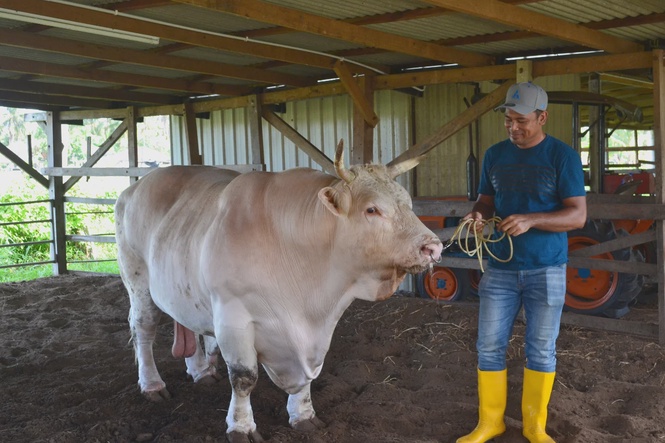
At the centre of attention is Bravo, a nearly one-tonne Charolais hybrid bull that has become both the pride of Zulkifli’s farm and one of Bachok’s most recognisable lembu sado attractions.
BACHOK: Weighing up to a tonne and fetching prices as high as RM60,000, Kelantan’s famed lembu sado are no longer just Aidiladha korban cattle but have also become prized attractions driving a booming culture of breeding, competitions and agrotourism.
At a farm in Bachok, Kelantan, breeder Mohd Zulkifli Ali has already secured bookings for 22 of his giant cattle weighing between 550kg and one tonne ahead of this year’s Aidiladha season – a demand he says reflects the growing commercial and cultural value of the animals.
READ MORE: ‘Not all in T20 bracket financially secure’
He added that the cattle now represent far more than seasonal korban supply, forming part of Kelantan’s premium livestock ecosystem that includes breeding, livestock competitions, farm tourism and social media visibility.
At the centre of attention is Bravo, a nearly one-tonne Charolais hybrid bull that has become both the pride of Zulkifli’s farm and one of Bachok’s most recognisable lembu sado attractions.
Four years old and built like a boulder, Bravo responds calmly to commands from his owner, drinking on instruction, walking back into his stable when told and standing still as he is groomed.
Zulkifli said the award-winning bull is his most prized animal, having won several lembu sado competitions.
Bravo also drew large crowds at the Malaysian Agriculture, Horticulture and Agrotourism Exhibition (Maha) 2024, where visitors gathered to see the gentle giant that has also gained traction on TikTok.
“If you treat them (well) every day, they feel happy. They feel they have a companion. They may not reply with words, but when they understand us, that is their communication. Their behaviour makes us feel calm,” he told theSun when met at his agrofarm in Kampung Panjang, Perupok.
Zulkifli said demand for larger cattle remained strong during Aidiladha as they produce more meat for distribution in korban sacrifices.
He added that korban shares at his farm are usually priced between RM1,000 and RM1,200 per portion. However, he said premium lembu sado reared for breeding, exhibitions or competitions could fetch between RM20,000 and RM30,000 depending on breed, size and quality.
He also said Bravo has been valued at RM60,000, with offers even higher already made. Despite this, Zulkifli has no plans to sell the bull he raised from birth.
“One reason people choose lembu sado for korban is because there is a lot of meat. When there is a lot of meat for Aidiladha korban, they feel it is worthwhile.
“For those who (are able to) afford it, they do not only look at money. They look at satisfaction.”
Zulkifli began cattle breeding in 2019 before moving seriously into hybrid cattle production in 2021.
He started with seven KedahKelantan cattle before transitioning to Charolais and Limousin beef hybrids. His farm has since become a reference point for other breeders and agriculture agencies.
Today, he keeps several breeds including Charolais, Limousin, Belgian Blue, Brahman and Angus cattle.
He said breeders are able to produce hybrid calves locally using imported semen straws from France for artificial insemination, with prices starting from RM60 per straw depending on breed and quality.
He added that hybrid cattle could reach more than 500kg within two years, making them commercially attractive compared with traditional village breeds.
However, he also said rising feed costs remain a major challenge. Zulkifli said cattle feed now costs between RM40 and RM100 per sack, while Bravo alone consumes about 6kg of bran daily in addition to grass. To manage costs, he relie on grass grown and collected around the farm.
“Feed is one of the main costs. At my shed, I use more grass to offset high costs.”
Beyond the Aidiladha season, Zulkifli believes lembu sado should be developed further as an agrotourism and education asset rather than purely livestock for meat production.
His farm regularly receives visitors including families, school groups, veterinary teams and Universiti Malaysia Kelantan students seeking hands-on exposure to cattle rearing.
Visitors have also come from Singapore, Thailand, Indonesia and several Arab countries, many drawn by videos of Bravo that were circulated online.
Certain Indonesian visitors had even expressed interest in bringing his cattle into their country but logistical costs made it impractical. “The price is one thing, but the animal itself becomes the passion.