
By a community pharmacist
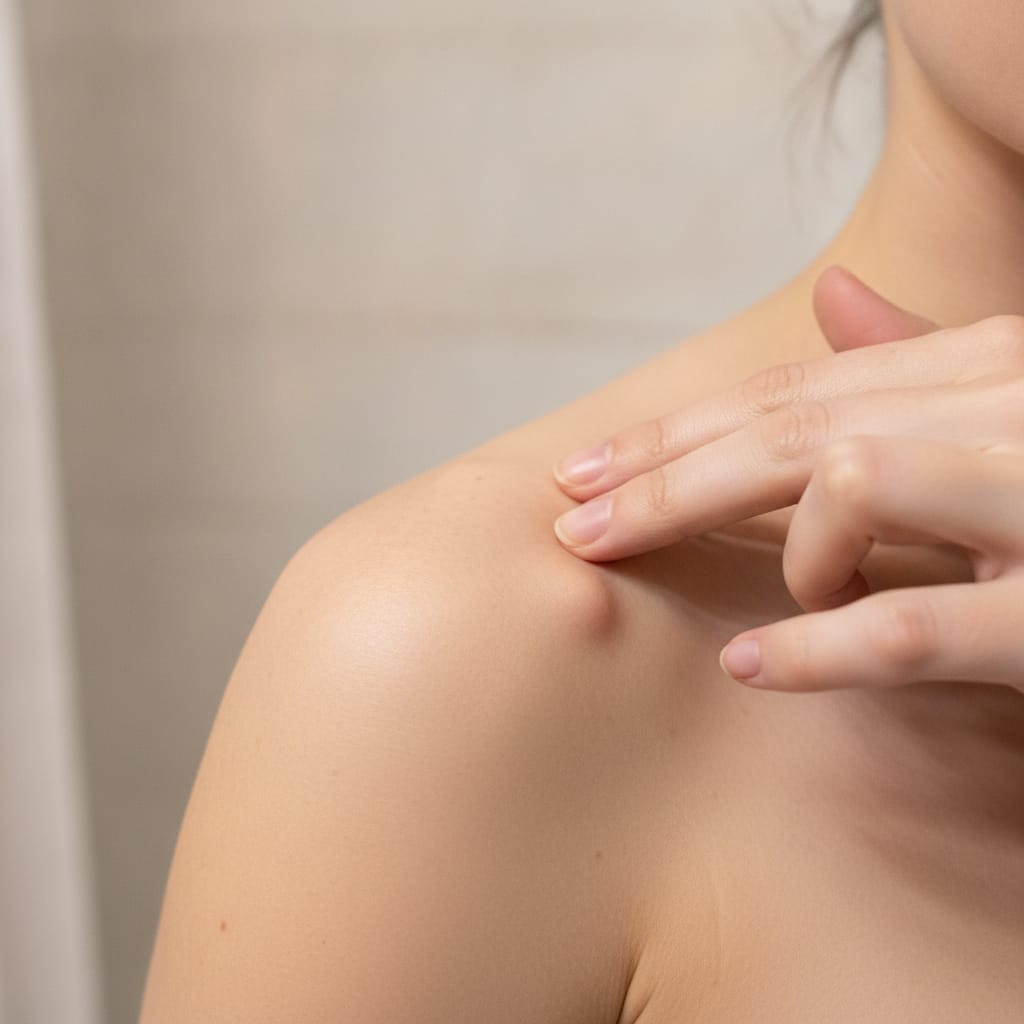
Have you ever discovered a small, soft lump under your skin while showering, getting dressed or applying moisturiser? Perhaps it is on your shoulder, back, arm or thigh. It does not hurt, it moves slightly when you press it, and you wonder whether you should be worried.
One possible explanation is a lipoma (pronounced lie-POH-muh).
Lipomas are common, usually harmless lumps made up of fatty tissue. They are not generally dangerous and often need no treatment. However, not every lump beneath the skin is a lipoma, which is why a new or changing lump should never be diagnosed by touch alone.
As community pharmacists, we often encounter people who are concerned about unexplained lumps. The important thing is to offer reassurance where appropriate without overlooking signs that deserve further investigation.
What exactly is a lipoma?
A lipoma is a slow-growing collection of fatty cells that develops beneath the skin, usually in the layer between the skin and the underlying muscle.
Unlike an ordinary fatty deposit associated with body weight, a lipoma forms a distinct lump. It is classified as a benign growth, meaning it is not cancer.
Lipomas can occur almost anywhere on the body, but common locations include:
- The shoulders and upper back.
- The arms and thighs.
- The chest and abdomen.
- The neck and buttocks.
Some people develop just one lipoma, while others may have several. They are particularly common in middle age, although they can occur at any age.
According to the NHS guide to lipomas, these lumps are usually harmless and do not normally require treatment.
How can you recognise a lipoma?
A typical lipoma has several characteristic features.
It usually feels soft, squashy or rubbery when gently pressed. It may move slightly beneath the skin rather than feeling firmly attached to the surrounding tissue. It generally grows slowly and is not painful.
Most are only a few centimetres across, although some can become considerably larger.
Pain is possible, particularly if a lipoma presses on a nearby nerve or contains numerous blood vessels. A lipoma can also become uncomfortable because of its position, for example beneath a waistband or where a bag strap repeatedly presses against it.
However, these features are only clues. A cyst, swollen lymph node and other soft-tissue growths can sometimes feel similar. A healthcare professional needs to assess an unexplained lump to establish what it is.
The Mayo Clinic’s explanation of lipoma symptoms and causes provides further information.
Why do lipomas develop?
This is a question patients often ask, particularly when a lump appears without any obvious reason.
The exact cause is not fully understood. Genetic factors appear to play a role, and lipomas sometimes run in families.
They are not considered contagious, and you cannot catch one from another person. Having a lipoma also does not automatically mean you are overweight or unhealthy.
There is no convincing evidence that ordinary dietary changes, creams or massage will make an established lipoma disappear. Trying to squeeze, puncture or cut out a lump yourself can cause bleeding, infection and tissue damage.
If you have several lipomas or a strong family history of them, mention this during your medical assessment.
Is a lipoma the same as a cyst?
No. Although both can produce a lump beneath the skin, they are different conditions.
A lipoma consists mainly of fatty tissue. A common skin cyst, such as an epidermoid cyst, is a sac-like structure that often contains keratin, a protein found in skin.
A cyst may have a small opening or visible central dot, whereas a lipoma usually sits beneath normal-looking skin. A cyst can also become inflamed or infected, leading to redness, tenderness and sometimes discharge.
Neither appearance is definitive. A pharmacist or GP should not assume a lump is a lipoma simply because it feels soft.
When should you be concerned about a lump?
Most lipomas are harmless, but the crucial point is knowing when a lump needs medical assessment.
Arrange a GP appointment if you discover a new lump, particularly if it persists for more than two weeks, grows, becomes painful or feels hard and fixed in place. A lump that is red or hot should also be assessed.
Seek prompt medical advice if a lump:
- Is growing noticeably over a short period.
- Feels deep beneath the skin or firmly attached to underlying tissues.
- Causes persistent pain without an obvious explanation.
- Returns after previous removal.
These features do not necessarily mean cancer. They do, however, mean the lump should not simply be assumed to be a lipoma.
Rarely, a different condition called a soft-tissue sarcoma can resemble a benign fatty lump. A cancerous tumour arising from fatty tissue is known as a liposarcoma. It is uncommon, and most lipomas do not turn into cancer. The concern is that an apparently harmless lump may occasionally be a different growth that needs investigation.
The NHS explains when lumps should be checked in its guidance on lumps.
How does a doctor confirm a lipoma?
A GP will usually ask when the lump appeared, whether it has changed in size and whether it causes pain. They will examine its size, consistency, mobility and position.
If the diagnosis is straightforward, no further tests may be necessary. If there is uncertainty, an ultrasound scan can help establish the nature and depth of the lump.
Larger, deeper or unusual lumps may require further imaging, such as an MRI. In selected cases, a biopsy may be needed, in which a tissue sample is examined in a laboratory.
The aim is not to investigate every harmless-looking lump unnecessarily, but to make sure that something requiring treatment is not missed.
Does a lipoma need to be removed?
Usually, no.
If a doctor confirms that a lipoma is harmless and it is not causing problems, leaving it alone is generally appropriate. It may remain unchanged for years or gradually increase in size.
Removal may be considered if it becomes painful, restricts movement, grows, causes pressure on nearby structures or creates significant concern about its appearance.
The usual procedure is surgical removal under local anaesthetic for suitable superficial lipomas. The lump may be sent to a laboratory for examination. As with any procedure, there can be bruising, scarring, bleeding or infection, and recurrence is possible.
In the UK, removal of an uncomplicated lipoma on the NHS is generally considered when there is a clinical reason, rather than purely for cosmetic purposes. Availability depends on the circumstances and local commissioning arrangements.
There is no licensed cream or tablet that reliably dissolves an ordinary lipoma. Be cautious about products advertised online as a way to melt fatty lumps away.
Further information is available from the Mayo Clinic’s guide to lipoma diagnosis and treatment.
What can your community pharmacist do?
A pharmacist can help you decide what to do next, explain the possible causes of a lump and advise whether medical assessment is needed. We can also review any medicines you are taking if you are experiencing pain or discomfort.
But there is an important limitation: a pharmacist cannot reliably confirm that an unexplained lump is a lipoma simply by feeling it.
If a lump is new, changing, painful or otherwise concerning, arrange a GP assessment rather than waiting for it to disappear. If you already have a diagnosed lipoma, monitor it for changes and seek reassessment if it starts growing or developing new symptoms.
The message from your community pharmacist
Finding a lump beneath your skin can be worrying, particularly when you do not know what has caused it. Fortunately, lipomas are common and are usually harmless. Many require nothing more than reassurance and observation after an appropriate assessment.
But reassurance should come from knowing what the lump is, not simply assuming that it is harmless because it does not hurt.
If you discover a new lump, get it checked. If it changes, grows or becomes painful, get it checked again. A simple examination can often provide reassurance, while further investigation, when needed, helps ensure that more serious conditions are not overlooked.
Until next time, take care of your health.
Health Matters — practical health advice from a community pharmacist.
Health Matters (zaynp100@yahoo.com) is a content creator under the Newswav Creator programme, where you get to express yourself, be a citizen journalist, and at the same time monetize your content & reach millions of users on Newswav. Log in to creator.newswav.com and become a Newswav Creator now!
The User Content (as defined on Newswav Terms of Use) above including the views expressed and media (pictures, videos, citations etc) were submitted & posted by the author. Newswav is solely an aggregation platform that hosts the User Content. If you have any questions about the content, copyright or other issues of the work, please contact creator@newswav.com.