
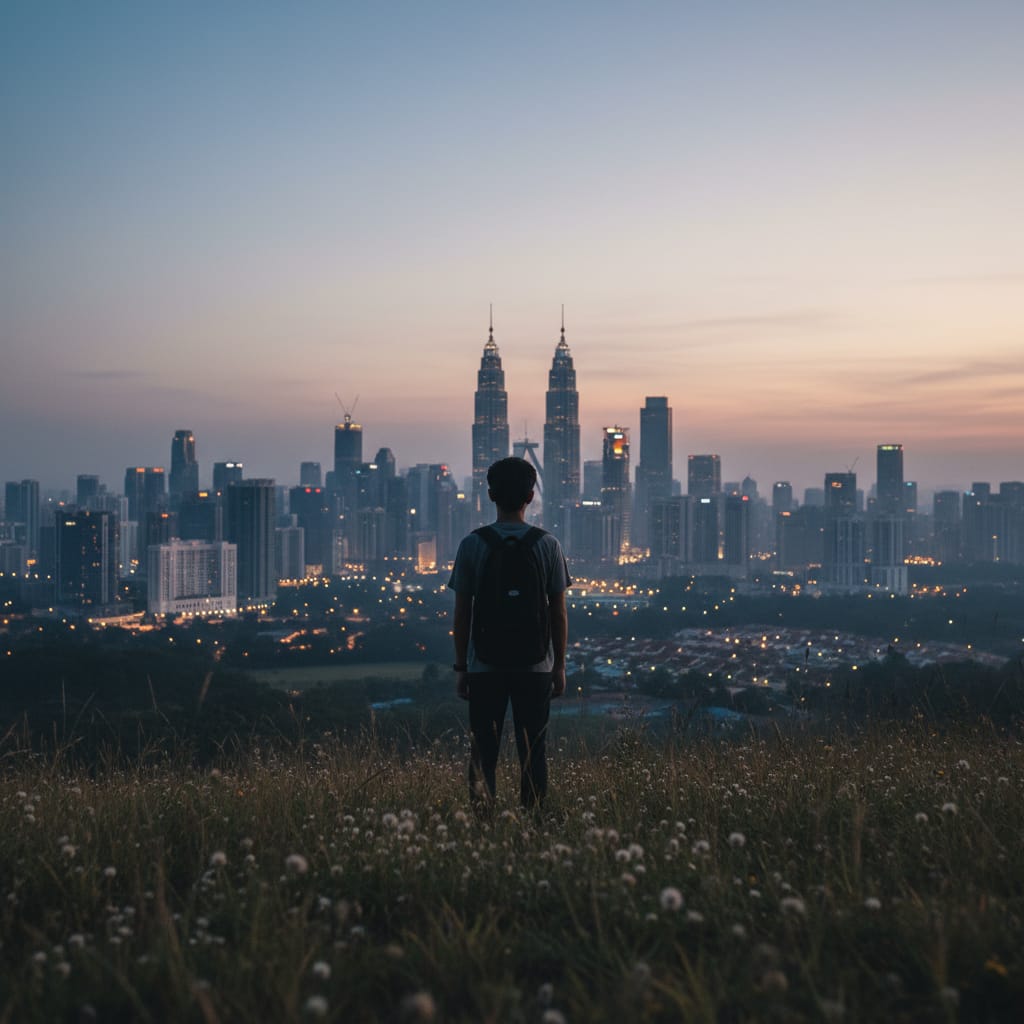
The Great KL Exodus: Why Local Kuala Lumpur residents Are Being Pushed to the Fringes of Their Own City
For a young Kuala Lumpur resident, the glittering towers of the city centre are no longer a destination—they are a backdrop. They are the glass and steel equivalent of a movie poster: beautiful to look at, but impossible to step inside. The dream of a condo with a view of the Merdeka 118 tower or a quick commute to Tun Razak Exchange (TRX) is evaporating like morning mist under a tropical sun. A quiet but seismic shift is occurring beneath the feet of the Klang Valley. While gleaming new financial districts rise like artificial mountains, the average Malaysian salary has become a thin blanket on a cold night—unable to cover the cost of staying warm inside the city.
The first domino has already fallen. The TRX district, Malaysia’s shiny new financial jewel, and the bustling Velocity area in Cheras are rapidly transforming into islands reserved for foreigners. This isn't xenophobia; it's arithmetic. Under government guidelines, foreigners are largely barred from purchasing affordable homes, forced instead to fish in the deep end of the pool—properties priced above RM1 million. Developers, hungry for fat margins, have happily dangled that bait. A local executive or a young family hunting for a condominium near the MRT station in TRX isn't just competing against another local bidder. They are standing in the shadow of expatriate housing allowances and foreign investment capital—forces as immovable as a boulder in a stream. For the average KLite earning between RM5,000 and RM7,000 per month, a RM1.2 million apartment is a mirage. The monthly mortgage would swallow 80% of their paycheck, leaving only crumbs.
Consequently, the locals have raised a white flag and retreated. But their retreat has been met with a bitter irony. Thirty years ago, suburbs like Puchong, Kepong, and Rawang were considered the ragged edges of civilisation—swampy, congested, and socially inferior to the polished glitter of Bangsar or Damansara. They were the ugly ducklings of the property pond. Today, those "ugly ducklings" have turned into swans that no local can afford to catch. Puchong is now a saturated sponge, unable to absorb another resident. A terrace house in Kepong that sold for RM150,000 in the 1990s now wears a price tag of RM700,000 or more—a heavy necklace for any middle-class neck. Rawang is no longer a cheap alternative; it is a traffic-choked dormitory town where even the entry-level apartments have begun to strain local wallets like a shoe two sizes too small.
So where do the locals go when even the "inferior" suburbs have closed their doors? They are being pushed further down the river, past the second ring road and into the agrarian frontier. The new face of the KL resident is no longer found in the city centre but in Semenyih, Rimbayu, and Cyberjaya. These are the lifeboats.
Look closely. Semenyih, once known only for its university and durian orchards, has become a sprawling quilt of affordable housing projects. Rimbayu, with its manicured township concept, is absorbing thousands of local families who have given up on the city centre dream. They have traded the bright lights of KL for a garden and a gate. Cyberjaya, ironically built as a futuristic tech hub, has settled into a quieter role: a residential ark for locals who work in KL but can no longer afford to sleep there. These areas offer decent homes—spacious, green, and often more family-friendly than a shoebox condo in the city. But they come with a venomous sting hidden in their tail: the commute.
This is the birth of the "Tokyo Scenario." Anyone who has endured rush hour in Greater Tokyo knows the ritual: a door-to-door commute of two to three hours each day is not considered extreme. It is the price of admission. It is the toll you pay to exist. Kuala Lumpur is now hurtling down that same highway.
Consider the local resident who works in the Golden Triangle—KLCC, TRX, Ampang Park. To afford a landed house or a larger apartment, they have bought a unit in Semenyih. Their life has become a pendulum. They wake at 5:00 AM, still half-dreaming. By 6:00 AM, they are a small fish swimming into the current of the LEKAS Highway, merging onto the SILK or MEX. If the traffic gods are merciful and no accident occurs, they might reach TRX by 7:30 AM. That is 1.5 hours one way. Three hours a day. Fifteen hours a week. That is nearly two full working days each month swallowed whole by the asphalt snake.
Why does this happen? Because the price correction never came. For decades, the myth that property only rises—like a tide lifting all boats—has locked the middle class out of the city centre. Now, the new reality is a three-tiered cake: Foreigners and the ultra-wealthy will dine on the top layer, enjoying the high-rise luxury of TRX and Velocity. Local professionals—engineers, accountants, mid-level managers—will squeeze into the sticky middle layer of Puchong and Kepong, paying premium prices for used cars to navigate perpetual gridlock. And the rest—the clerks, the junior execs, the young couples—will scrape the bottom crumbs in the exurbs of Semenyih and Rimbayu.
The psychological weight is crushing. In Tokyo, workers have learned to sleep standing up on trains like exhausted marionettes. In KL, we have no such infrastructure yet. The MRT and LRT are silver threads trying to stitch a ripped fabric, but they cannot cover the vast distance from Semenyih to the city core. The 2- to 3-hour daily commute is a slow bleed—draining energy, family time, and the very joy of living. It turns a human being into a commuter, and a home into just a place to sleep before the next dawn journey.
The stage is set. The city centre will become a gilded cage for non-citizens and the elite. The "inferior" lands of yesterday are the premium suburbs of today. And the local Kuala Lumpur resident—resilient yet resigned—is packing their bags for the next frontier, trading their hours like currency for a roof. In 20 years, a two-hour drive to TRX will not cause raised eyebrows. It will be the heartbeat of the average Malaysian. Just like Tokyo, we are learning that in a globalised city, the local often ends up waiting at the last bus stop—watching the headlights fade into the distance.
moykokming@gmail.com
Moy Kok Ming (moykokming@gmail.com) is a content creator under the Newswav Creator programme, where you get to express yourself, be a citizen journalist, and at the same time monetize your content & reach millions of users on Newswav. Log in to creator.newswav.com and become a Newswav Creator now!
The User Content (as defined on Newswav Terms of Use) above including the views expressed and media (pictures, videos, citations etc) were submitted & posted by the author. Newswav is solely an aggregation platform that hosts the User Content. If you have any questions about the content, copyright or other issues of the work, please contact creator@newswav.com.