THE local currency and the stock market started the week weaker following the slower-than-expected third quarter growth.
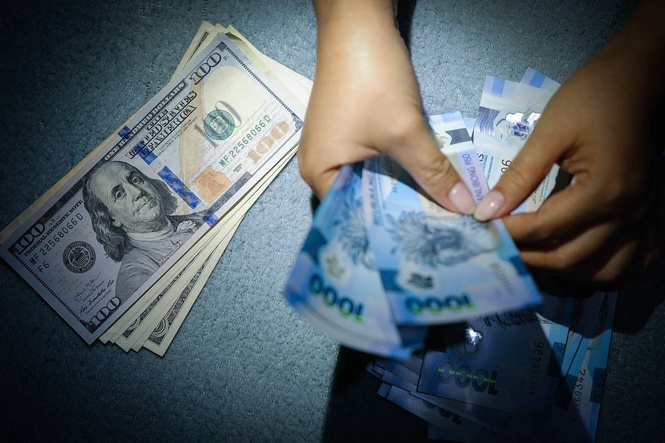
The peso closed 25 and a half centavos lower to P63.31 on Monday from Friday’s P63.055.
It opened at P63.06 and traded between P63.02 and P63.33. The volume reached $1.264 billion, up from the previous $1.196 billion.
Rizal Commercial Banking Corp. chief economist Michael Ricafort said the peso weakened amid the subdued third-quarter economic growth.
Gross domestic product (GDP) markedly slowed to 2.1 percent in the third quarter from 2.3 percent in the previous quarter and 4.0 percent in the same period last year.
Ricafort added that the “higher US dollar versus major global currencies” also weighed on the currency.
Citi Head of Emerging Market Economics and Chief Asia Economist Johanna Chua, meanwhile, said the peso remained the region’s underperformer.
“So I would have to say in the basket of kind of Asia, our view on peso seems to be a little bit more of the underperformer, under-laggard,” Chua said.
“But again, peso is very sensitive to oil. So that is something that we obviously need to watch very closely,” she added.
Philippine shares also fell on Monday with analysts warning that elevated inflation and slowing consumer spending could further weigh on corporate earnings and market sentiment.
The Philippine Stock Exchange index (PSEi) dropped 1.46 percent to 5,677.92, while the broader All Shares index declined 1.08 percent.
Only the mining and oil sector ended higher, gaining 2.34 percent, while property stocks posted the steepest decline at 2.07 percent.
Japhet Tantiangco, research manager at Philstocks Financial Inc., said concerns over the economic outlook, alongside high inflation and the possibility of another interest rate hike by the Bangko Sentral ng Pilipinas (BSP), weighed on equities.
“The local market declined as investors digested the Philippines’ Q3 2026 GDP data with growth coming in at a dismal 2.1 percent,” Tantiangco said.
Luis Limlingan, head of sales at Regina Capital Development Corp., said the weaker-than-expected economic growth raised concerns about the country’s prospects, keeping investors cautious toward local equities.
“Sentiment remained fragile amid potential El Niño risks and persistent inflationary pressures, which could further weigh on domestic demand and economic activity,” Limlingan said.
DragonFi Securities research analyst Jarrod Tin said the economy would need to expand by about 6.3 percent in the fourth quarter to reach even the lower end of the government’s 3.5- to 4.5-percent growth target for 2026.
“That looks out of reach, so we expect the government to revise its growth assumptions when it reviews them next month,” Tin said.
Tin warned that weaker household consumption, which grew by just 2.4 percent, could weigh on earnings expectations for consumer, retail and property companies as high inflation erodes purchasing power.
“Dividend-paying defensives and dollar earners should continue to outperform in this environment,” he said.
Manny Ocampo, president and chief operating officer of Investment and Capital Corp. of the Philippines, said the slowdown was largely expected but would continue to challenge the market, particularly as listed companies were already reporting flat or declining earnings.
Jonathan Ravelas said the latest GDP result showed that the economy was slowing but not stalling, advising investors to favor companies with resilient earnings, strong balance sheets and exposure to exports.
Ricafort warned of stagflation risks, or a combination of sluggish economic growth and elevated inflation.
He noted that third-quarter growth was the slowest in more than five years, as agricultural output contracted by 4.8 percent and construction declined by 4 percent. Investments also slipped by 0.2 percent, while consumer spending, which accounts for about 73 percent of the economy, grew by only 2.4 percent.
Ricafort said higher fuel, fertilizer and transport costs, elevated borrowing costs and weak infrastructure spending had weighed on economic activity. Exports, however, expanded by 8.6 percent, providing some support amid stronger global demand for electronics and artificial intelligence-related products.
The latest inflation reading of 7.8 percent in October further heightened concerns about purchasing power and the outlook for domestic demand.
Ricafort said slower economic growth could temper the urgency for further BSP rate increases, although additional tightening remained possible if inflation stayed above the central bank’s 2- to 4-percent target or the peso came under renewed pressure.
Monday’s market turnover reached P4.9 billion, with foreign investors recording net selling of P233.95 million. The market recorded 74 gainers, 100 decliners and 69 unchanged issues.
Tantiangco said investors would continue monitoring inflation, fuel prices, peso movements and the BSP’s next policy decision as they assess the economic outlook.