Brazilian President Luiz Inácio Lula da Silva has pulled off a historic comeback, winning the October 25 presidential runoff with 51.8% of the vote against 48.2% for Senator Flávio Bolsonaro, the eldest son of former president Jair Bolsonaro. Lula, 80, trailed by about 2.2 million votes in the first round three weeks earlier, and is now the first candidate in Brazil's history to finish second in the opening round and go on to win the runoff. He will begin a fourth, non consecutive term on January 5, 2027.
The result halts a run of victories by right wing, Washington friendly candidates across Latin America, and Britain's Guardian described it as a blow to US President Donald Trump. But the night ended without a concession. After a Supreme Court justice extended voting nationwide by two hours, Flávio Bolsonaro said he could not accept the result and would seek to have the election annulled.
How Lula Overturned A 2.2 Million Vote Deficit
With 99.9% of ballots counted, official preliminary results from the Superior Electoral Court (TSE) showed Lula ahead by 3.6 percentage points. Court president Kássio Nunes Marques announced that Lula had been reelected with more than 64 million votes and would become the 40th president of the Federative Republic of Brazil.
The turnaround was dramatic. In the first round on October 4, Flávio Bolsonaro won 56,104,503 votes to Lula's 53,879,538, Al Jazeera reported, and polls released in the final weeks still gave the senator a narrow edge. CNT/MDA had him at 46.8% to Lula's 45.9%, Quaest at 46% to 44%, and Datafolha at 47% to 45%, all within the margin of error. With every vote counted, Lula won by about 4.4 million, a wider margin than his victory over Jair Bolsonaro four years ago. Fox News noted he is the first first round runner up to win the presidency since Brazil's return to democracy in 1985.
Turnout was a decisive factor. According to the Guardian, abstention hit a record 21.08% in the first round and hurt Lula most, because his supporters tend to live farther from polling stations. In the runoff, abstention fell to 19.21%. Lula's campaign had identified getting supporters to the polls as the key to a comeback, and that appears to be how he closed most of the gap.
The New York Times reported that most pollsters had expected supporters of eliminated first round candidates to swing to Flávio Bolsonaro. They did not. Of roughly 14 million votes up for grabs in the runoff, including new voters, backers of eliminated candidates and people who had cast blank or spoiled ballots, Lula won about three in four. Between the two rounds, he added 10.4 million votes, while his rival gained only 3.7 million. Fox News reported that Lula ran up wide margins in the North and Northeast, while Bolsonaro carried southern strongholds by smaller margins than in the first round, and the bellwether state of Minas Gerais was essentially tied.
Online organizing also helped. According to the Times, André Janones, a congressman from a party allied with Lula's government, grew his WhatsApp channel "Lula's Army" from about 50,000 followers to nearly 11 million, using it to push videos and posts that followers were asked to share. Before the first round, the Bolsonaro camp had dominated online, but its rival channel peaked at just over 2 million followers.
Why Voting Was Extended By Two Hours
Election day was marred by transport problems. In Salvador, a major city in Brazil's northeast, voters complained of severe bus delays, with some buses held in depots for more than an hour. Authorities said 370 buses were affected. Election officials ordered them back on the road under threat of fines of US$200,000 an hour, and a federal electoral judge ordered the arrest of the local official in charge of public transport. Salvador Mayor Bruno Reis told reporters the buses had been held up by parking lot problems and political protests.
Lula's campaign first asked for voting to be extended in three pro Lula cities in Bahia state, then widened the request to parts of Piauí, Paraíba, Paraná, Pará, Rio de Janeiro, São Paulo, Alagoas, Pernambuco and Roraima. "I have never complained about an election. Win or lose, I calm down and prepare for the next one. But this time, something abhorrent is happening," Lula said. "What we want is simple: an honest election in which everyone has the right to vote."
The Bolsonaro campaign also sought extensions in 17 cities in São Paulo, Paraná and Santa Catarina, with its lawyers citing rain, flooding and power cuts. The Times reported that Brazil's national meteorological institute had issued an orange alert for 81% of Paraná, a state where Flávio Bolsonaro won about 60% of the first round vote, and that more than 30 polling stations there lost power, affecting about 21,500 voters.
According to the Guardian, Nunes Marques, who was appointed by Jair Bolsonaro and had been criticized during the campaign for rulings seen as favoring his son, went hours without ruling on Lula's request. In 2022, the Times noted, then court president Alexandre de Moraes rejected a similar request, warning that extending voting could feed the baseless fraud claims already spread by Jair Bolsonaro's supporters.
In the end, Supreme Court Justice Cristiano Zanin, a Lula appointee, ordered all polling stations nationwide to stay open two extra hours. "Given the seriousness of the facts described, and considering the evident urgency of the matter, I hereby order that the closing time for voting at all polling stations throughout Brazil be extended by two hours," he wrote. Latin Times reported that the order was published at 5:03 p.m., three minutes after the scheduled close, moving the deadline to 7 p.m. Brasília time. It was issued unilaterally at the Lula coalition's request, and Zanin, a substitute justice on the electoral court, once served as Lula's criminal defense lawyer.
Confusion At The Polls And Questions Over Legitimacy
The order caused confusion. According to the Times, some polling stations had already closed and their voting machines had been switched off and could not be restarted. Election officials said electronic machines may not be able to reopen once they have tallied their votes. A poll worker in central São Paulo, who gave only her first name, Bárbara, said staff heard about the extension around 5 p.m. but were told by local authorities to close anyway, and only received the order to reopen at 6 p.m., too late for many voters. Within the electoral court, there were worries that the chaos could undermine confidence in a voting system that the Bolsonaro camp has long attacked.
All four election lawyers interviewed by the Times called the situation unprecedented, and said the vote could potentially be annulled because of the confusion. "This is an extremely serious, critical situation," said election lawyer Priscilla Sodré Pereira. Fernando Neisser, an election law professor at the Fundação Getulio Vargas, said an election could be annulled if the margin were very narrow and it could be shown that polling stations in areas strongly favoring one candidate had stayed open longer. Nunes Marques, however, said the extension did not affect the result, and legal experts told Fox News that annulment faces a high bar. Under Brazil's electoral rules, Latin Times noted, annulment requires documented proof that a specific irregularity materially changed the count.
Why Flávio Bolsonaro Refuses To Concede
At a news conference in Brasília, Flávio Bolsonaro refused to recognize Lula's victory. "It is impossible to recognize the outcome of this election given what happened today," he said, according to Latin Times, adding that his legal team would petition for a full annulment. He accused Zanin, Lula's former lawyer, of "changing the rules in the middle of the game," called the decision a dirty trick by "Lula's friend on the Supreme Court," and said, "What happened today is not normal, and is even unacceptable."
He also alleged that his party's monitors had been barred from the electoral court's secure counting room, though Latin Times said no documentary evidence had been presented, and argued that stations which had already sealed their ballot boxes never reopened. The Guardian pointed out that he made no mention of his own campaign's requests for extended voting. He took no questions and appeared to time his remarks to begin after Lula's televised victory speech had ended. "I will not give up on my Brazil, and I hope you won't either," he told supporters. The Times put the statement at under three minutes; the Guardian said about five.
The Guardian noted that the son was following his father's script. Four years ago, Jair Bolsonaro also refused to concede to Lula and was later convicted of plotting a coup to stop Lula from taking office. He was sentenced to 27 years in prison and is serving his sentence under house arrest for health reasons. Nunes Marques, for his part, recognized Lula's victory and said he had called both candidates, describing Lula's political career as spanning different eras of Brazilian democracy, with eight presidential runs and four wins, and congratulating Flávio Bolsonaro on a substantial vote in his first presidential race.
Lula Says Brazil Is No One's Backyard
Speaking at a São Paulo hotel alongside his wife, running mate Geraldo Alckmin and political allies, Lula thanked voters. "I want to thank the Brazilian people for their generosity toward me over so many years. In this second round, I want to thank the generosity of Brazil's young people, who took to the streets to defend democracy," he said. The rallies of the past week, he added, "proved that this country refuses to be anyone's backyard." The Times read that as a reference to the United States, which has sought a new level of control over Latin America through tariffs, sanctions and intervention in elections.
"No one is required to like the president elect, but he must govern for everyone," Lula said, according to Fox News, calling the result "a defeat for denialism and lies." According to Reuters, as cited by the Guardian, he said his campaign had defeated foreign interference carried out through digital platforms, which he said must be regulated, and promised to govern for all 215 million Brazilians. Before the vote, Lula and independent watchdogs had accused Meta's platforms of favoring Flávio Bolsonaro, and his campaign filed a complaint with the electoral court on October 10. Meta denied the claim, telling the court it does not manipulate its systems to harm or favor any candidate.
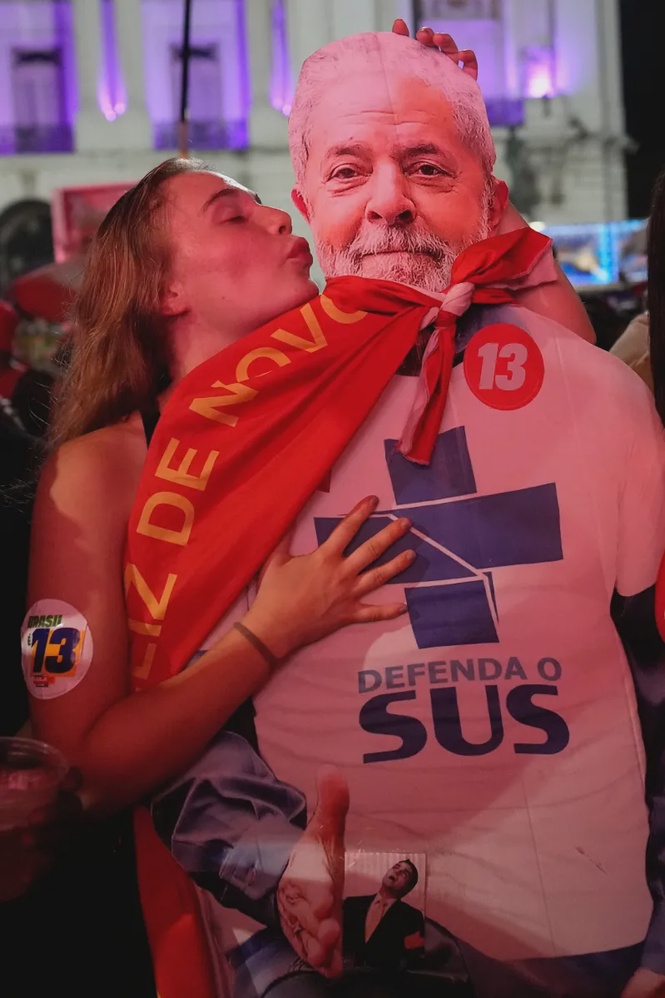
Spontaneous celebrations erupted on São Paulo's Avenida Paulista, with fireworks going off even before the result was announced and supporters weeping in disbelief. Mexican President Claudia Sheinbaum wrote, "Long live democracy, the Brazilian people won. Congratulations, President Lula!" Congratulations also came from the presidents of Paraguay, Uruguay, Bolivia and Panama, and from Cuba's leader, according to Reuters.
Why The Result Is A Setback For Trump
The New York Times described Trump as a kingmaker in Latin American elections since returning to office. Over the past 18 months, right wing candidates aligned with Washington have won seven presidential elections, in Colombia, Chile, Honduras, Bolivia, Peru, Ecuador and Costa Rica, and Trump explicitly endorsed two of the winners.
Trump did not publicly endorse either candidate in Brazil. But according to the Times, his administration boosted Flávio Bolsonaro in subtler ways, including designating two Brazilian gangs as terrorist organizations at his urging and trying to send a delegation to examine the fairness of Brazil's election. The administration denied trying to interfere. In 2025, Trump also tried to intervene in Jair Bolsonaro's trial through tariffs and sanctions, without success. After the son led the first round, Trump told reporters, "That's a big win."
The Guardian called the Bolsonaro family Trump's most important international allies in Brazil and said Trump had hoped Flávio Bolsonaro would join the ranks of pro Trump leaders in the region, alongside Abelardo de la Espriella in Colombia, Daniel Noboa in Ecuador, José Antonio Kast in Chile and Javier Milei in Argentina.
The Challenges Of A Fourth Term
The next president will have the power to fill four of the 11 seats on Brazil's Supreme Court, the Times noted, which could shape the country's direction on many divisive issues for years. The court itself became a campaign issue after Justice Alexandre de Moraes was revealed this year to have ties to a banker suspected of fraud. Flávio Bolsonaro told rallies that "a vote for Lula is a vote for Moraes," while Lula tried to distance himself, calling for an investigation into the justice's conduct and a sweeping overhaul of the judiciary.
Lula is also likely to face strong checks on his power. Right wing candidates, including four other members of the Bolsonaro family, made major gains in congressional elections, leaving a center right and right leaning majority in Congress. The two camps are far apart on policy. Flávio Bolsonaro had said he would bring Brazil into the Shield of the Americas, the Trump administration's coalition against drug cartels, while Lula has resisted, warning that tying Brazil too closely to the United States on security could threaten national sovereignty. With Lula in office for another term, the Times said, the risk of further economic clashes with Washington that could hurt Brazil's economy is likely to rise.