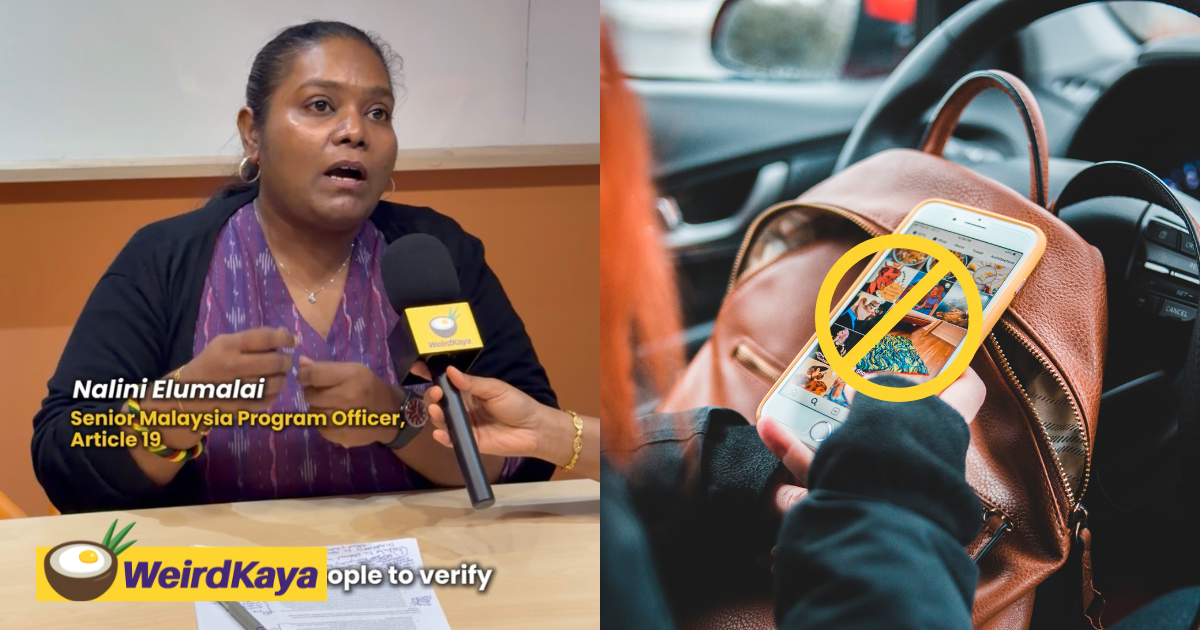
From June 1, 2026, Malaysians below the age of 16 are no longer allowed to register their own social media accounts.
Under the new rules, social media platforms must introduce age verification measures, which may require users to verify their age using official identification such as a MyKad or passport. Verification for existing users is being introduced in stages.
The measures are intended to protect teens from online grooming, scams, cyberbullying and harmful content.
However, the policy has also raised serious questions about data privacy, government surveillance, freedom of expression and how young people will continue accessing information online.
To understand these concerns, WeirdKaya exclusively spoke to human rights defenders and members of the Malaysian public.
‘You may never know how your data is being used’

Speaking to WeirdKaya, ARTICLE 19 Senior Malaysia Programme Officer Nalini Elumalai questioned how personal information collected for age verification would be protected.
She noted that government agencies are exempted from Malaysia’s Personal Data Protection Act, raising concerns over whether people would know how their information is being used.
When people are asked to verify their identity on social media, you may never know how your data is being used or for what purpose,” she said.
According to Nalini, the lack of clear safeguards could potentially open the door to widespread surveillance.
She also raised concerns about transparency surrounding MyDigital ID and how security incidents involving personal information would be managed.
If an incident occurs, there is no transparency over how it is being handled, what information may have been leaked and what action has been taken,” she said.
‘We are giving another tool for surveillance’

Centre for Independent Journalism Executive Director Wathshlah Naidu shared similar concerns, saying that age verification could become another tool for surveillance and profiling if proper protections are not established.
She said civil society groups had submitted questions, criticism and recommendations during the public consultation process, but many of their concerns remained unanswered.
We keep hearing assurances that the measures will not undermine people’s rights, but the questions we raised have not been addressed,” she said.
How will the government protect the data? What measures are being put in place? These are critical questions, and we need answers.”
Wathshlah also questioned whether Malaysia’s digital infrastructure was prepared to handle such a large amount of sensitive information.
Does it have adequate safeguards to prevent abuse by third parties or hacking? Data leaks are a very real concern,” she added.
These concerns come against the backdrop of recent cyberattacks on Malaysian government websites.
On June 27, 2026, the Ministry of Health (MOH) confirmed that its official website had been hacked. The ministry urged the public to avoid accessing the site or clicking suspicious links while investigations and recovery work were carried out.
The National Cyber Security Agency (NACSA) also confirmed that several other government websites had been compromised, including those belonging to the Malaysia Co-operative Societies Commission, Handicraft Development Corporation and Women’s Development Department.
However, MOH clarified on June 30 that it had found no indication of sensitive data being leaked or critical systems being affected. It said its public website does not store patient medical records or individual health data, while healthcare systems operate on separate infrastructure.
Where will teens go after losing access?
Beyond privacy, the human rights defenders also questioned what the restrictions would mean for teenagers who already depend on social media.
Wathshlah pointed out that teens today use online platforms for much more than entertainment.
“That is where they interact, learn and access information,” she said.
For teenagers between 13 and 15 who already have social media accounts, losing access could mean suddenly being removed from an important part of their social lives.
“If they now have to give up that access, where will their new interaction space be?” she asked.
Nalini acknowledged that the government has legitimate reasons for wanting to protect Malaysians from scams and fraud while keeping teens safe online.
However, she argued that a blanket ban without strong and independent third-party oversight could affect more people than intended.
Malaysians prefer education over a complete ban
Members of the public who spoke to WeirdKaya also expressed mixed feelings about the restriction.
One Malaysian said completely banning something would almost always come with disadvantages.
While she understood the need to reduce grooming and protect teens from online predators, she said the internet had also played an important role in shaping who she is today.

“There is so much that the internet can offer. I am the person I am today because of all the information available online,” she said.
Another Malaysian said social media has become deeply connected to daily life as almost everything can now be accessed through a smartphone.
Others felt that education and moderation would be more practical than a complete ban.
Another suggested introducing social media and media literacy into Malaysia’s national education syllabus.
Instead of simply removing access, teens could be taught how to identify harmful content, protect their personal information and use social media responsibly.
“I think the best effort would be to help children understand how to navigate social media and consume content responsibly,” the person said.
One respondent agreed, adding that the government should focus on education while strengthening the security of Malaysians’ personal information.

“It is better to educate children and teach them how to use social media safely. The government should also do more to keep everyone’s personal information secure,” she said.
For many of those interviewed, the issue is not whether teens should be protected online. The bigger question is whether a blanket restriction and compulsory age verification are the safest and most effective ways to do it.
Watch the full video here:
What do you think about this issue? Share your thoughts with us in the comment section.