

Introduction
A scam is referred to as any fraudulent business or misconduct that reaps money or other goods from a credulous person. Scams tend to occur when a person acts as an authoritative individual performing a fraudulent scheme.
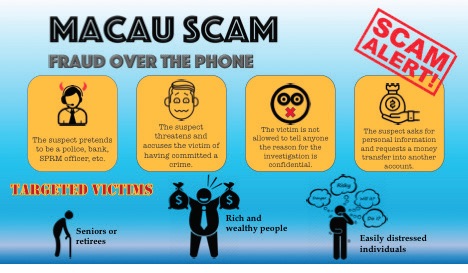
The Macau Scam is one of the financial scams frequently reported in Malaysia. It involves telephone calls from clever scammers camouflaging themselves as government officials, police authorities or bank officers. A syndicate calls innocent victims and creates stories about these individuals having been involved in money laundering, theft or credit card fraud and then requests the victims to make hefty payments into the scammer’s bank account to resolve the case or grow the problem.
Macau Scam
Taiwanese and Chinese syndicates operate the Macau Scam by using Hong Kong international and local calls. To collect money from the victims’ bank accounts, local Malaysian bank accounts are used to conclude the forgery scheme.
Money is then converted as cash before being transferred overseas through money exchange services. This technique is called Voice Phishing which involves messaging using the Voice over Internet Protocol (VoIP) that permeates syndicates to place any mobile number to trick victims.
It is reported that cases of online fraud are rapid making victims imbecile. Almost three and a quarter of complaints were reported to the Malaysian Computer Emergency Response Team (MyCERT) in recent years. Among the 5,507 complaints against cyber security attacks received by the government from the beginning of 2019 to July 2019, 3,973 (72.14%) were cited as online fraud cases dominantly ranging from the Macau Scam to illegal investments. Net losses from cybercrime in our country have hit RM309.67 million between January and July.
Macam scams use the IP-PBX technology to perform online frauds. IP-PBX is a non-public branch exchange, also known as an in-house telephone switching system that changes calls between VoIP users on local lines while enabling all users to communicate few numbers of external phone lines. The traditional IP-PBX is able to change calls just as the standard PBX involving a VoIP user and a traditional telephone caller or between only two traditional phone users.
The syndicate hacks an IP-PBX and uses its services to make complementary international calls. It is also common for scammers to have their VoIP service in a different country. The call goes through the affected PBX when a user of the fraudulent service makes a call to an abroad location. The original owner of the PBX server cannot request money from the subscriber of the fraudulent service, but the fraudster can receive payment from the users via stolen resources.
A prominent type of communication between a PBX and a VoIP service provider is called the Session Initiation Protocol (SIP). A SIP trunk is a direct link between an organization and phone provider (ITSP). It allows the extension of VoIP telephony to surpass the firewall without an IP-PSTN gateway. SIP trunking is also benefiting from PRIs (Primary Rate Interfaces), PSTN gateways and BRIs (Basic Rate Interfaces), which results in cost efficiency. Fraudsters can use this service without legal issues.
Types of Macau Scam Tricks
Types of Macau Scam include:
- Bank loan fraud
- Credit card fraud
- Kidnapping and ransom
- The release of prisoners
- PDRM suit and court
- Lucky draw gifts
- Travel pack
A few types of the scam have been reported to Cyber999 (MyCERT):
Credit Card Fraud
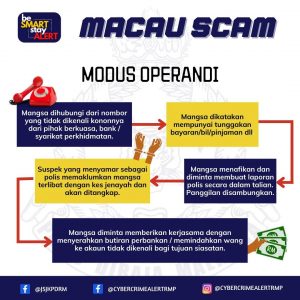
Modus operandi: A syndicate contacts a victim by impersonating a bank employee and claims that the victim's personal details and credentials have been used to replicate a credit card registered representing the victim. The victim is then communicated by the suspect to solve the matter by staying connected to the phone line of Bank Negara. The victim then calls the second fraudster who represents a National Bank officer and requests a money remittance to the account provided for safety purposes. The suspect also guarantees to return the money within a week before the completed investigation disappears.
- Do not share your card, personal information or bank details.
- Refer to your payment receipt each time and make sure the transaction is accurate.
- Immediately get the card cancelled when it is misplaced.
- Be wary when making big transactions.
- Be wary when investing in special online promotions.
- Try to memorize the PIN number instead.
- Lodge a police report immediately.
Authority Officer Trick
Modus operandi: The suspect impersonates a police, bank or other officials to cheat a victim by calling and threatening the victim over a phone call. They will inform that the poor victim has committed a criminal act, such as money laundering or others. The con artist will also bribe a fee to seal the case if the victim is not interested in being prosecuted. Individuals who are deceived by this scheme will exchange a large transaction for a given account.
- Immediately cancel the card when misplaced.
- Do not reveal your bank account number, ATM card or credit card number to a suspect.
- Do not return the suspects’ call. Instead, call the company or institution involved for further discussion.
- Never close a deal over the phone.
- In the event the call is from an authority officer, make an appointment or walk into the police station, bank or authority office for clarification.
- Lodge a police report without hesitating.
Prizes and Lucky Draw Trick
Modus operandi: Victims receive messages of winning a lottery or jackpot via phone call or SMS. These individuals are asked to make advance payments to claim the winnings. In some unrealistic cases, victims are informed they have won a car or a condominium out of their home country. Victims are told they could convert these assets into cash provided they will have to make an initial payment to a foreign bank account.
- To redeem any cash incentives, do not make any prior payment. Winning a lucky draw should not require advance fees.
- Ignore lucky draws or other incentive notifications, especially when you did not participate.
- Do not provide your personal details.
- Lodge a police report immediately.
Impersonating kidnappers
Modus Operandi: Victim receives a phone call from a fraudster claiming the victim's family member had been kidnapped for ransom. The victim is ordered to quickly pay the requested ransom with the amount stated by the caller to an unknown bank account, although there was no abduction in most cases.
- Do not close any deal over the phone.
- Cut the phone and immediately call the affected family member to check on them.
- Lodge a police report without hesitating.
Targeted Victims
These groups of individuals usually have more savings and accumulated wealth than other target victims. They are also least aware of the latest scams, thus making them profitable targets for scammers.
Wealthy people are among the top favourites for Macau scammers. Scammers impersonate themselves as police, Bank Negara or other authority officers to trick victims. A con artist informs the victim who is accused of having committed criminal acts and seeks to announce that their bank account has been suspended and will be frozen. This will subconsciously and very naturally make the victims nervous and obey the scheme instructions. Since these groups of people know they have a lot of money in their possession and in the bank, hence they don’t worry about losing it. Some of them may blindly adhere to all the instructions provided by the syndicate.
Some individuals have an overthinking mindset. These people may easily panic and will obey the instructions of the scam when accused of committing to a crime or was bullied that a family member was kidnapped for the transfer of a hefty sum of money.
How to Prevent Being Scammed
Public awareness plays a vital role in preventing falling victim to the financial scam. Below are a few steps to take note if you receive a suspicious call:
- Always be careful and do not be imbecile by the tricks of scammers.
- Don’t fear but follow the instructions given by the caller without first calling the police or money institution concerned.
- Do not return the call back from the contact number you received the call. Get the official phone number of the organization or institution for checking.
- Never share your personal or account details to another person for the purpose of verifying your identity.
- In the event of a fake call, lodge a police report and supply a recording of the call or any written notes you have recorded to ease police investigation, or report to Cyber999.
- Visit BNM's official portal for the latest and accurate information on financial fraud.
Recent Cases of Macau Scams
- Engineer loses RM2.9mil in Macau scam
- Macau scam leaves Gerik housewife RM460,000 poorer
- Retired civil servant loses more than RM800,000 to Macau Scam
Conclusion
Other than the Macau Scam, many other financial scams are populating each day. Unaware people can be trapped by scammers who cheat on hard-earned money. Although prevention is better than detection, it is a daunting task because scammers are always working with fresh ideas to trap victims in online fraud, especially when an old method is made aware to the public. Hence, it is also difficult for victims to identify new fraud methods.
It is advisable to always be on trend with the latest news on scam syndicates and pay close heed to community service alerts from your service providers.

Lavanya Balakrishnan is a content creator under the Newswav Creator programme, where you get to express yourself, be a citizen journalist, and at the same time monetize your content & reach millions of users on Newswav. Log in to creator.newswav.com and become a Newswav Creator now!
The User Content (as defined on Newswav Terms of Use) above including the views expressed and media (pictures, videos, citations etc) were submitted & posted by the author. Newswav is solely an aggregation platform that hosts the User Content. If you have any questions about the content, copyright or other issues of the work, please contact Newswav.