
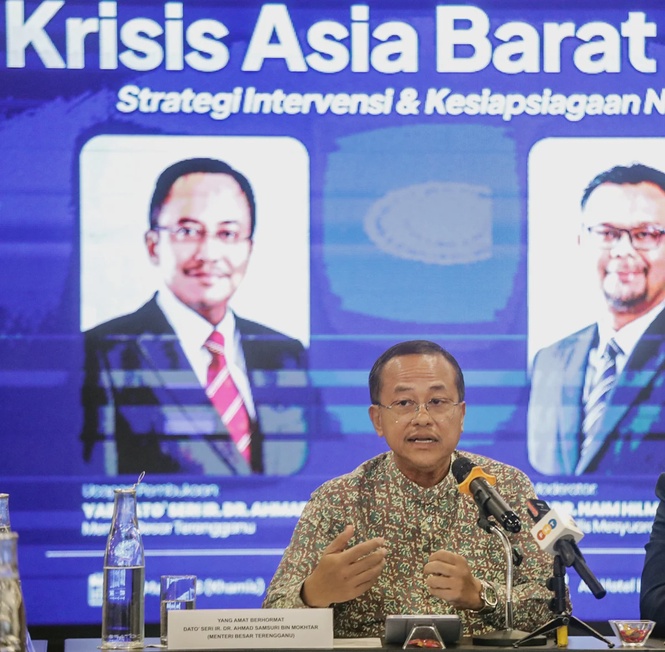
Terengganu MB calls for long-term safeguards and stronger policy execution against future global shocks
KUALA LUMPUR: Malaysia must move beyond merely reacting to global economic shocks and instead strengthen long-term safeguards to better withstand recurring crises linked to growing geopolitical uncertainty, said Terengganu Menteri Besar Datuk Seri Ahmad Samsuri Mokhtar.
Warning that future disruptions are inevitable, he said Malaysia risked being dragged “back to square one” each time a global crisis erupts if durable economic safeguards are not put in place.
“There may be another war somewhere else 10 or 15 years from now. We do not want to return to square one every time something happens, going back to the drawing board again and again without end,” Ahmad Samsuri said during a roundtable discourse on the West Asia crisis and its economic implications on Thursday.
Ahmad Samsuri said Malaysia must move away from short-term reactive policymaking and adopt more coordinated and forward-looking strategies across key economic sectors.
Earlier, he announced Phase One of the Terengganu government’s Economic Stimulus Action Plan, aimed at addressing global supply pressures, strengthening economic growth, supporting micro, small and medium enterprises and boosting padi production activities.
The PAS vice-president said many well-intentioned policies fail not because the ideas are weak, but due to poor execution and a failure to account for public sentiment and realities on the ground.
“Most good policies fail because of the way they are carried out.
“We may have 10 excellent ideas to address an energy crisis. The idea itself may sound brilliant.
“But once it reaches the implementation stage within government or government agencies, that becomes the critical point,” he said.
Ahmad Samsuri stressed that effective policymaking depends not only on substance, but also on communication and public acceptance.
“It is not 100% about the value. It is also about the packaging,” he said, adding that poorly communicated policies could trigger public backlash even when economically sound.
He cited former British prime minister Margaret Thatcher and the controversial poll tax as an example, saying public anger was fuelled more by perceptions of unfairness than by the actual financial burden.
“Because the packaging of the policy was poor and people saw it as (unfair), public anger erupted.
“Massive demonstrations took place, and eventually Margaret Thatcher was forced to step down,” he said.
Ahmad Samsuri also referenced former Afghan president Ashraf Ghani as an example of how even highly qualified technocrats could fail if they misread complex social realities.
“He failed not because his policies were bad, but because he failed to fully grasp the extremely complex social structure of Afghanistan, although he is an anthropology expert.
“So at the end of the day, it is not just about policy. It is also about how you understand the people who will be affected by the intervention,” he said.
He urged policymakers, economists and regulators to formulate both immediate and medium-term strategies to strengthen Malaysia’s resilience, particularly in food security, energy, logistics and finance.
“What we need are proposals that can be implemented now for future use, so that our economy becomes more robust than before,” he said.
He also called on financial regulators, as well as state and federal authorities, to explore practical measures that could cushion external shocks without undermining national financial stability.
“We need to examine how strategic sectors such as food security, energy, logistics and finance can be strengthened to become more stable and resilient in the years ahead.
“Most importantly, all of this is for the benefit of the people.”