
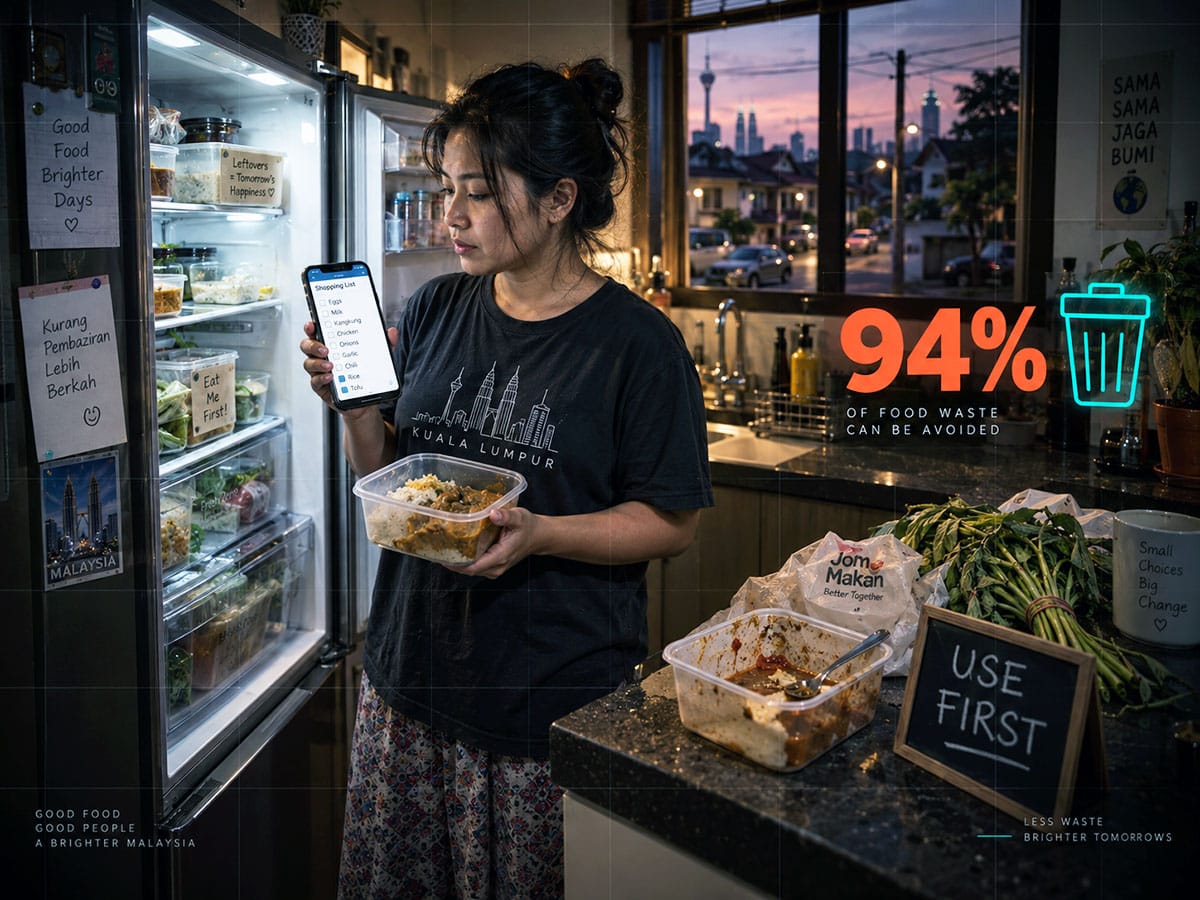
Out of every 100 Malaysian households, 94 throw away cooked food they paid for.
That is not a guess. It is the finding of DOSM's 2025 release on household food waste, published in July 2026. Not "some households." Not "a few bad habits here and there." Ninety four point one percent of us threw out processed or cooked food, and 88.7% threw out raw food too. If you are reading this thinking your kitchen is the exception, the numbers say otherwise for almost everyone.
What we are actually throwing away
DOSM's survey breaks it down by what ends up in the bin. For raw food, vegetables lead at 29.1%, followed by fruits at 22.4% and fish or seafood at 15.0%. For cooked food, rice tops the list at 16.7%, vegetables again at 15.8%, and leftover takeaway at 13.8%.
Read that last one twice. We are not just wasting food we cooked ourselves. We are wasting food we paid someone else to cook for us, then never finished.
Most households are not dumping huge amounts at once. DOSM found that 48.2% discard under 500 grams of raw food a week, and 45.6% discard under 500 grams of cooked food a week. Half a kilo does not sound like much. Multiply it by every household in the country, every week of the year, and you understand why this adds up to a national problem instead of a personal one.
Why it happens, according to our own answers
The survey also asked people why. Expired food came first at 19.3%. Food left too long in the fridge or freezer was next at 18.1%. Overbuying came in at 15.2%, and cooking too much came in at 15.1%.
None of these are exotic reasons. They are the ordinary mechanics of a Malaysian kitchen. You buy vegetables for the week, then a work dinner or a mamak run replaces two nights of home cooking. You cook a big pot of curry because portioning for exactly four people feels stingy, especially with guests around. The extra rice sits in the cooker, then in the fridge, then nowhere. None of this is unusual or shameful. It is just expensive, and the survey shows almost everyone is doing some version of it.
The scale gets bigger than your kitchen
Zoom out from your own bin and the picture gets heavier. SWCorp figures put the country's daily edible food waste at about 6,000 tonnes in 2025, and that number has been climbing over the years, not falling.
Now here is the part that actually annoys me, and I will say it plainly. We are not just throwing food away. We are throwing money away, and the people who can least afford to waste anything are watching us do it. DOSM's spending survey put average monthly spending on food at home at RM876 in 2024. Nobody has published an official ringgit figure for how much of that gets binned, so I will not invent one. But if even a slice of that RM876 ends up in the rubbish every month because of overbuying and expired produce, that is real money that could have gone toward the next grocery run, the kids' school fees, or simply staying in your pocket.
The households that would not waste a grain of it
While plenty of us are scraping half-eaten curry into the bin, groups like the Lost Food Project are stretching every kilogram they can find. Since 2015, they have rescued about 9 million kilograms of surplus food and turned it into roughly 25 million meals, reaching more than 20,000 B40 families a month through 107 charities nationwide.
That contrast is the part I cannot get past. Households with money to spare rarely give food waste a second thought, because a wasted RM20 of vegetables does not change anyone's week. Families getting by on what a charity delivers know exactly what every single item is worth, because they do not have the luxury of not knowing. The waste and the need are happening in the same country, often in neighbourhoods not far from each other.
My Take
I am not going to pretend guilt alone fixes a kitchen habit, so here is what actually helps.
Buy and cook only what you expect to eat. This sounds obvious, but a proper shopping list, and cooking for the number of people actually eating tonight rather than the number you wish were eating tonight, solves a big share of the overbuying and over-cooking that DOSM flagged.
Use your fridge before it uses you. Pick one day a week to check what is close to going off and build that meal around it, instead of discovering a soft cucumber and a forgotten pack of fish the day you finally clean out the shelves.
If you truly have extra, whether it is a catering tray after a kenduri or vegetables you know you will not finish, look at donating it rather than binning it. Groups like the Lost Food Project exist precisely for that surplus, and what feels like leftovers to you can be someone else's proper meal.
The bottom line
Ninety four percent is not a fringe statistic. It is nearly everyone, and that includes people who think of themselves as careful. The fix is not complicated, and it does not need a new appliance or a lifestyle overhaul. It needs slightly smaller pots, a five-minute fridge check, and a bit more honesty about how much we actually eat versus how much we like to cook. Do that, and your wallet notices before the planet does.
Figures are from the sources linked above, as published up to September 2026.
Kamarul Azwan (k.azwan@gmail.com) is a content creator under the Newswav Creator programme, where you get to express yourself, be a citizen journalist, and at the same time monetize your content & reach millions of users on Newswav. Log in to creator.newswav.com and become a Newswav Creator now!
The User Content (as defined on Newswav Terms of Use) above including the views expressed and media (pictures, videos, citations etc) were submitted & posted by the author. Newswav is solely an aggregation platform that hosts the User Content. If you have any questions about the content, copyright or other issues of the work, please contact creator@newswav.com.