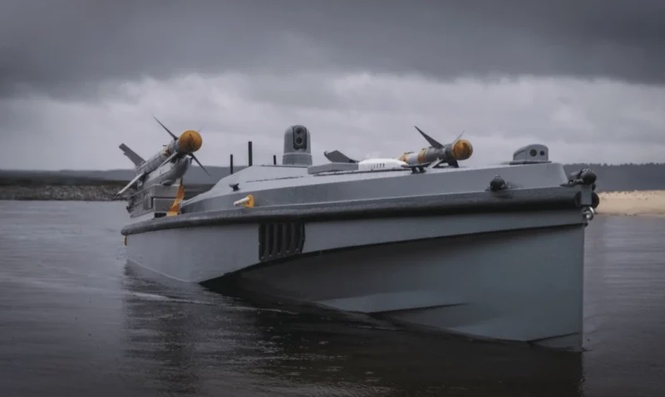
Earlier this year, during exercises in the Philippines, US forces tested Ukrainian Magura naval drones and used one to sink a decommissioned target ship, marking the drones’ first reported use in the Indo-Pacific.
The boat was Ukrainian. The hands guiding it were US special operations forces. And the moment marked the first time this particular weapon – a naval strike drone – had been used in our part of the world.
Sit with that for a moment. The most disruptive naval weapon of the decade did not arrive in Southeast Asia on the deck of an aircraft carrier. It arrived as a motorised dinghy, and it worked.
For Malaysia, a country forever told its navy is too old and too small, this should not read as a threat. It should read as an opening.
Consider what these drones have already done. In the Black Sea, Ukraine has used sea drones to damage Russian naval power, and in 2025 also reported the first combat shootdowns of Russian fighter jets by a maritime drone. Using sea drones built for a few hundred thousand dollars each, it has damaged or destroyed about a third of Russia’s Black Sea Fleet and forced the survivors to pull back from their bases in occupied Crimea. The US Naval Institute has reported that retreat.
Time magazine put the cost of a single such drone at around US$200,000 – less than one modern torpedo. Treat the exact figures as approximate, but the pattern is now beyond argument.
These are not toys. Ukraine’s military intelligence says one of its drones shot down two Russian fighter jets last year, each worth an estimated US$50 million, in what was reported as the first time a drone had killed a jet. A weapon costing less than a luxury car, taking out aircraft that cost more than an office block. That is not a fair fight. It is a new one.
And it has now reached the doorstep of the South China Sea.
Here is why this matters for us, in three plain points.
First, cheap and many now beats few and expensive. For a century, sea power meant big ships and bigger budgets – a game only the wealthy could play. Drones invert it. A navy can lose a hundred of them and still spend less than the price of one frigate. Malaysia has waited years, and paid billions, for a handful of new warships. The lesson from the Black Sea is that a swarm of small, smart, expendable craft can do much of the work those warships were meant to do, and absorb losses along the way.
Second, this suits our geography exactly. Malaysia must watch an enormous maritime zone, two coastlines and the approaches to some of the world’s busiest waters, with a fleet that cannot be everywhere at once. Drones can. They are the cheapest way to put eyes – and, if needed, teeth – across a vast sea without asking sailors to be in 10 places at the same time.
Third, our own navy has already said the quiet part aloud. The chief of the Royal Malaysian Navy told the New Straits Times this month that the service is developing unmanned surface and aerial vehicles and adopting artificial intelligence to sharpen awareness, while keeping command firmly in human hands. He also admitted, with rare candour, that more than 60 per cent of our warships are over 40 years old. Read those two statements together, and a strategy appears. We cannot afford the old game, so we should stop playing it.
This is the part that should excite us rather than worry us. Malaysia has made exactly this kind of leap before. We never laid a dense web of copper telephone lines across every kampung. We skipped it and went straight to mobile. A generation later, a fisherman in Sabah carries more computing power in his pocket than a bank once held in a whole building. The countries that leap past an expensive old technology are not the losers. They are often the ones who move first.
So what is the lesson?
Stop mourning the frigates we do not have, and start building the fleet the next contest at sea will actually reward. That fleet is smaller, more numerous, unmanned where it can be and human where it must be.
Four things would turn this from an idea into an advantage.
First, build for scale, not showpieces. One exquisite drone is a science project. A thousand good-enough ones is a deterrent. Malaysia should treat unmanned craft as ammunition to be spent, not treasures to be guarded.
Second, make them here. The hardest lesson of the past two years is that a capability bought from abroad can be switched off from abroad. Sea drones are simple enough for Malaysian engineers, shipyards and universities to build at home. That is jobs, sovereignty and security in a single hull.
Third, invest in the brain, not just the boat. The drone is cheap. The advantage lies in the software that lets it see, decide and coordinate, and in the sailors trained to command it. This is where a country with real talent in artificial intelligence can punch far above its tonnage.
Fourth, keep the human in charge. Speed is the temptation, and the trap. A machine can find a target faster than any officer. It must never be left to decide, on its own, to take a life. The navy chief drew that line already. We should hold it.
None of this needs a bigger budget. It needs a braver imagination.
The major powers are now studying these little boats because they fear what they can do. Malaysia should study them for what they offer – a rare chance for a middle power to matter at sea again, not by spending the most, but by thinking soonest.
The old ships will retire. Let them. The future of our navy may already be floating quietly in a workshop somewhere, waiting for us to be bold enough to build it.
Ts Dr Manju Appathurai holds dual PhDs in Artificial Intelligence (2026) and Crisis Economics, is a licensed clinical psychologist and Licensed Technologist (Ts), and is the founding principal of Mahat Advisory and a strategic adviser to the Dutch Coalition for Defence and Security (Malaysia).
The views expressed here are the personal opinion of the writer and do not represent that of Twentytwo13.
Image: Ministry of Defense, Ukraine.