
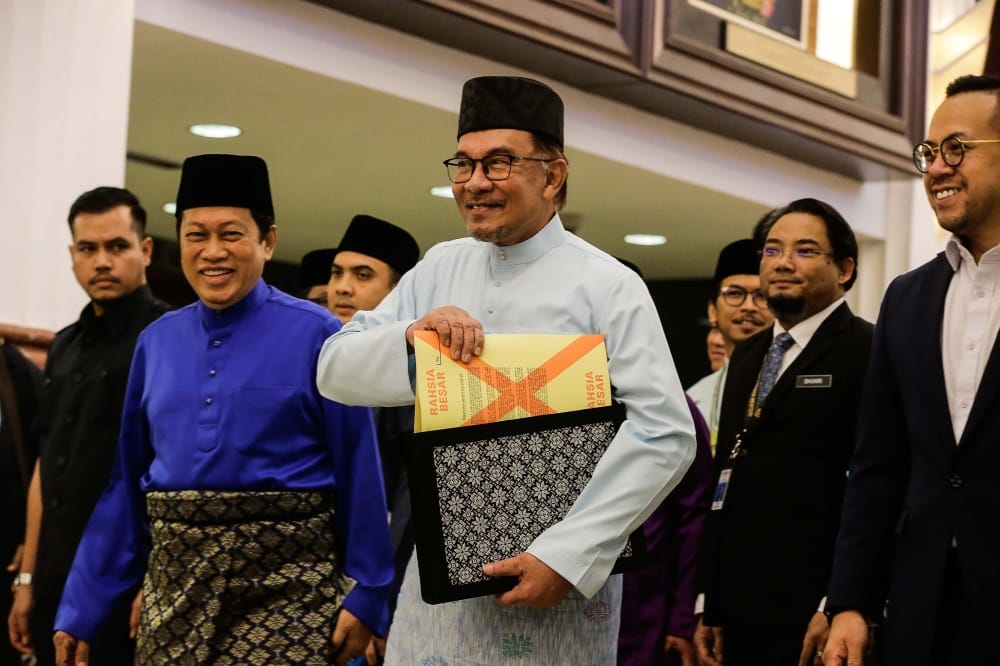
Deep inside the corridors of the Ministry of Finance in Putrajaya, beyond the political speeches and the celebratory headlines announcing record-breaking allocations, lies a stark financial balance sheet that keeps economic planners awake at night. When Prime Minister Datuk Seri Anwar Ibrahim presented a historic federal spending blueprint totaling RM459.8 billion in Parliament, the sheer size of the numbers commanded immediate attention. Yet, as market analysts, institutional investors, and civic researchers scrutinize the fine print of the fiscal balance sheet, an alarming structural ratio emerges: a staggering RM376.84 billion or exactly 81.9% of the entire national budget has been earmarked strictly for Operating Expenditure (OE). For everyday Malaysians navigating their own family budgets, the concept of operating costs is instantly relatable: it is the mandatory monthly rent, utility bills, and loan repayments that must be paid before setting aside a single ringgit for long-term investments, house repairs, or children's education funds. When a household commits nearly 82% of its income just to keep the lights on and maintain day-to-day existence, its financial flexibility dissolves, leaving it acutely vulnerable to sudden economic shocks. At the national scale, this elevated operational ratio exposes a deep institutional dilemma. While direct civil service salaries, statutory pensions, debt service charges, and social welfare programs are essential to maintaining social stability, an overwhelming operational burden risks crowding out crucial Development Expenditure (DE). As the country aims to transform into a high-income, tech-driven nation, unpacking the systemic risks embedded within this spending structure is vital to securing Malaysia’s long-term economic resilience.
Institutional Rigidities, Fiscal Drag, and the Development Dilemma
To understand how Malaysia’s operational spending reached this critical threshold, one must examine the fixed institutional obligations built into the federal ledger over decades. Analysis published by The Star reveals that more than half of the RM376.84 billion operating allocation is consumed by just three non-negotiable categories: public sector emoluments, pension charges, and debt servicing. As the civil service workforce expands and debt obligations accumulate from past infrastructure borrowing, these fixed commitments continuously raise the baseline floor of state expenditure, leaving minimal room for discretionary fiscal adjustments.
A particularly pressing fiscal pressure point is the rising cost of national debt service charges, which are projected to jump by 6.5% to RM61 billion, accounting for 16.2% of total operating expenditure alone. Economic reports covered by The Edge Malaysia emphasize that for every single ringgit spent on long-term development projects, nearly RM2.62 must be funneled directly into paying public sector salaries, retirement obligations, and interest on existing government bonds. This growing disparity highlights how historic liabilities restrict modern policy choices, effectively tying the hands of fiscal authorities.
This heavy reliance on operational spending creates a direct trade-off with development expenditure, which receives RM83 billion under the current framework. While RM83 billion remains a substantial commitment, economists cited by Scoop point out that constraining development capital limits the state's capacity to build high-impact infrastructure such as modern climate-resilient flood mitigation systems, upgraded rural digital grids, advanced public healthcare facilities, and renewable energy networks. Without robust public investments in foundational capital, long-term GDP productivity growth risks slowing, creating a challenging cycle where slower growth yields lower tax revenues to cover expanding operational bills.
Nevertheless, institutional safeguards introduced by the administration under the Public Finance and Fiscal Responsibility Act aim to mitigate these structural risks. According to disclosures summarized by FMT, the federal government remains committed to gradually trimming the fiscal deficit to 3.5% of GDP, relying on targeted subsidy rationalization and enhanced revenue collection mechanisms to offset rising fixed costs. By shifting away from broad-based subsidies toward targeted assistance programs like SARA Madani, Putrajaya seeks to optimize its operational spending while shielding vulnerable communities from price shocks.
Ultimately, addressing this high operational ratio requires courageous structural reforms rather than incremental adjustments. Transforming public service efficiency through accelerated digitalization, restructuring civil service pension frameworks for new hires, and expanding the federal revenue base through broader tax mechanisms are essential steps toward rebalancing the national ledger. Restoring equilibrium between routine daily spending and strategic long-term development remains the cornerstone of sustainable nation-building.
What Do You Think? I’d Love to Hear Your Opinion in The Comments Section.
The reality that operational spending swallows 81.9% of the national budget serves as a sobering reminder of the delicate balance between short-term stability and long-term ambition. While meeting immediate public salary obligations, debt interest, and social assistance is essential to maintaining domestic peace, a nation cannot simply consume its way into sustainable prosperity. Rebalancing Malaysia's fiscal architecture requires a clear commitment to curbing fixed costs while prioritizing transformative investments that prepare the country for future global challenges. As the nation navigates this economic crossroads, ensuring that every ringgit spent actively contributes to future productivity remains a vital priority for policymakers and citizens alike.
AM World (tameer.work88@gmail.com) is a content creator under the Newswav Creator programme, where you get to express yourself, be a citizen journalist, and at the same time monetize your content & reach millions of users on Newswav. Log in to creator.newswav.com and become a Newswav Creator now!
The User Content (as defined on Newswav Terms of Use) above including the views expressed and media (pictures, videos, citations etc) were submitted & posted by the author. Newswav is solely an aggregation platform that hosts the User Content. If you have any questions about the content, copyright or other issues of the work, please contact creator@newswav.com.