

Recently, Malaysia was swept by a heated debate over an announcement made by the Minister of Communications and Digital, Fahmi Fadzil, concerning the rerouting of Domain Name System (DNS) requests. In an effort to address concerns around online criminal activities like gambling, pornography, fraud, and scams, the government announced a plan to block access to private DNS services, including popular ones such as Cloudflare and Google, and reroute all internet traffic to the government-controlled Unifi DNS.
The plan, however, faced immediate backlash from both the tech community and the public at large. Critics viewed this decision as an infringement on the freedom of communication and privacy, a step backward in a world that is increasingly pushing for open internet policies. The public outcry was swift and intense, leading to a reversal of the plan within just a few days.
The Initial Announcement: A Focus on Internet Security
Fahmi Fadzil made the initial announcement that the government would begin rerouting all DNS queries through the Unifi DNS system. According to the minister, this move was meant to protect Malaysians from the rising threats of online fraud, scams, money laundering, and access to illegal websites, such as those related to gambling and pornography.
Fahmi Fadzil explained that the growing menace of cybercrime and illegal online activities was a serious concern that required a comprehensive solution. According to him, rerouting DNS queries to a centralized system would allow the government to better monitor and block harmful websites and services that pose risks to the general public, especially to children and families. The idea, he argued, was not to curtail internet freedoms but to create a safer online environment for Malaysians.
While the goal of improving internet security was widely accepted, the means of achieving it sparked widespread concern. Blocking access to private DNS services, such as Google DNS and Cloudflare’s 1.1.1.1, was seen by many as a disproportionate response that could undermine privacy, reduce internet speeds, and give the government too much control over the flow of information online.
What Is DNS, and Why Does It Matter?

To understand the controversy, let’s break down what DNS is and why it’s important. The Domain Name System (DNS) is often referred to as the “phonebook of the internet.” Just like a phonebook translates names into phone numbers, DNS translates domain names (like www.example.com) into IP addresses (a string of numbers) that computers can read.
When you type a website’s name into your browser, your computer needs to find out where that website is located on the internet. It sends a request to a DNS server, which finds the IP address associated with that domain name and returns it to your computer. The browser then connects to that IP address and loads the website.
In simpler terms, DNS acts as the middleman between you and the websites you visit. Normally, internet users have the freedom to choose their DNS provider. Some prefer Google’s DNS (8.8.8.8), while others may use Cloudflare (1.1.1.1), OpenDNS, or their Internet Service Provider’s default DNS. People choose private DNS services for various reasons, such as faster browsing speeds, better privacy protection, or the ability to bypass content restrictions.
In Malaysia’s case, the government planned to block access to these third-party DNS providers and reroute all DNS requests through Unifi’s DNS. By controlling the DNS, the government could potentially block access to any website it deemed harmful, thereby achieving its goal of preventing illegal activities. However, this also meant that users would have less control over their internet browsing experience and might face reduced privacy.
Public Backlash and Concerns
Almost immediately after the announcement, the tech community, privacy advocates, and general internet users voiced their concerns. Many argued that rerouting DNS requests through government-controlled servers would give the authorities unprecedented control over the flow of information. Critics worried that this could open the door to internet censorship, limiting Malaysians’ ability to access certain websites or services that the government might disapprove of in the future.
The potential impact on internet speeds also worried some. Third-party DNS providers like Google and Cloudflare often offer faster and more reliable services compared to ISPs’ default DNS servers. Forcing everyone to use a single DNS provider, such as Unifi DNS, could lead to slower connections and a degraded online experience.
Furthermore, concerns over privacy were at the forefront of the public backlash. Many Malaysians feared that a government-controlled DNS system would allow authorities to track their online activities more easily, thus infringing on their right to privacy. While the government claimed that the rerouting plan was purely for security reasons, the public wasn’t convinced that this was a necessary or proportionate response.
Fahmi Fadzil’s Reversal: Listening to Public Opinion
As public dissent grew, Fahmi Fadzil and the Malaysian Communications and Multimedia Commission (MCMC) took notice. The minister and the MCMC held a series of engagement sessions with key stakeholders, including internet service providers, privacy advocates, and members of the public.
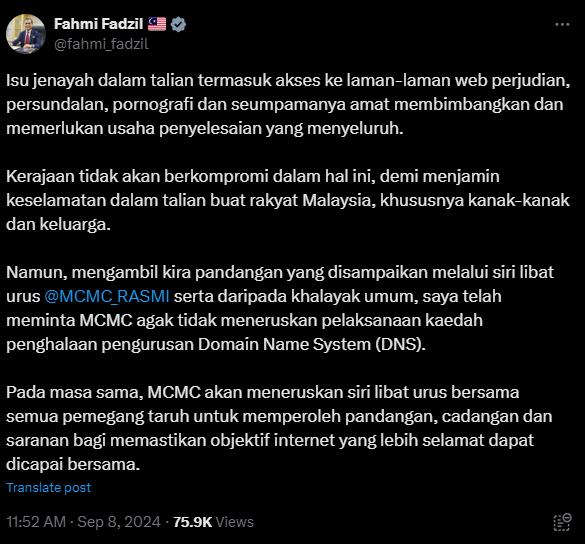
On 8 September 2024, Fahmi Fadzil took to Twitter to announce that the government would not be proceeding with the DNS rerouting plan. In his tweet, he acknowledged the concerns raised by the public and stakeholders, and stated that after careful consideration, the decision had been made to halt the implementation of the DNS rerouting system.
“Online criminal activities, including access to gambling websites, prostitution, pornography, and similar concerns, are deeply worrying and require a comprehensive solution. The government will not compromise on this matter to ensure online safety for Malaysians, especially children and families. However, taking into account the feedback gathered through engagement sessions and public opinion, I have asked MCMC not to proceed with the DNS rerouting plan,” Fahmi Fadzil tweeted.
At the same time, the minister emphasized that the MCMC would continue to engage with all stakeholders to find alternative ways to ensure a safer internet for Malaysians without infringing on their freedoms. While the DNS rerouting plan had been shelved, the government’s commitment to combating cybercrime and ensuring online safety remained a top priority.
Conclusion
The Malaysian government’s plan to block private DNS services and reroute traffic through Unifi DNS sparked a major public outcry. While the initiative was intended to improve internet security and protect users from online threats, the method chosen raised significant concerns over privacy, internet freedom, and government control. After considering the feedback from various stakeholders, the government has decided not to proceed with the DNS rerouting plan. However, the conversation about balancing internet safety and freedom is far from over, and further discussions are expected as Malaysia navigates the complex world of online regulation.
Beru is a content creator under the Newswav Creator programme, where you get to express yourself, be a citizen journalist, and at the same time monetize your content & reach millions of users on Newswav. Log in to creator.newswav.com and become a Newswav Creator now!
The User Content (as defined on Newswav Terms of Use) above including the views expressed and media (pictures, videos, citations etc) were submitted & posted by the author. Newswav is solely an aggregation platform that hosts the User Content. If you have any questions about the content, copyright or other issues of the work, please contact Newswav.
