
GRID-CONNECTED SOLAR PV • BESS • ADVANCED INVERTER CONTROL
CHALLENGES OF GRID-CONNECTED PHOTOVOLTAIC GENERATION SYSTEMS WITH INCREASING DATA-CENTRE POWER DEMAND — MALAYSIA PERSPECTIVE
A rapidly changing electricity landscape
Malaysia is entering a new phase of electricity demand. Data centres are no longer a niche digital infrastructure segment. They are becoming major electricity consumers as Malaysia accelerates its renewable-energy (RE) transition. Government projections indicate that data-centre electricity consumption in Peninsular Malaysia could rise from 10,544 GWh, or 7% of total electricity demand in 2026, to 73,274 GWh, or 31%, by 2035. Over the same period, peak demand is projected to increase from 21.3 GW to 33.5 GW. The Malaysia Renewable Energy Roadmap (MyRER) links PV expansion with storage, demand response, forecasting, grid enhancement and greater system flexibility. This raises a critical question: how can Malaysia expand reliable electricity supply for data centres while increasing solar photovoltaic (PV) generation?
The answer is unlikely to be PV alone. It will require a coordinated combination of REs, grid reinforcement, energy efficiency, battery energy storage systems (BESS), advanced power-electronic converters and intelligent energy management.
The scale of the challenge
The scale of the challenge is already visible. In 2026, Tenaga Nasional Berhad (TNB) was supplying 36 operating data centres with planned supply capacity of about 4.5 GW, while 23 data-centre projects under construction represented another 3.8 GW of maximum demand. These figures demonstrate that data centres are becoming large, concentrated loads that must be planned together with generation and network capacity.
Malaysia at an energy crossroads
At the same time, Malaysia is also committed to expanding renewable energy (RE). The National Energy Transition Roadmap targets a 70% renewable-energy capacity mix by 2050, while MyRER established earlier milestones of 31% by 2025 and 40% by 2035. The Large Scale Solar (LSS) programme continues to expand utility-scale PV through competitive procurement administered by the Energy Commission. The Corporate Renewable Energy Supply Scheme (CRESS) enables direct renewable purchases, while LSS5 and LSS5+ target 4 GW of additional capacity in Peninsular Malaysia.
This creates a strategic tension. Data centres need electricity continuously, while solar PV generation is inherently variable. PV output falls rapidly during cloud events and becomes unavailable at night. Consequently, a high-PV system serving a 24/7 data centre must manage the mismatch between renewable energy generation and demand.
“The answer is unlikely to be PV alone. It will require coordinated combination of REs, grid reinforcement, energy efficiency, BESS, advanced converters and intelligent energy management.” — Strategic research premise
From intermittent PV to firm digital power
For a data centre, annual renewable-energy production is not enough. Electricity must be available continuously and at the required quality. Solar PV can reduce daytime grid demand, while the utility grid and BESS maintain supply when solar output falls or the data-centre load rises unexpectedly.
When PV output exceeds data-centre demand, surplus energy can charge the BESS or be exported subject to network constraints. When PV output falls below demand, the BESS can discharge to reduce grid dependence. This makes storage a key enabling technology rather than simply an optional addition. Grid flexibility also depends on forecasting, operating reserves, interconnection standards, advanced inverter controls and responsive market arrangements.
Malaysia's regulatory direction already supports this layered approach. The Energy Commission lists LSS and BESS projects under its generation-sourcing framework. This is an important signal that future renewable energy (RE) integration will increasingly depend on flexibility and storage.
A CONTROLLED PATH TO RELIABLE DIGITAL POWER
PV + BESS + GRID
Grid stability and power quality cannot be overlooked
A second challenge is electrical rather than purely energetic. Modern data centres are dominated by power-electronic equipment, including UPS systems, rectifiers, cooling drives and server power supplies. Grid-connected PV and BESS also rely on power converters. Consequently, the future network may contain large concentrations of converter-based generation and converter-based demand.
This creates potential concerns involving voltage regulation, harmonic distortion, reactive-power management, rapid power fluctuations and interactions between PV inverters, BESS converters and data-centre UPS systems. The problem becomes more important when large data centres are concentrated geographically, as is already occurring in regions such as Johor, Malaysia.
For grid-connected PV plants, compliance with network-connection requirements and site-specific utility studies is essential. The Energy Commission administers the Large Scale Solar programme through open competitive bidding. Future research should go beyond steady-state compliance and investigate dynamic interactions among PV, BESS, the grid and data-centre loads under realistic operating conditions.
Energy efficiency is the first layer of defence
RE generation should not be considered a substitute for energy efficiency. Malaysia’s National Energy Efficiency Policy and Action Plan 2026–2035 (NEEAP 2.0) places energy efficiency at the centre of the current energy transition. Implemented alongside the Energy Efficiency and Conservation Act (EECA) 2024, the plan targets an 11.6% reduction in national energy demand and cumulative savings of 815,382 TJ by 2035 against business-as-usual projections.
The EECA 2024, effective from 1 January 2025, provides the regulatory foundation for large energy consumers. Qualifying consumers must appoint Registered Energy Managers, implement an Energy Management System, submit energy-efficiency reports and conduct periodic energy audits.
Together, NEEAP 2.0 and EECA make energy efficiency a practical and measurable part of energy planning. Using less electricity reduces the need for additional generation, grid upgrades and battery storage for each new data-centre campus.
For data centres, this policy direction supports lower power usage effectiveness through efficient cooling and airflow management, high-efficiency UPS systems, improved server utilisation, automation and continuous energy monitoring.
Reducing the base load makes every megawatt of PV and BESS more effective.
A research framework for Malaysia
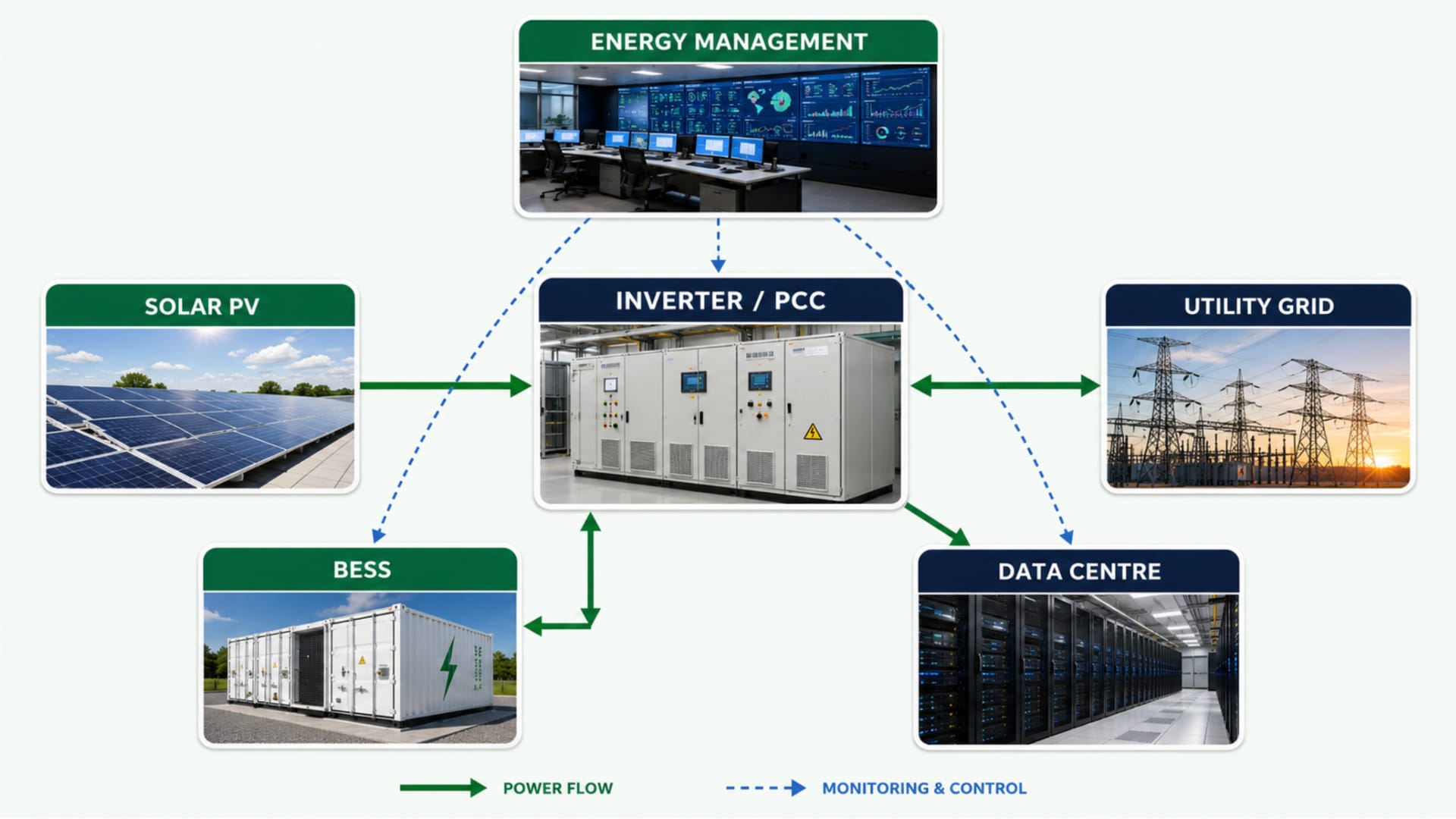
A promising research direction is to develop an adaptive grid-connected PV-BESS architecture for high-density data-centre loads. The framework should combine PV generation, a DC/DC MPPT stage, a bidirectional BESS converter, a grid-connected or grid-forming inverter, the utility grid, data-centre loads and an energy management system (EMS). Figure 1 shows a conceptual PV–BESS–data-centre architecture. Johor’s data-centre planning guidelines state that electrical substations should be available at 33 kV for small data centres and 132–275 kV for large-scale facilities. The final PCC and substation arrangement must therefore be verified against project capacity, site conditions and TNB connection requirements.
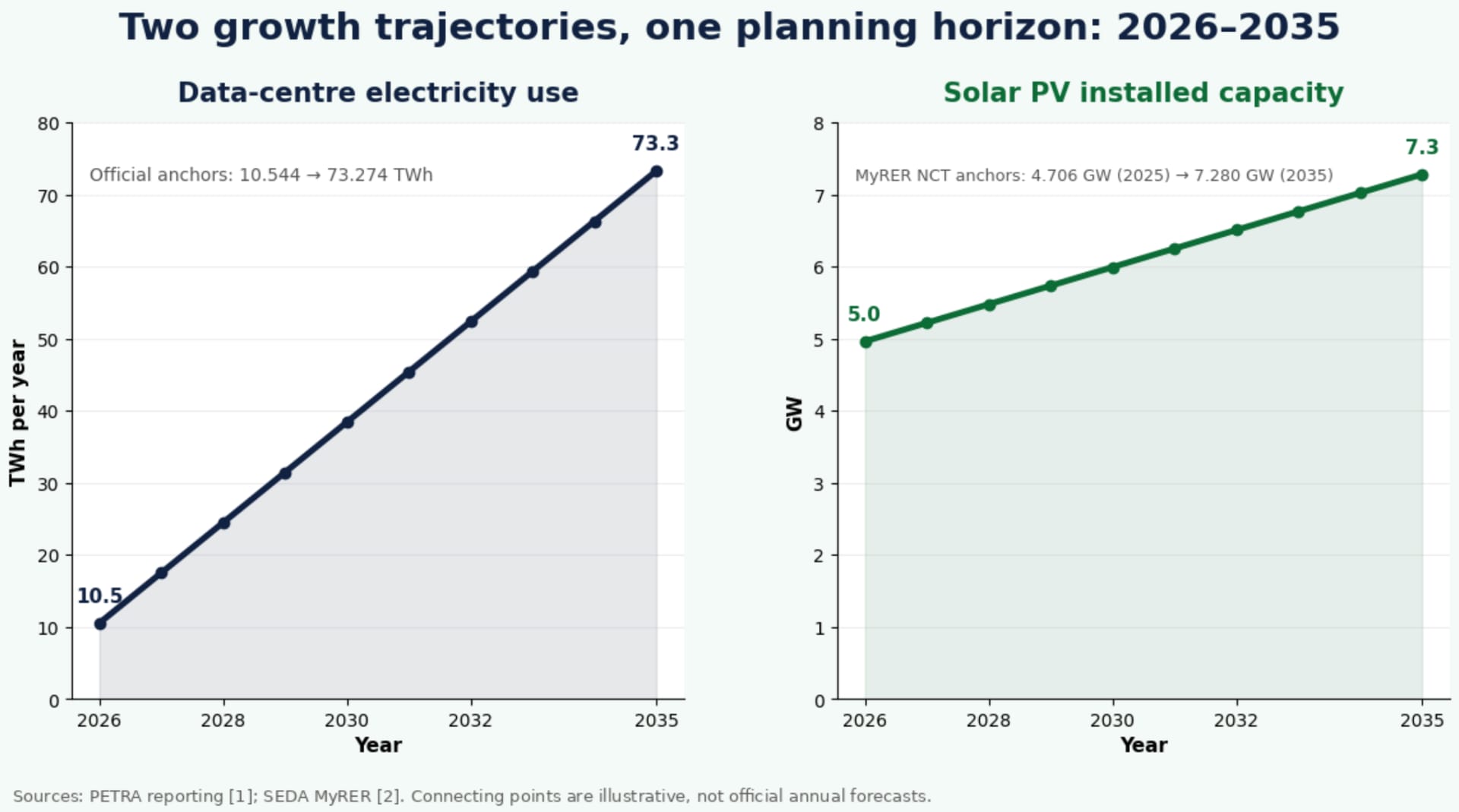
Figure 2 compares how quickly data-centre electricity use and planned solar PV capacity are expected to grow. Data-centre use rises from 10.544 TWh in 2026 to 73.274 TWh in 2035, while the MyRER solar pathway rises from 4.706 GW in 2025 to 7.280 GW in 2035 [2]. Because the graphs use different units (TWh vs GW), their values cannot be compared directly. The key message is that data-centre demand grows much faster than planned solar capacity, increasing the need for energy efficiency, storage and grid flexibility. Intermediate yearly points are illustrative estimates rather than official forecasts.
The research should evaluate different data-centre load profiles, solar intermittency, BESS state-of-charge constraints and grid disturbances. Key performance indicators should include voltage deviation, frequency response, power-quality indices, renewable-energy utilisation, peak-demand reduction, battery cycling and grid import.
An adaptive control layer could dynamically determine whether the BESS should prioritise PV smoothing, peak shaving, voltage support, frequency support or backup readiness. Such a multi-objective approach is more relevant to data centres than a conventional PV maximum-power-point-tracking study.
The framework should also investigate grid-forming inverter control. As RE penetration in terms of PV increases, advanced inverter functions can strengthen voltage and frequency support and improve resilience during weak-grid conditions or disturbances. This aligns with Malaysia’s need for greater system flexibility as variable renewable-energy capacity expands.
FROM RESEARCH FRAMEWORK TO NATIONAL OPPORTUNITY
RELIABLE • EFFICIENT
RESILIENT • SUSTAINABLE
Research priorities
The framework brings together PV forecasting, BESS sizing, adaptive control, power-quality monitoring, peak shaving and resilience. Performance should be assessed under realistic Malaysian solar variability, data-centre load dynamics, grid disturbances and state-of-charge constraints.
Priority outcomes: lower grid peak demand, higher renewable utilisation, reduced voltage deviation, lower power-quality risk and improved operational resilience.
Turning the challenge into an opportunity
Malaysia’s data-centre expansion should not be viewed only as a threat to the national electricity system. It can become a catalyst for a smarter, more flexible and cleaner grid.
The opportunity is to move from the conventional model of “generate electricity and consume it” towards an integrated energy-management model in which renewable PV, BESS, efficient data-centre systems and advanced inverters actively cooperate with the grid. The energy-management layer can forecast solar PV output and demand, schedule flexible processes, preserve battery reserves and exchange active and reactive power with the grid. This coordination converts separate assets into a dependable operating portfolio.
The research challenge is therefore not simply how to install more PV panels. It is how to make solar power reliable enough, controllable enough and grid-supportive enough to serve one of Malaysia’s fastest-growing electricity-demand sectors. PV supplies low-carbon daytime energy; BESS delivers fast balancing and time shifting; demand response avoids peaks; and network reinforcement, advanced inverters and system operations maintain security during disturbances and prolonged low-solar periods.
With appropriate standards, market signals and transparent connection studies, this combination can support Malaysia's digital growth while improving renewable energy utilisation, reducing peak grid stress and retaining reliable service for all consumers. The competitive advantage will not come from the largest data-centre cluster alone, but from the most efficient, flexible and resilient electricity ecosystem.
THE ENGINEERING QUESTION IS NOT SIMPLY HOW TO INSTALL MORE SOLAR PV — IT IS HOW TO MAKE SOLAR POWER RELIABLE, CONTROLLABLE AND GRID-SUPPORTIVE FOR MALAYSIA’S FASTEST-GROWING LOAD SECTOR.
This article is a collaboration between SEDA Malaysia and Universiti Sains Malaysia
By:
MUHAMMAD HAFEEZ BIN MOHAMED HARIRI (IR.DR.)
SCHOOL OF ELECTRICAL & ELECTRONIC ENGINEERING
TUANKU SYED SIRAJUDDIN ENGINEERING CAMPUS
UNIVERSITI SAINS MALAYSIA