
Security today is no longer just about conventional threats. It now extends into cyberspace, the economy, information flows, and social stability. In this environment, relying solely on full-time armed forces is no longer enough.
This is where the concept of Total Defence (HANRUH) becomes important. It is not just a policy on paper. It is a national approach that requires broader participation from society, including professionals and the wider public.
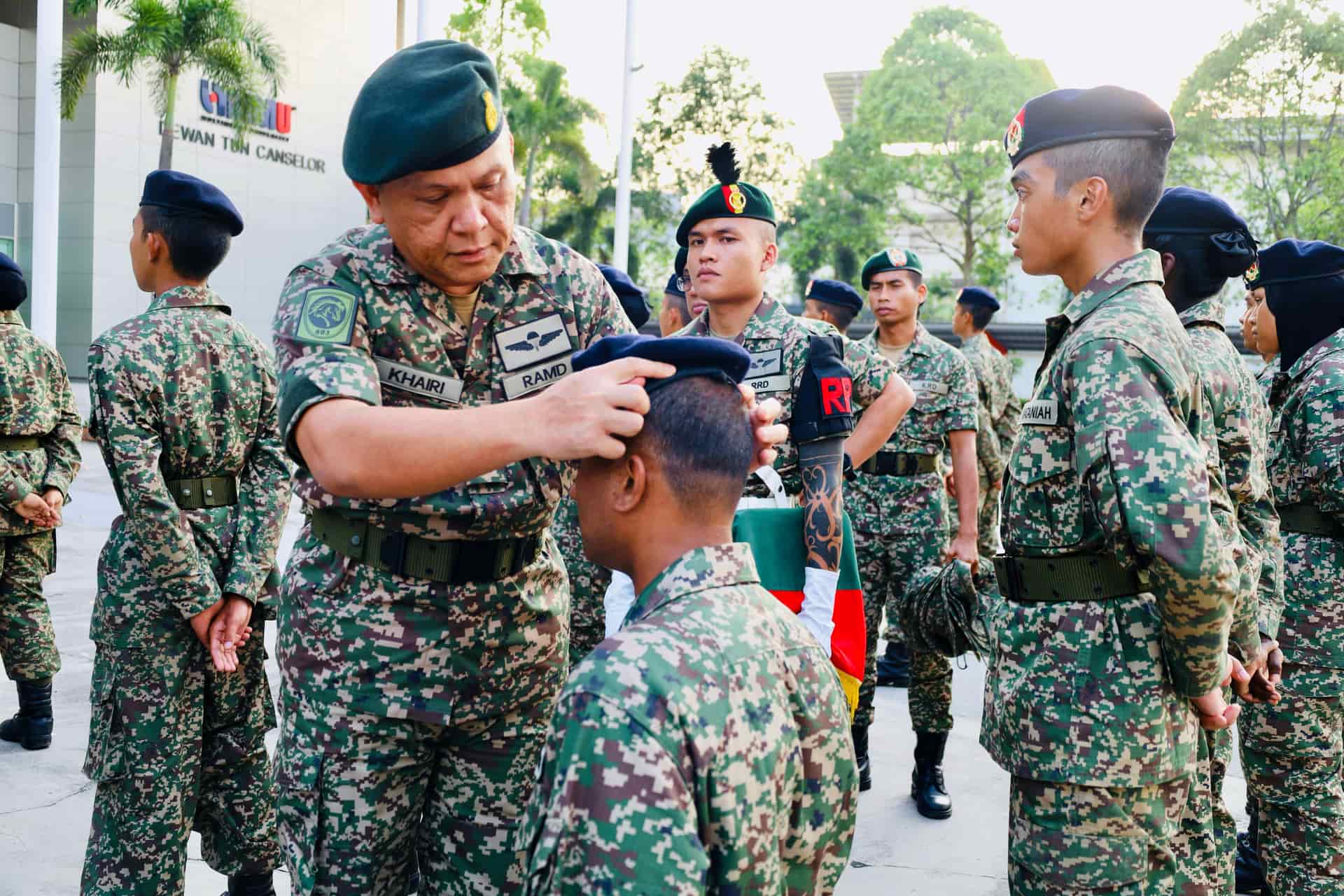
Recent developments suggest that the role of the Territorial Army is evolving. It is no longer seen as merely a supporting force, but as a key component of the country’s defence structure. The target of achieving a one-to-one ratio between reserve and regular personnel by 2033 signals a clear shift in how Malaysia is thinking about defence.
This reflects ongoing efforts by the Malaysian Armed Forces to strengthen national preparedness in a more comprehensive way.
As highlighted by Defence Minister Mohamed Khaled Nordin, the involvement of professionals acts as a force multiplier.
This is not just about increasing numbers. It is about expanding capability. When professionals from different fields are integrated into the system, expertise from the civilian sector can be absorbed into national defence. This strengthens readiness in ways that traditional structures alone cannot achieve.
But this effort requires wider support.
In reality, commitment to the reserve force is still not a social norm.
For some, it is seen as optional.
For some employers, it is seen as a disruption.
This does not reflect a weakness in the institution. It shows that the idea of shared responsibility in defence is not yet fully understood.
As long as this perception remains, targets will remain numbers on paper rather than real capability.
The Malaysian Armed Forces’ move to establish specialist regiments in areas such as healthcare, geospatial intelligence, and communications reflects the changing nature of modern defence. Today’s conflicts are not defined only by weapons, but by information, coordination, and operational efficiency.
This shows that the military is adapting to modern realities.
But these capabilities cannot be built on an ad hoc basis.
They require consistent training and sustained commitment from everyone involved.
The reserve force also plays a role beyond defence. It creates a space for national integration.
At a time when issues of race and religion can be easily politicised, environments that require cooperation across backgrounds are increasingly important. Military training is one such space. It demands teamwork, trust, and shared responsibility.
The understanding that comes from this is not theoretical.
It is lived experience.
At the same time, the idea of a “citizen soldier” has broader implications for society.
Those who go through this system often return with a more structured way of thinking, a greater awareness of risk, and a clearer sense of responsibility. These values extend beyond the military and influence workplaces and communities.
Countries like Finland and Switzerland have long practised this model. Their citizens are not only aware of their role in national defence, but are trained and maintained within the system.
Malaysia is moving in that direction, but the approach is still being strengthened.
As long as the country appears stable, readiness is rarely seen as urgent.
But defence is not built during a crisis.
It is built before one.
The question is no longer whether this concept is relevant, but how effectively it is being implemented. Without proper coordination, numerical targets alone do not guarantee real capability. What matters more is how expertise and roles are integrated into a system that actually works.
HANRUH will not succeed if it is seen as the responsibility of the military alone. It requires wider participation, including readiness from society and support from employers.
In the end, everything comes down to one thing.
Execution.
If participation remains low and commitment is not supported, the potential being built will not be fully realised. Without a system that is active and sustained, the concept will remain an idea.
The real question is whether we are prepared to make it real.
Ultimately, the strength of a nation is not measured only by its military assets, but by how prepared its people are.
If this approach is implemented properly, the Territorial Army will not just remain a reserve force. It will become a core pillar of national strength in facing an uncertain future.
When discipline becomes culture and unity becomes practice, a country gains more than a strong defence force.
It builds a resilient society.
And in an increasingly uncertain world, that is the strongest defence of all.
By Dr Mahathir Mohd Rais
Dr. Mahathir (mahathirmohdrais@gmail.com) is a content creator under the Newswav Creator programme, where you get to express yourself, be a citizen journalist, and at the same time monetize your content & reach millions of users on Newswav. Log in to creator.newswav.com and become a Newswav Creator now!
The User Content (as defined on Newswav Terms of Use) above including the views expressed and media (pictures, videos, citations etc) were submitted & posted by the author. Newswav is solely an aggregation platform that hosts the User Content. If you have any questions about the content, copyright or other issues of the work, please contact creator@newswav.com.


