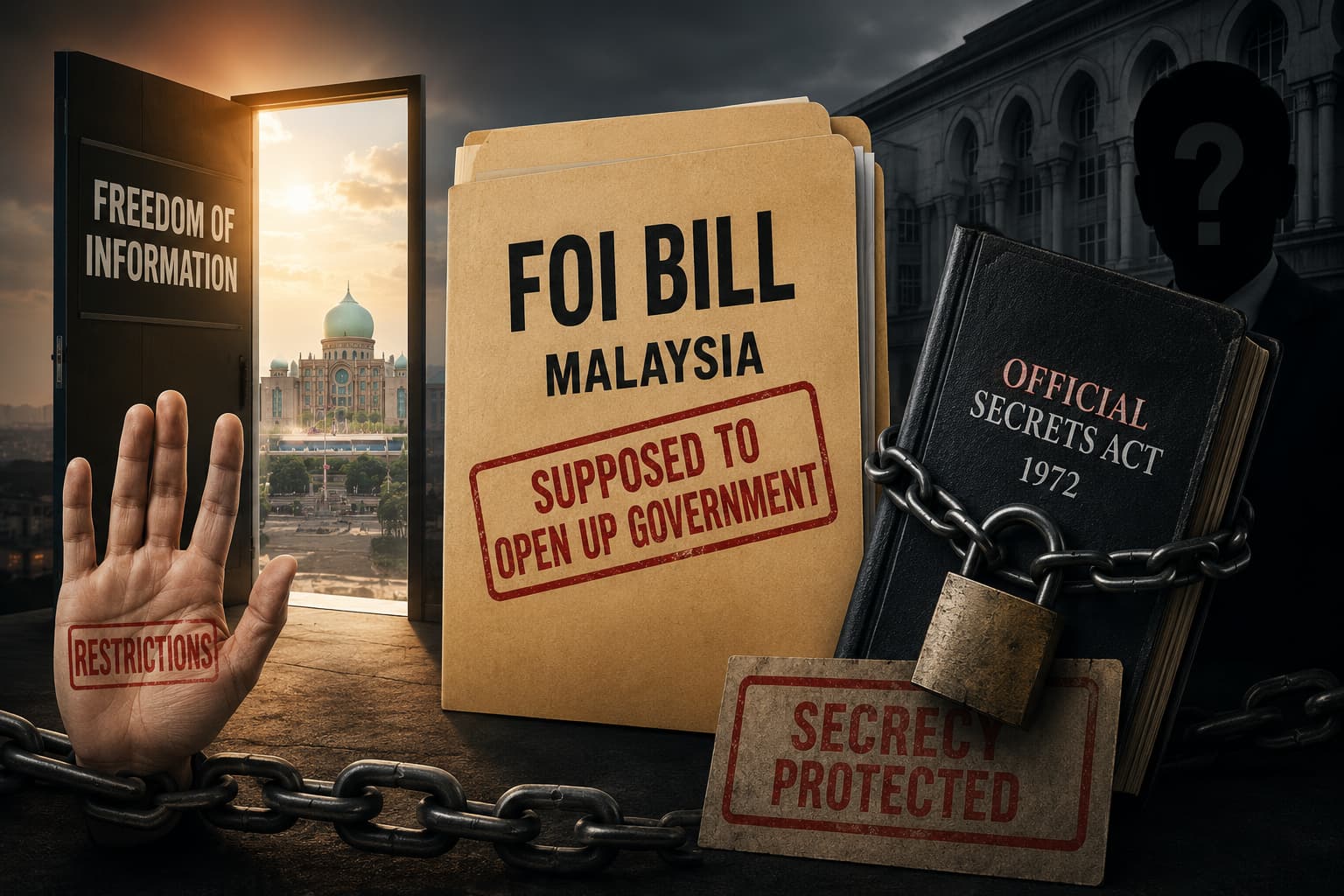
For years, Malaysians have been told a Freedom of Information law is coming, one that will finally let ordinary people ask the government hard questions and get real answers. On 13 July, that bill was tabled in the Dewan Rakyat for its first reading. Within days, more than a dozen civil society groups, including the Centre for Independent Journalism, Article 19 and the Centre to Combat Corruption and Cronyism, urged the government to withdraw and review the bill entirely.
Their complaint is not that the bill does too little. It is that the bill actively protects the culture of secrecy it was meant to dismantle. The groups point out that the Official Secrets Act 1972 stays fully intact under this bill, along with every other law that already restricts access to information. Instead of starting from the position that government information belongs to the public unless there is a good reason to withhold it, the bill keeps the current default: information stays closed unless you can convince an official otherwise.
There is a provision that has raised even more eyebrows. If you request information and then use it for a purpose other than what you originally stated, you could face criminal liability. Journalists chasing a story that develops in an unexpected direction, researchers whose findings lead them somewhere new, or ordinary citizens who stumble onto something bigger than they expected, all of them could be exposed. Clause 22 goes further still, stating outright that nothing in the act can be read as protecting a fundamental liberty under the constitution.
Law minister Azalina Othman Said responded to the backlash by agreeing to send the bill to a Parliamentary Special Select Committee for closer scrutiny, a move civil society groups have cautiously welcomed while insisting the review process needs to be genuinely open, bipartisan and not just a formality before the bill returns largely unchanged.
The irony is hard to miss. A law meant to prove Malaysia is serious about transparency risks becoming a case study in how governments can dress up secrecy as reform. Selangor and Penang have both run their own state-level FOI enactments for over a decade, so it is not as though nobody in this country knows what a workable version looks like.
My Opinion
If this bill passes as currently drafted, it will hand the government a shiny new law to point to while changing almost nothing about how hard it already is to get a straight answer out of a government agency. That is worse than having no FOI law at all, because at least right now nobody is pretending otherwise.
Ronny M (ronny76netstuff@gmail.com) is a content creator under the Newswav Creator programme, where you get to express yourself, be a citizen journalist, and at the same time monetize your content & reach millions of users on Newswav. Log in to creator.newswav.com and become a Newswav Creator now!
The User Content (as defined on Newswav Terms of Use) above including the views expressed and media (pictures, videos, citations etc) were submitted & posted by the author. Newswav is solely an aggregation platform that hosts the User Content. If you have any questions about the content, copyright or other issues of the work, please contact creator@newswav.com.