
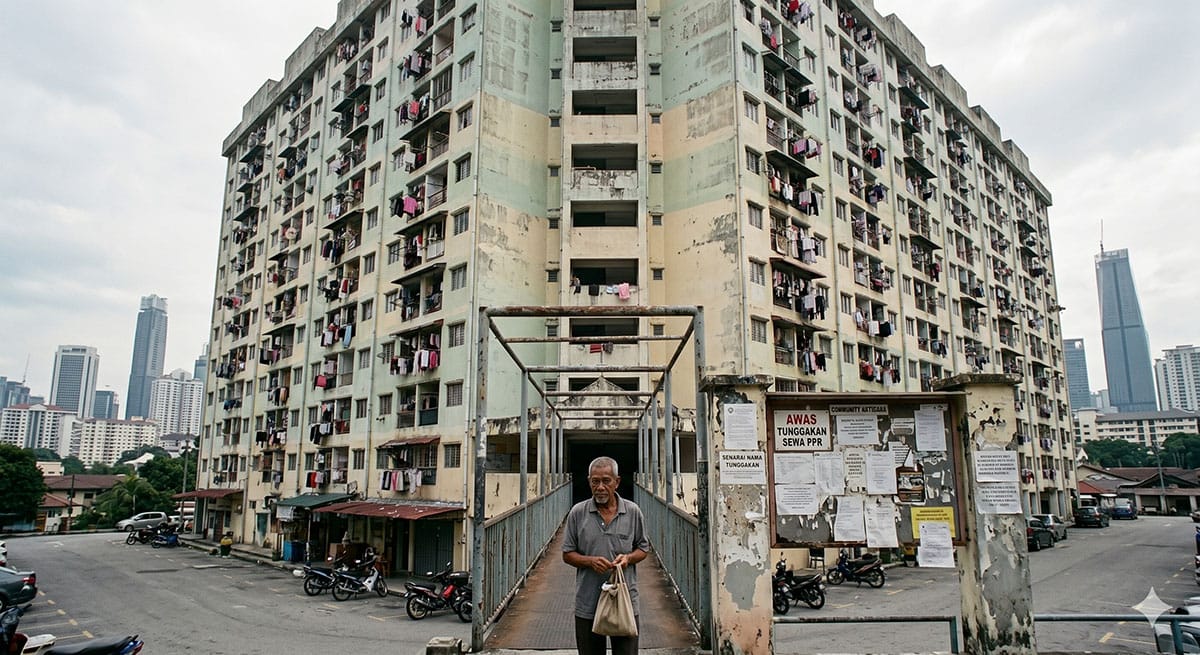
DBKL spends RM300 to maintain each flat. It collects RM124 in rent. The maths only works one way.
Here is a question worth sitting with for a moment.
If you pay RM124 a month to live somewhere, how much maintenance can you reasonably expect in return?
That is the monthly rental rate for a DBKL People's Housing Project flat. RM124. Less than most Malaysians spend on their weekly grocery run. A figure that has not been meaningfully revised in decades. And according to a new report, it is at the very heart of why Malaysia's public housing system is quietly heading toward collapse.
A report by Think City titled "From Roof to Resilience", highlighted by Malay Mail, found that stagnant rental rates and mounting rental arrears have rendered public housing in Malaysia financially unsustainable. The math, once you look at it clearly, is not complicated. It is just uncomfortable.
The Numbers That Tell the Story
DBKL charges RM124 per month for a PPR or Public Housing (PA) flat unit. The actual cost of managing and maintaining each unit, covering cleaning, utility bills, lift maintenance, and public facilities, is estimated at RM300 per month. Every single month, DBKL loses RM176 per unit just by keeping the lights on and the lifts running. Across tens of thousands of units, that gap compounds into a structural financial problem that no amount of goodwill can paper over.
And that is before you factor in the arrears.
As of mid-2025, DBKL was facing RM70 million in outstanding rental arrears from PPR and PA tenants. Seventy million ringgit in unpaid rent from people already paying among the lowest rental rates in the country. Some of those arrears stretch back years. Some tenants have not paid in six months, a year, or longer.
DBKL Mayor Datuk Seri Maimunah Mohd Sharif put it plainly: "Rental collection is our primary source of income for financing management and maintenance. When tenants do not pay, the burden does not fall on DBKL alone. It is the entire community that suffers through delayed maintenance, malfunctioning lifts and an overall decline in their living environment."
She is right. And she is describing something that every resident of a PPR block who faithfully pays their RM124 every month already knows from lived experience. The lifts break down. The hallways are poorly lit. The rubbish collection falls behind. And somehow it always seems to be the paying residents who suffer most from the non-payment of others.
How Did We Get Here?
Malaysia's public housing model was built on a philosophy of welfare provision. The government, through DBKL and other authorities, would build and manage affordable housing for the urban poor, charging rents low enough that even the most economically vulnerable could afford them. The social intention was noble and the political logic was clear.
But the financial model was never fully thought through. Or if it was, the thinking was always that the government would absorb the shortfall indefinitely.
The Edge Malaysia reported as far back as 2024 that DBKL had failed to collect an estimated RM600 million in arrears accumulated over decades, and that the rental rate was insufficient to cover maintenance costs. The then-city hall management acknowledged the problem openly. Nothing materially changed.
Successive governments have maintained the low rental rates for political reasons. Raising rents on the urban poor is politically costly in a way that allowing the physical condition of public housing to gradually deteriorate is not. The deterioration happens slowly, spread across thousands of units, invisible in press conferences. A rent increase is immediate and measurable and generates complaints.
The result is a system where the average PPR flat now costs more to maintain per month than it earns in rental revenue, the building fabric is ageing without adequate funding for repairs, and hundreds of millions of ringgit in arrears sit uncollected because enforcement is difficult against people who genuinely cannot pay.
The Question Nobody Wants to Answer
This brings us to the question at the heart of the whole debate. Who is actually responsible for the condition of public housing?
Is it DBKL's responsibility to maintain every unit to a standard proportionate to the rent charged? Is it the resident's responsibility to maintain their own unit even if they are paying almost nothing? Or is the problem that the rent is so low it creates a psychological disconnect between what people pay and what they feel entitled to expect?
These are not rhetorical questions. They are the questions that Malaysia's public housing policy needs to answer honestly before any meaningful reform can happen.
Most residents of PPR and PA flats are from B40 households. Young people who came to the city looking for work and found that even the cheapest private rental was beyond their reach. Families who have been on the waiting list for years and feel fortunate to have a roof at all. Single mothers, elderly residents on fixed incomes, new workers in their first jobs. These are not people gaming the system. They are people the system was designed to serve.
But a system that collects RM124 per unit and spends RM300 per unit to maintain it, while sitting on RM70 million in uncollected arrears, is not serving anyone well. Not the residents who deserve better maintained homes. Not the taxpayers who ultimately fund the gap. And not the long-term viability of affordable housing as a concept in Malaysian cities.
What Actually Needs to Change
The Think City report's title, "From Roof to Resilience," implies a transformation rather than a patch. And that is exactly what is needed.
Rental rates in public housing need to be reviewed and gradually adjusted to reflect at least a portion of the actual maintenance cost. Not in a single jump that shocks residents, but in a carefully phased increase accompanied by genuine improvements in maintenance standards. If rents go up even modestly and the lifts start working consistently, the bins get emptied on time, and the hallways are properly lit, most residents would accept the trade-off.
Arrears collection needs to be paired with support systems rather than just enforcement. Cutting water to chronic defaulters, as DBKL has been doing, punishes an entire household including children for an adult's non-payment. Structured repayment plans, employment assistance programmes, and social work interventions targeted at the most financially distressed households would be more effective and more humane than utility disconnections.
And the design of public housing itself needs rethinking. DBKL's own management has acknowledged that 500 square foot flats designed for smaller households decades ago are no longer adequate for the families now living in them. New public housing developments, including Residensi Madani, are moving toward larger units and better community infrastructure. But the existing stock of PPR and PA blocks, housing hundreds of thousands of Malaysians right now, cannot simply be replaced overnight. They need to be maintained and improved with the funding that adequate rental rates would generate.
My Take
I have not lived in a PPR flat. I cannot speak from personal experience about what it is like to wait for a lift that keeps breaking down, or to watch the corridor outside your front door deteriorate year by year.
But I can understand the financial logic clearly enough. If everyone pays RM124 for something that costs RM300 to maintain, and a significant portion of those people do not pay even the RM124, the maths only works one way. The building gets worse. The services get worse. The community suffers.
Public housing is not charity. It is a service. And for it to work, both sides of the relationship need to hold up their end. The government needs to fund it adequately, maintain it properly, and charge enough to make that sustainable. The residents need to pay what they owe, take care of their units, and hold the management accountable when standards slip.
What Malaysia has instead is a system where neither side is fully meeting its obligations, and the people caught in the middle are the honest, paying residents trying to live decently in buildings that the funding model was never designed to sustain.
That is not a welfare system. That is a slow decline pretending to be one.
Kamarul Azwan (k.azwan@gmail.com) is a content creator under the Newswav Creator programme, where you get to express yourself, be a citizen journalist, and at the same time monetize your content & reach millions of users on Newswav. Log in to creator.newswav.com and become a Newswav Creator now!
The User Content (as defined on Newswav Terms of Use) above including the views expressed and media (pictures, videos, citations etc) were submitted & posted by the author. Newswav is solely an aggregation platform that hosts the User Content. If you have any questions about the content, copyright or other issues of the work, please contact creator@newswav.com.