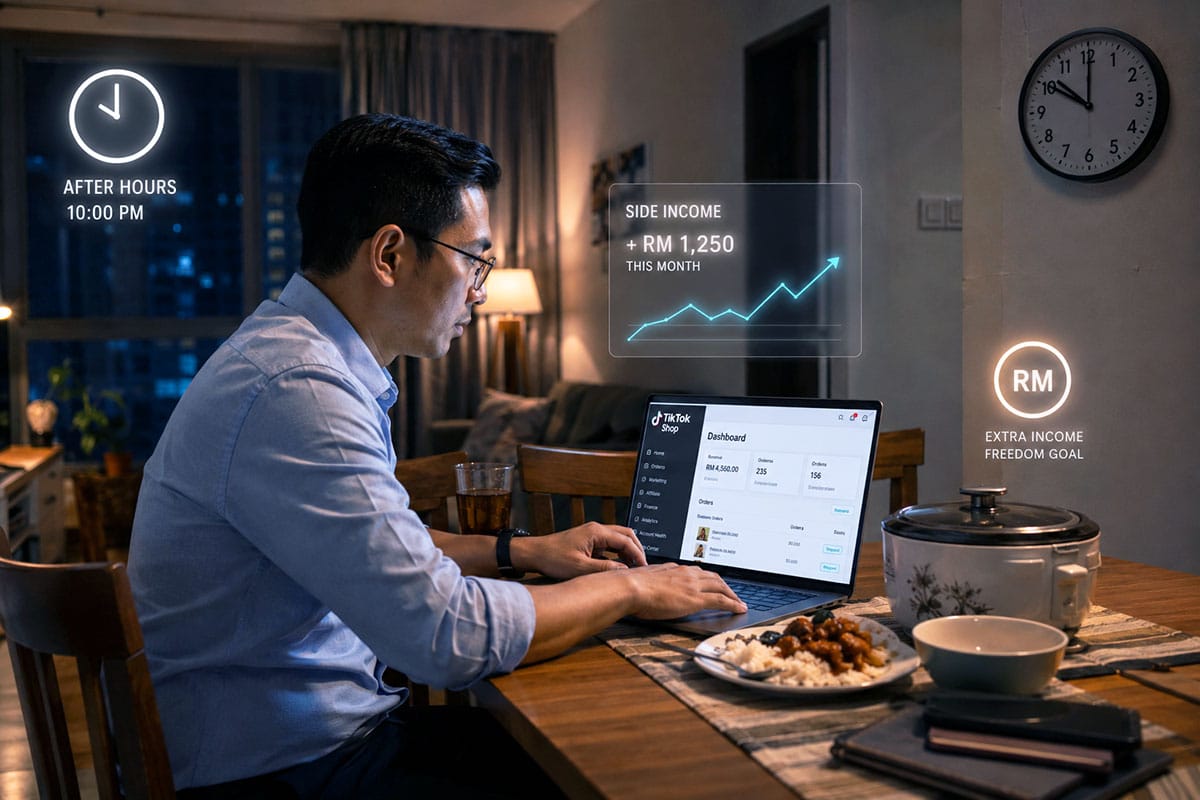
I did it too, mostly just to breathe easier.
For years while I was still fully employed, I ran a blog on the side and picked up freelance writing and marketing work in the evenings. It was never meant to become a career. It was there to help pay off a loan faster and give my family a bit more room to breathe when the salary alone felt tight. That is the honest version of most side hustles in Malaysia right now, not a grand entrepreneurial dream, just quiet, practical math.
This Isn't Hustle Culture, It's Wage Math
The framing you see online, "hustle culture," "passion projects," "building your empire on the side," makes it sound aspirational. For most Malaysians doing it, the truth is plainer. Randstad Malaysia's 2026 Workmonitor report found that 52% of Malaysian talent have already taken on, or are actively planning to seek, a second job just to cope with rising costs. Among people still in full-time roles, 36% said they would rather keep their job and layer a side hustle on top of it, not quit for it.
That distinction matters. This is not a wave of Malaysians dreaming of becoming their own boss. It is a wave of Malaysians whose main paycheck simply does not stretch far enough anymore, quietly patching the gap with a second and sometimes third income stream.
The wage side of the story backs this up. According to gig economy data drawn from the Department of Statistics, informal and gig income in Malaysia sits at a median of around RM2,000 a month, well below the national median wage of RM3,600. When your day job's pay has not kept pace with rent, groceries and petrol, a side hustle stops being optional and starts feeling necessary.
What Malaysians Are Actually Doing After Hours
Drive for Grab or Foodpanda after the office closes. Sell on TikTok Shop or run a small Shopee store. Tutor a few students on weekends. Take on freelance design, writing or social media work for clients who are not your employer. Bake and deliver on weekends. Livestream and sell. None of this is new behaviour exactly, but the scale and normalcy of it is.
For me, it was blogging and freelance marketing work, done strictly after office hours, for clients completely unrelated to whichever company I worked for at the time. Some employers never knew about it. My most recent one did, and there was no tension about it at all, because the work never touched their business, their clients or their time. That distinction, whether your side hustle overlaps with your employer's interests, ends up mattering a lot more than most people realise until it becomes a problem.
The Contract Clause Nobody Reads
Moonlighting is not illegal in Malaysia. There is no law that says you cannot have a second income. But your employment contract might say otherwise, and most people sign it during onboarding without reading the fine print closely.
A detailed breakdown of the legal position lays out what actually gets employees into trouble. It is rarely the side hustle itself. It is conflict of interest, using company time or resources, working for a direct competitor, or letting your day job's performance slip because your attention is split. A finance executive running a weekend coffee stall is low risk. The same executive quietly consulting for a rival firm is a very different situation. Civil servants have it even stricter, needing formal approval under Public Service Department rules before taking on outside work at all.
The safest side hustles share a pattern: they happen after hours, use none of the employer's equipment or client lists, and sit in a completely different lane from whatever your day job does. If your contract has an "outside employment" or non-compete clause, actually read it before you commit to anything.
The Tax Surprise Catching Side Hustlers Off Guard
Here is the part most people doing a side hustle in 2026 do not see coming. LHDN has been expanding a mechanism called CP500 to more taxpayers this year. Your monthly salary is already taxed through PCB, deducted automatically by your employer. But income from freelance work, content creation, online selling or rental is separate, and CP500 is how LHDN collects advance tax on that side income, in instalments roughly every two months instead of one lump sum at filing time.
A lot of salaried employees who never registered as freelancers, and simply treated their side income as spending money, are now getting these notices and wondering why. The good news for 2026 is that first-time recipients will not be penalised for missing instalments this year while the system rolls out. The tax itself is still owed though, it just will not carry the usual late payment penalty for now. If a notice looks wrong, you can amend it using Form CP502, and if your side income has stopped altogether, the same form lets you correct that too.
The practical lesson here is simple: if you are earning consistently outside your day job, keep records, keep receipts, and assume LHDN will eventually notice, because they increasingly do.
Doing It Safely
Keep your side income genuinely separate from your employer's business. Check your contract for outside employment or conflict-of-interest clauses before you start, not after HR asks a question. Track your earnings and expenses from day one rather than scrambling later. If it grows into something consistent, consider whether it needs to be formally declared. And if you are relying on gig platforms specifically, look into EPF's i-Saraan voluntary contribution scheme and SOCSO's self-employed protection option, since a side income comes with none of the safety net a salaried job automatically gives you.
My Take
Most of the people I know doing this are not chasing a side business empire. They are covering a gap that their main income used to cover on its own. That is not a personal failing, and it is not really a hustle culture story either. It is a wage story wearing a side hustle costume.
I do not think that makes the side hustle itself a bad idea. It genuinely helped me get through a tighter financial period without touching savings I could not afford to lose. But I also do not think we should call it empowerment when what is actually happening is that a full-time salary in Malaysia increasingly is not enough on its own. Do the side hustle if you need the breathing room. Just go in with your eyes open about your contract, your time, and your taxes, because none of those three wait for you to catch up.
Kamarul Azwan (k.azwan@gmail.com) is a content creator under the Newswav Creator programme, where you get to express yourself, be a citizen journalist, and at the same time monetize your content & reach millions of users on Newswav. Log in to creator.newswav.com and become a Newswav Creator now!
The User Content (as defined on Newswav Terms of Use) above including the views expressed and media (pictures, videos, citations etc) were submitted & posted by the author. Newswav is solely an aggregation platform that hosts the User Content. If you have any questions about the content, copyright or other issues of the work, please contact creator@newswav.com.