
Nearly six in ten Malaysian workers who went through its health screenings are overweight or obese. Not a guess, not a vibe, an actual number from actual screenings. So let's not sugarcoat this one, pun very much intended.
The Numbers Perkeso Doesn't Want to Sugarcoat
Deputy human resources minister Khairul Firdaus Akbar Khan laid it out plainly while launching Perkeso's Run and Ride 2026 programme: 59.2 percent of workers screened between 2023 and 2025 were overweight or obese. About 19 percent had diabetes. 17.45 percent had high blood pressure. And 59.24 percent, almost the exact same figure as the overweight statistic, had high cholesterol.
The risk cluster sits mainly in the 40 to 59 age bracket, which is a delightful way of saying the years you're supposed to be at your career peak are also the years your body quietly starts filing complaints.
Malaysia's Not Just Chubby, We're Regional Champions
Here's the part that stings a bit more. This isn't a Perkeso-only problem, it's a national scoreboard, and Malaysia is winning in the worst possible category. The 2024 National Health and Morbidity Survey found that one in two Malaysians is overweight or obese, giving us the highest obesity and overweight rate in the entire Asean region. We didn't just join the club, we're the founding member with the loudest jersey. If there were a regional leaderboard for waistlines, we'd be printing the certificates ourselves.
This Isn't Just a Personal Problem, It's a Payroll Problem
Before anyone dismisses this as a personal lifestyle matter that's none of anyone else's business, here's a number that should get every employer's attention. The World Obesity Federation estimates the economic burden of overweight and obesity in Malaysia at roughly US$5.68 billion, about 1.6 percent of GDP. More than 86 percent of that cost isn't hospital bills. It's missed workdays, reduced performance while still clocked in, early retirement, and premature death.
In other words, your employee's health isn't just their business, it's quietly sitting on your company's balance sheet whether you acknowledge it or not. And if nothing changes, that burden is projected to climb toward 4 percent of GDP by 2060. That's not a distant hypothetical, that's well within the working life of everyone reading this.
My Desk Doesn't Know Me That Well
For what it's worth, I move around a lot during my workday, up for coffee, pacing while on calls, wandering the house for no good reason other than my brain works better in motion. I don't have any health issues to report, and I'm not saying that to gloat, just to be transparent about where I'm coming from before I go around being blunt about everyone else's cholesterol.
I'm squarely in that 40 to 59 risk bracket Perkeso is worried about, and so far my body hasn't filed a formal complaint. I'd like to keep it that way, which is honestly half the reason I still get up from this chair every twenty minutes.
The Colleagues I've Watched Turn It Around
What actually gives me some optimism here is what I've seen anecdotally among people in my own circle. I've noticed friends and acquaintances who were visibly carrying extra weight a while back, and after not seeing them for a few months, they'd clearly worked on it, lost weight, looked healthier, moved better. It tells me the awareness is genuinely out there. People aren't oblivious to this, plenty are actively doing something about it. The stats might be grim, but the culture around fixing it doesn't feel hopeless, it feels like something that's slowly, unevenly, catching on.
What Employers Can Actually Do About It
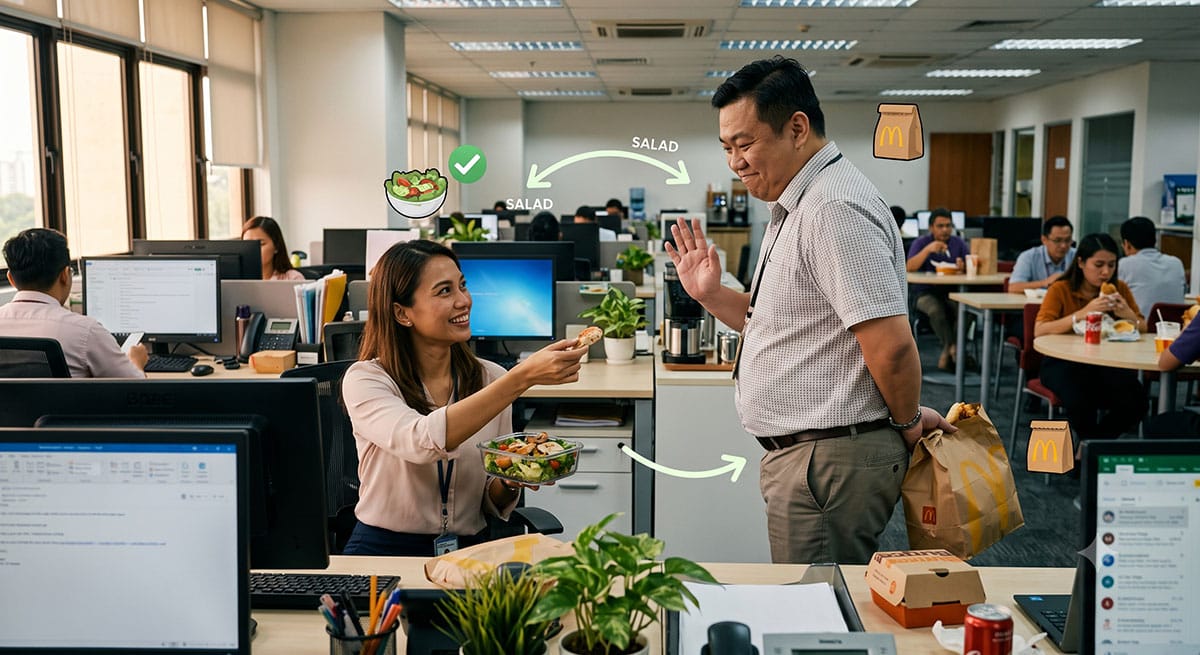
Since I just spent a paragraph putting this on employers' balance sheets, it's only fair to offer something more useful than a shrug. Subsidised or provided lunches with genuinely healthy, balanced meals is one real lever, not a free-for-all buffet, but food that's actually good for the people eating it every working day.
Pairing colleagues up as informal accountability partners, someone to eat lunch with, compare notes, gently call out the fourth teh tarik of the day, works better than any wellness poster in a break room ever has. None of this requires a huge budget or a corporate wellness consultant. It requires an employer who's decided their staff's health is worth thirty minutes of actual thought.
My Take
I'm not going to pretend this is a light topic dressed up in jokes for no reason, the humour here is doing real work. Malaysians respond better to a blunt, slightly cheeky wake-up call than a lecture, and frankly, we've had enough lectures about eating less rice that clearly haven't moved the needle.
Nearly 60 percent of workers being overweight or obese isn't a personal failing on 60 percent of individuals, it's a signal that our workplaces, our food environment, and our default habits have quietly built obesity into how we live. Fixing that starts with admitting the number is bad, laughing at ourselves a little for how bad, and then actually getting up from the desk. Starting with the one you're sitting at right now.
Kamarul Azwan (k.azwan@gmail.com) is a content creator under the Newswav Creator programme, where you get to express yourself, be a citizen journalist, and at the same time monetize your content & reach millions of users on Newswav. Log in to creator.newswav.com and become a Newswav Creator now!
The User Content (as defined on Newswav Terms of Use) above including the views expressed and media (pictures, videos, citations etc) were submitted & posted by the author. Newswav is solely an aggregation platform that hosts the User Content. If you have any questions about the content, copyright or other issues of the work, please contact creator@newswav.com.