
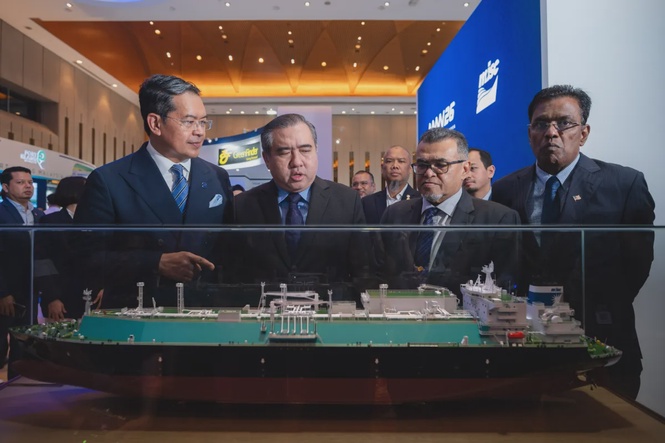
PETALING JAYA: Putrajaya is targeting 100 million twenty-foot equivalent units (TEU) in national port-handling capacity by 2035, through a new port on Carey Island and expansions at four existing ports.
Transport Minister Anthony Loke said the expansion is aimed at strengthening Malaysia’s position as a global maritime and logistics hub.
“Our ambition is to raise the nation’s port handling capacity to 100 million TEUs by 2035,” he said in his keynote address at the opening of Malaysia Maritime Week 2026 at the Kuala Lumpur Convention Centre today.
“We will pursue this through the development of a new port on Carey Island, the Westports 2 expansion at Port Klang, Phases 3 and 4 of the Port of Tanjung Pelepas development, and the Kuantan and Kemaman Port expansions.”
Loke said the positive growth of Malaysia’s port sector reflected the direction of government policy and the implementation of the Malaysia Maritime Transformation Plan 1.0.
“Under the plan, expanding port infrastructure and handling capacity are priorities to keep Malaysia competitive as a leading global maritime and logistics hub,” he added.
Loke said Port Klang retained its position as the world’s 10th busiest container port in the Lloyd’s List One Hundred Container Ports 2026 ranking, handling 15,138,772 TEU in 2025, up 3.4% from 14,644,527 TEU in 2024.
The Port of Johor ranked 11th, handling 15,110,050 TEU in 2025. Together, the two ports handled more than 30.2 million TEU last year.
The Port of Johor combines the reported container throughput of Port of Tanjung Pelepas (PTP) and Pasir Gudang Port after Lloyd’s List approved their consolidation under a single reporting entity in May, Loke said in June. The consolidation is for container throughput reporting for the Lloyd’s List rankings, rather than an operational merger of the two ports.
Loke said maritime transport accounted for approximately 98% of Malaysia’s international trade, while the shipping and maritime services sector contributed more than 6.5% of gross domestic product.
“Since Malaysia’s independence, maritime transport has contributed directly through the value it produced and indirectly by helping Malaysian trade and industry move,” he added.
“If we strengthen this sector, we strengthen Malaysia’s competitiveness, resilience and future prosperity.”
Loke said Malaysia recorded RM3.061 trillion in merchandise trade in 2025, the highest on record, with exports of RM1.607 trillion and imports of RM1.455 trillion, resulting in a trade surplus of RM151.8 billion.
“The importance of Malaysia’s maritime transport and its efficiency can be measured by its trade performance,” he added.
The Cabinet approved the development of Port Klang’s third terminal on Carey Island on March 11, with the Selangor government to lead the project through a special purpose vehicle with private companies, while the Transport Ministry acts as regulator.
In July, Loke said the terminal would take nearly 20 years to be fully completed.
Westports 2 involves eight new container terminals, CT10 to CT17, and is expected to raise Westports’ container handling capacity from about 14 million TEUs to about 28 million TEUs, according to the company.
Under the 2023 concession agreement, Phase 1, covering CT10 to CT13, runs from 2024 to 2038, while Phase 2, covering CT14 to CT17, runs from 2036 to 2053.
Westports said CT10’s 600-metre wharf is scheduled to be completed by the end of 2028.
PTP CEO Mark Hardiman said in August that the port’s long-term expansion programme would raise its handling capacity to 16.3 million TEU a year by 2029.
Kemaman Port Authority chairman Datuk Azan Ismail said in January that the port’s expansion was expected to be completed by 2028, with wharf and breakwater works estimated at between RM1.5 billion and RM1.8 billion.