.jpg)
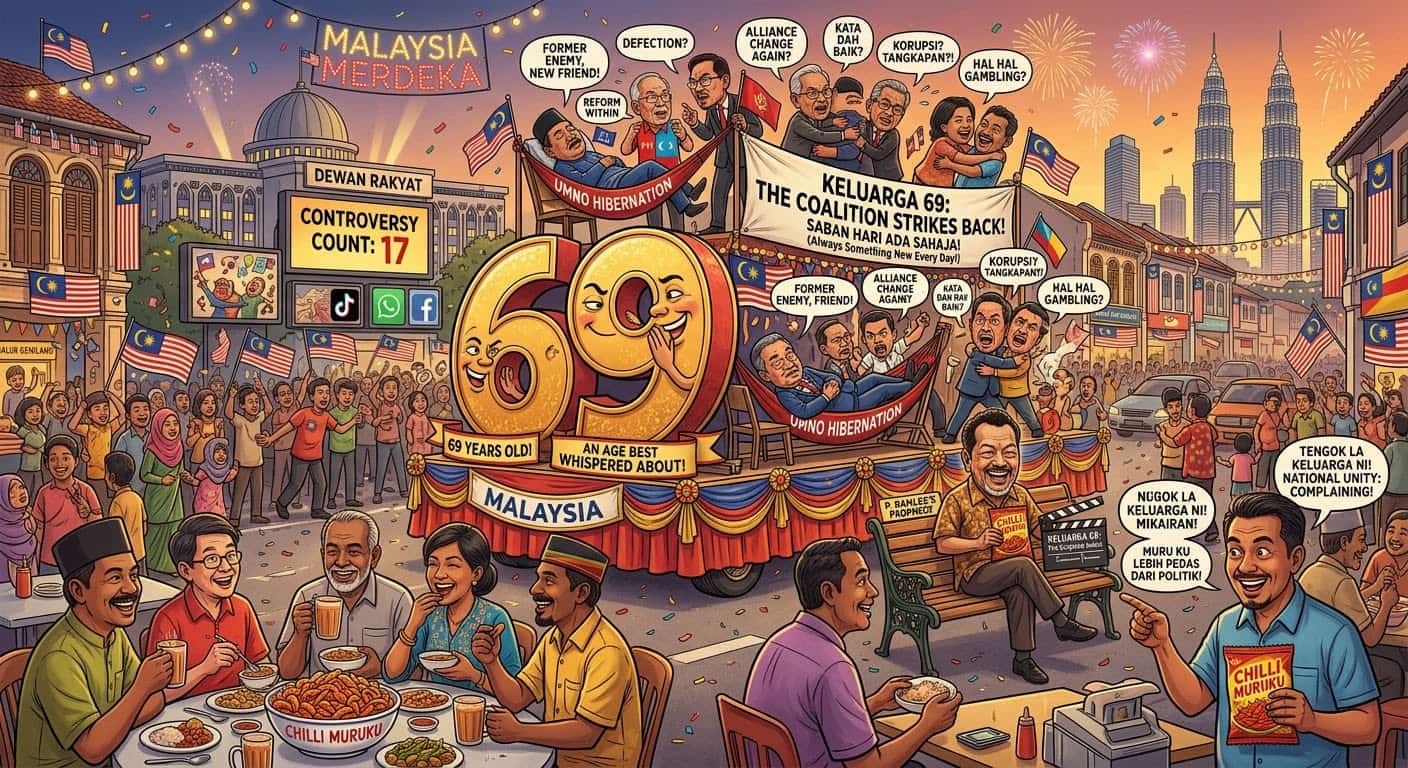
Malaysia turns 69 this year.
Sixty-nine.
It is, of course, merely a number.
Six followed by nine.
Perfectly innocent.
Nothing to see here.
And yet, say “69” in certain circles and suddenly voices become softer, eyebrows go up and somebody invariably develops a very interested expression.
Malaysia, however, has arrived at 69 in full public view.
And perhaps there is no more appropriate number for the country at this particular moment.
Because if 69 is supposed to suggest a complicated relationship between two parties, Malaysia's political life has certainly mastered the art.
Alliances come together.
Then they separate.
Then they come together again.
Enemies become friends.
Friends become suspicious of each other.
Former partners discover new partners.
And everyone insists that this is perfectly normal.
It is not.
But then again, this is Malaysia.
We have been doing complicated for decades.
And if the late P. Ramlee were around today, he might have looked at the current political circus and concluded that his old comedy Keluarga 69 was not really fiction after all.
It was a prophecy.
The title alone seems tailor-made for Malaysia in 2026.
A Keluarga 69 where everybody appears to be related somehow, although nobody is entirely sure how.
There are political cousins, former political brothers, estranged political siblings, newly discovered relatives and the occasional family member who announces that he has never actually been part of the family despite appearing in every family photograph.
If P. Ramlee had made a sequel today, the title could simply be:
Keluarga 69: The Coalition Strikes Back.
The plot would need no script.
Just switch on Parliament.
At 69, you would think Malaysia might have settled down.
Instead, the country seems to have developed the political equivalent of restless legs.
Something is always moving.
A party.
An alliance.
A minister.
An allegation.
A court case.
A political position.
Sometimes all of them simultaneously.
And then there is corruption.
To be absolutely fair, an arrest is not a conviction, an allegation is not proof and an investigation is not a verdict.
That distinction matters.
But Malaysians cannot be blamed for noticing that corruption-related arrests, investigations and allegations seem to be appearing with increasing frequency.
There are days when the headlines resemble a national clearance sale:
“Arrests! Investigations! Allegations! Everything must go!”
Nobody knows what the final outcome will be.
But there is certainly no shortage of plot development.
And just when Malaysians think they have understood one controversy, another one arrives carrying a folder.
At 69, Malaysia has also discovered that gambling is one of those subjects that can produce instant political electricity.
Gambling is bad.
No, certain gambling is worse.
But what about government revenue?
What about special draws?
What about morality?
What about enforcement?
What about the voters?
And suddenly everybody is arguing about gambling while ordinary Malaysians are left wondering whether they should place a bet on what the next political argument will be.
Of course, nobody should actually do that.
There are already enough gamblers in politics.
Then there is BN.
Once considered by some to be a political dinosaur, BN has somehow wandered back into the political landscape and found itself in power in two states, with another apparently looming on the horizon.
This is Malaysia.
Political parties here do not die.
They hibernate.
And when they wake up, they sometimes discover that the political furniture has been rearranged but there is still a chair with their name on it.
Then we have PKR, which seems to be discovering that maintaining a political party can sometimes be more difficult than establishing one.
Internal disagreements, departures and political tensions have provided enough material for commentators to keep their keyboards warm.
The irony is most apropo.
A party built around the language of reform occasionally finds itself requiring reform from within.
You couldn't write it better.
Well, you could.
P. Ramlee probably already did.
And that is where Keluarga 69 becomes particularly appropriate.
The genius of P. Ramlee's comedies was that beneath the laughter there was always a little social observation.
People were complicated.
Families were complicated.
Society was complicated.
And human beings had an extraordinary ability to create chaos out of perfectly manageable circumstances.
Sound familiar?
Today, we have merely upgraded the technology.
P. Ramlee had misunderstandings, mistaken identities and family complications.
We have WhatsApp groups, TikTok, Facebook, X, press conferences, political podcasts and AI.
The misunderstandings now travel at broadband speed.
A politician can say something at 10am and by 10.05am half the country has misunderstood it, the other half has weaponised it and somebody has already produced a meme.
At 69, Malaysia has also become remarkably talented at turning almost anything into a national controversy.
A signboard.
A restaurant.
A speech.
A photograph.
A slogan.
A religious issue.
A political appointment.
A dinner.
An upside down flag on the eve of Merdeka.
Sometimes even a sentence that nobody actually said becomes controversial because someone insists that it was probably going to be said.
We have reached a stage where one almost expects the evening news to begin:
“Good evening. Here are today's controversies. We have 17. Five are new, four are denials, three are counter-denials and the remaining five are awaiting clarification.”
And yet, amid all this, something rather remarkable continues.
Ordinary Malaysians continue to live together.
The Malay eats with the Chinese.
The Chinese eats with the Indian.
The Indian eats with everybody because, frankly, nobody wants to miss lunch.
Sabahans and Sarawakians continue to remind Peninsular Malaysians that Malaysia is considerably bigger than the Klang Valley.
Everyone complains about traffic.
Everyone complains about prices.
Everyone complains about politicians.
On that last matter, at least, we appear to have achieved national unity.
This may be Malaysia's most impressive achievement at 69.
Politicians sometimes seem determined to convince us that the country is permanently divided.
Ordinary Malaysians frequently demonstrate otherwise.
They work together.
They do business together.
They attend weddings together.
They sit at the same mamak tables.
They share jokes.
And increasingly, when politicians start performing their familiar routines, Malaysians simply sit back and watch.
With muruku — preferably the chilli-flavoured variety — within reach.
Because popcorn is far too Western for a Malaysian political drama.
Muruku has the appropriate crunch.
And the chilli gives you something to blame when the political theatre becomes too hot.
Perhaps that is what being 69 really means.
We have lived long enough to recognise the patterns.
The outrage will come.
The denial will follow.
Then the counter-accusation.
Then the explanation.
Then the clarification of the explanation.
Then somebody will demand an apology.
Then somebody else will refuse.
Then, eventually, something else happens.
And Malaysians move on.
At 69, Malaysia is not perfect.
Far from it.
We still have corruption to fight, institutions to strengthen, political accountability to demand and an endless supply of issues that politicians seem remarkably capable of making worse before making them better.
But perhaps maturity does not mean eliminating all the country's problems.
Perhaps it means becoming wise enough not to panic every time politicians manufacture another one.
So happy 69th, Malaysia.
Sixty-nine.
A number that makes some people whisper.
A number that makes others giggle.
And, thanks to P. Ramlee, a number that now comes with its own cinematic family history.
Perhaps Keluarga 69 was never merely an old comedy.
Perhaps it was an early warning.
The difference is that P. Ramlee had to invent the plot.
Our politicians provide theirs for free.
All we need to do is sit back, open the packet of chilli muruku and watch.
Because at 69, Malaysia has learned one great national truth:
When the political family starts behaving strangely, don't panic.
Check the snacks.
The next episode is probably already on its way.

Share your Anak Malaysia stories and stand a chance to win prizes worth up to RM2,880! Find out how to join here. T&Cs apply.
Mihar Dias (mihardias@gmail.com) is a content creator under the Newswav Creator programme, where you get to express yourself, be a citizen journalist, and at the same time monetize your content & reach millions of users on Newswav. Log in to creator.newswav.com and become a Newswav Creator now!
The User Content (as defined on Newswav Terms of Use) above including the views expressed and media (pictures, videos, citations etc) were submitted & posted by the author. Newswav is solely an aggregation platform that hosts the User Content. If you have any questions about the content, copyright or other issues of the work, please contact creator@newswav.com.



.jpg?width=1200&auto=webp&trim=0%2C0%2C0%2C0)
