
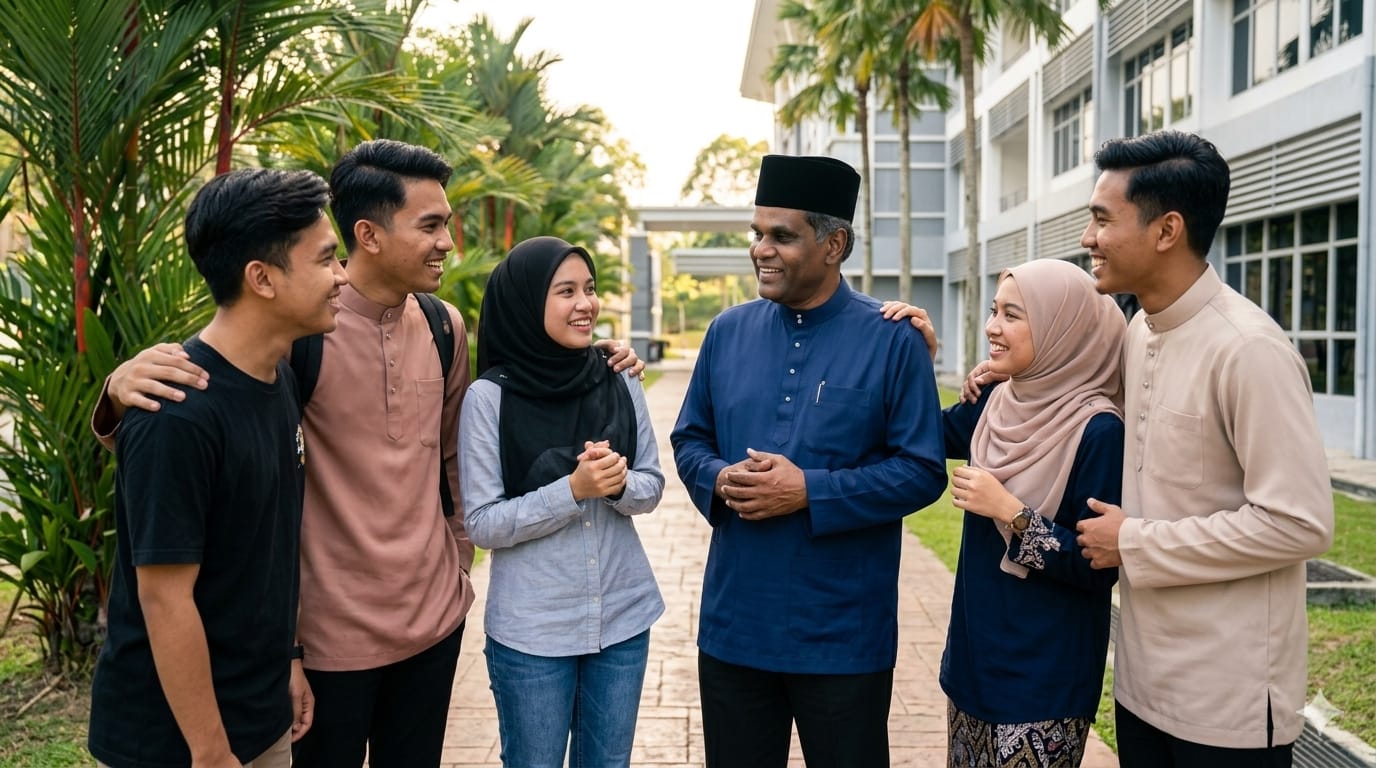
In late January 2026, I wrote a column titled “From Guru to Provocateur: A Line Teachers Should Never Cross,” examining how S. Chandrasegaran (Cikgu Chandra) was systematically misusing the sacred title of “Cikgu”. A teacher, by definition and historical tradition, is an entity meant to eradicate ignorance, nurture discipline, and elevate the mind. Yet, Cikgu Chandra had chosen to trade the moral authority of an educator for the fleeting algorithms of social media agitation normalizing slurs, shouting down dissent, and reducing an entire community to caricature.
In the months that followed, his public trajectory took an even more dramatic turn. Following widespread online speculation, he publicly declared his intention to embrace Islam.
For his supporters, this spiritual transition was framed as a personal transformation. But for observant critical thinkers, it brought a sharper, far more troubling paradox to the surface: Can a public figure claim spiritual ascension while simultaneously engaging in public degradation? Does adopting a new faith erase a pattern of hostility or does it merely weaponize it?
The hard truth facing Malaysian society today is simple: embracing Islam does not make someone an inherently noble person, nor does it grant them a license to condemn, demean, or insult others. Faith without character (adab) is merely an empty shield for personal ambition.
1. The False Equation: Conversion is Not Character
There is a dangerous tendency in public discourse to conflate religious conversion with moral redemption. When a public figure announces a spiritual shift, their followers often expect the public to grant them an immediate clean slate as if public hostility is magically erased the moment one adopts sacred vocabulary.
But in Islamic scholarly tradition itself, faith is inextricably bound to character (adab) and restraint (sabr). True spiritual conviction elevates a person’s humanity; it makes them more humble, more compassionate, and more protective of the dignity of others. Prophet Muhammad explicitly stated that he was sent to perfect good character (akhlaq).
What we see in Cikgu Chandra’s public posture, however, is a stark contradiction:
- Faith as a Moral Shield: A person cannot use religious transition to escape accountability for public harm. Embracing a new faith while continuing to shout, condemn, and antagonize does not reflect spiritual enlightenment; it reflects a performative exercise in self-justification.
- The Hypocrisy of Condemnation: To publicly embrace a faith that explicitly forbids insulting the sacred symbols or dignity of other communities and then turn around to label one's former background as "uncivilised" (tidak bertamadun) is a profound distortion of religious teachings.
If conversion does not produce humility, restraint, and respect for one's neighbors, then it is not spiritual progress it is simply a change in branding.
2. When Public Posts Cross the Line: The "Kafir" and Nepal Declarations
To understand why Cikgu Chandra’s online presence causes profound hurt across community lines, one need only look at the specific rhetoric broadcasted across his social media channels during his transition.
Two particular public declarations illustrate the deep insensitivity of his commentary:
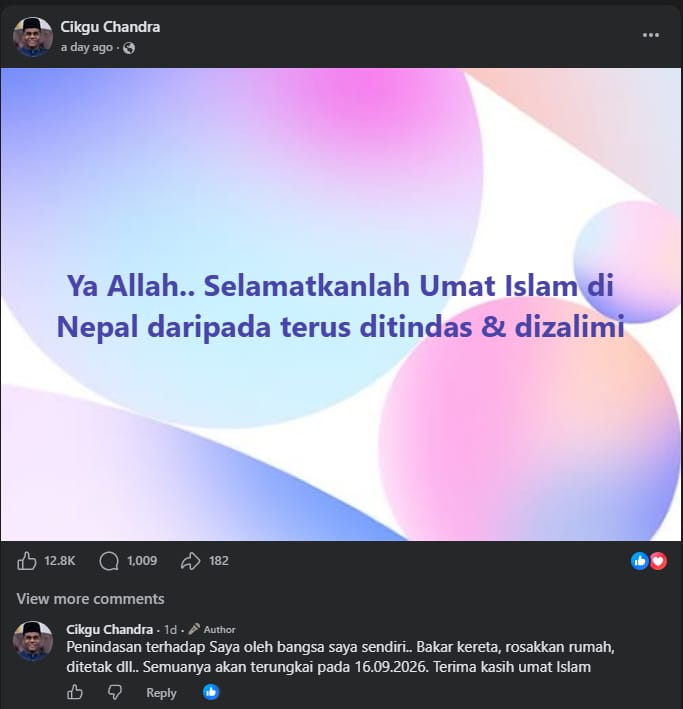
Post 1: “Ya Allah.. Ampunilah dosa dosaku yang lalu sewaktu menjadi kafir”
(“Ya Allah.. Forgive my past sins from when I was a kafir”)
While the term kafir is a theological classification in Islamic jurisprudence for non-Muslims, broadcasting it on a public social feed to describe one's former life carries deep social friction. In Malaysia’s multicultural setting, using theological labels loaded with social sensitivity to publicly disown one's heritage feels less like quiet devotional repentance and more like a performative rejection of the very community that raised him.
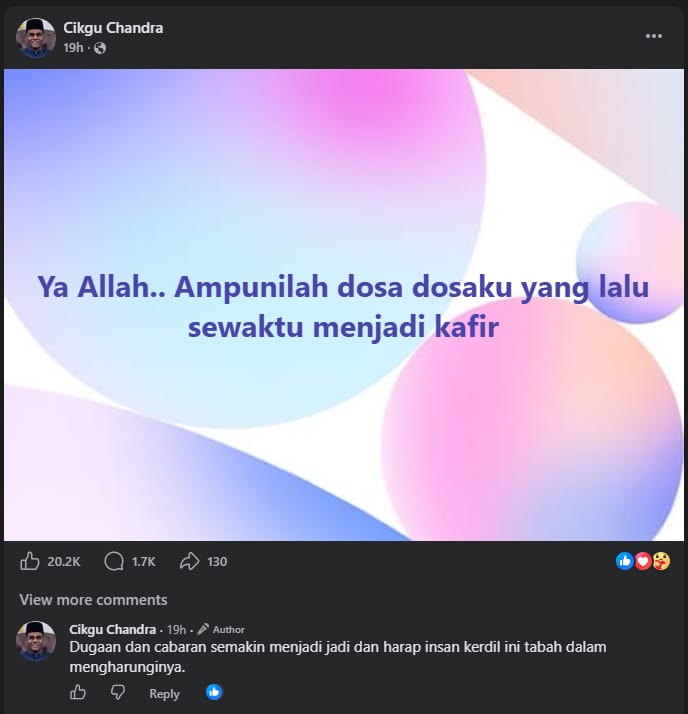
Post 2: “Ya Allah.. Selamatkanlah Umat Islam di Nepal daripada terus ditindas & dizalimi”
(“Ya Allah.. Save the Muslim Ummah in Nepal from continuing to be oppressed & persecuted”)
Here, Cikgu Chandra deployed emotive, high-arousal global rhetoric. While expressing concern for overseas minorities is common, broadcasting sweeping statements of foreign "oppression" without nuanced context serves a specific digital function: it stokes domestic religious anxieties, paints non-Muslim majorities elsewhere as inherent aggressors, and imports external polarization directly into Malaysian feeds.
When an educator broadcasts content that alienates former peers and stokes inter-communal fear, the primary impact is not enlightenment it is social harm.
The Teacher’s Vocation: A Standard He Continued to Fail
In my previous column, I highlighted that a teacher does not speak merely as an isolated citizen; when someone uses the prefix “Cikgu,” they carry institutional weight and societal trust. Society entrusts parents' children to teachers with the expectation that they will rise above prejudice and impulse.
A true teacher sets an example first. They demonstrate how to critique without humiliating, how to disagree without destroying, and how to lead without dividing.
Cikgu Chandra failed this fundamental test on every front:
When a former educator chooses to publicly disparage an entire ethnic group to gain social media traction as confirmed by law enforcement following his arrest in February 2026 under the Sedition Act and Communications and Multimedia Act he does not just dishonor himself. He dishonors the entire noble teaching profession.
If a teacher demonstrates that the path to relevance is paved with contempt and self-loathing, what exactly are students meant to learn? Truth or intolerance?
3. The Pattern of Condemnation: Self-Loathing as Public Performance
What makes Cikgu Chandra’s rhetoric particularly corrosive is his relentless focus on condemning his own origin community.
Rather than addressing genuine social challenges such as local governance, municipal compliance, or socio-economic issues through constructive, policy-driven channels, his content relies heavily on broad generalizations.
- Collective Shame: As noted in my previous analysis, Cikgu Chandra deliberately collapses individual wrongdoing into collective shame. A land dispute involving a single structure is rhetorically stretched until it becomes a moral indictment of an entire race.
- The Convenience of Outrage: Pointing out flaws within a community is a necessary part of social reform. But there is a vast gulf between critique meant to elevate and condemnation meant to provoke. Constructive reform requires discipline, empathy, and intellectual honesty. Public condemnation requires nothing more than volume and a smartphone.
His public admissions to police acknowledging that provocative posts were uploaded out of personal dissatisfaction and a desire to attract online followers reveal the mechanical reality behind his activism. It was never about genuine reform; it was about viral engagement.
4. Applying the Universal Standard
A healthy, peaceful society cannot operate on double standards. We must evaluate public figures by their actions and impact, not by their religious identity or public declarations.
- If a non-Muslim uses derogatory language against another community, it is wrong and must be condemned.
- If a Muslim convert uses derogatory language against another community, it is equally wrong and must be condemned.
- The law, social accountability, and moral judgment must apply symmetrically to everyone.
Malaysia does not need self-appointed provocateurs who use religion or civic activism as a battering ram to tear down their neighbors. We do not need public figures who measure their worth by how much outrage they generate on a digital feed.
Conclusion: Character Over Clout
Cikgu Chandra’s journey from classroom educator to public agitator serves as a solemn warning for modern Malaysia.
Embracing Islam or any faith is a deeply personal journey that should yield wisdom (hikmah), patience (sabr), and noble character (adab). It is not a license to look down upon others, nor does it excuse years of public hostility, racial stereotyping, and social provocation.
As a teacher, Cikgu Chandra had the rare privilege of holding a title that society inherently respects. He chose to trade that sacred responsibility for the temporary rush of social media clout.
Malaysia does not measure good citizens or good believers by how loudly they attack another community. The true test of any human being, teacher, or religious seeker is whether their presence builds dignity, justice, and peace in the world around them. When a public figure fails that test, no title, no conversion post, and no social media following can hide the vacuum where their character ought to be.
“A change of faith that does not produce a change in character is not spiritual renewal it is merely a change of audience.” - Annan Vaithegi

Share your Anak Malaysia stories and stand a chance to win prizes worth up to RM2,880! Find out how to join here. T&Cs apply.
Annan Vaithegi (annanvaithegi@icloud.com) is a content creator under the Newswav Creator programme, where you get to express yourself, be a citizen journalist, and at the same time monetize your content & reach millions of users on Newswav. Log in to creator.newswav.com and become a Newswav Creator now!
The User Content (as defined on Newswav Terms of Use) above including the views expressed and media (pictures, videos, citations etc) were submitted & posted by the author. Newswav is solely an aggregation platform that hosts the User Content. If you have any questions about the content, copyright or other issues of the work, please contact creator@newswav.com.