
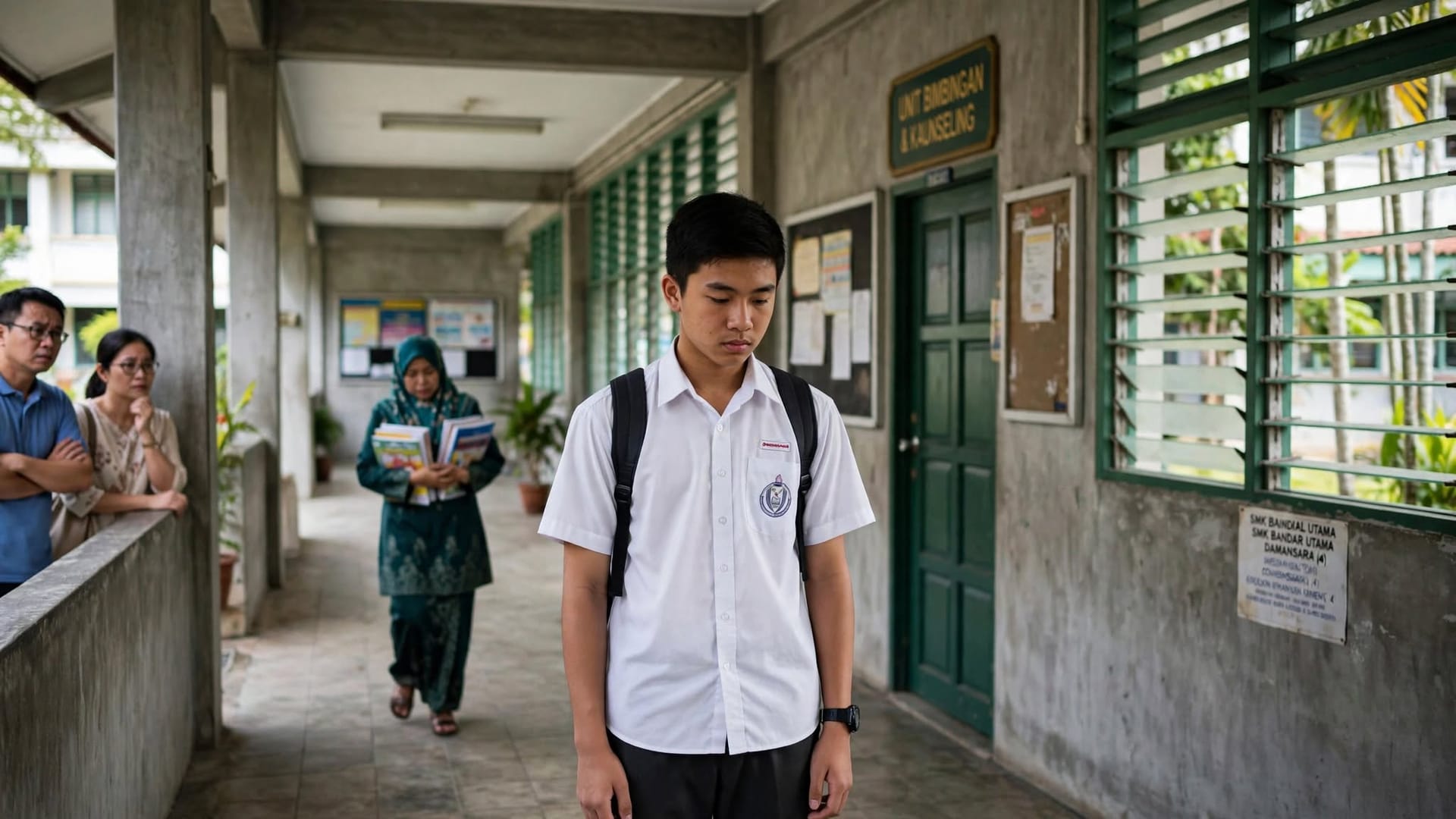
Who notices when a child is struggling? Behind the silence, someone may be quietly asking for help.
Can the court system help Malaysia confront a problem that the education system has struggled to see clearly the warning signs in a child's behaviour before something irreversible happens?
As the legal battle surrounding the tragic Bandar Utama school incident moves toward the higher courts and the grieving family pursues civil pathways to seek answers, public attention remains gripped by the courtroom drama. Yet a court can only determine legal responsibility based on evidence and law. A courtroom cannot go back five years and intervene when warning signs may first have appeared. That responsibility belongs to the adults and institutions surrounding a child beginning with the family, continuing through teachers, and ultimately involving the school system.
The release of the High Court’s detailed grounds of judgment revealed a sobering, agonizing reality: the teenage accused had suffered from very early-onset schizophrenia that went unrecognised and untreated for five years. This harrowing revelation forces Malaysia to confront an uncomfortable question. When a child slips away into a severe psychological breakdown over half a decade, who is supposed to notice, and what happens after somebody notices?
Parents The First Line of Awareness
If the court judgment and expert psychiatric testimonies establish that a child can experience serious mental health difficulties over a prolonged period, how could warning signs potentially go unnoticed for years under the same roof?
This is not about assigning sweeping blame or assuming parents knowingly ignored a crisis. Rather, it exposes a deeper educational question: How well do parents actually know their children's emotional and behavioural lives?
In contemporary Malaysian households, life moves at a relentless pace. Parents juggle demanding careers, urban traffic, financial pressures, and household chores. A child can attend school every day, maintain passing examination results, use a smartphone, sit down for dinner, and appear outwardly normal while privately experiencing profound emotional or psychological fracture. There is a dangerous gulf between saying "my child is quiet" and asking whether "my child may be quietly suffering."
Warning signs in youth do not always look like explosive anger. They can manifest as major behavioural changes, extreme withdrawal, social isolation, persistent use of face masks to hide behind, unusual fixation on digital fantasy worlds, sudden changes in sleep or daily routines, or an uncharacteristic detachment from family life. Naturally, one unusual habit does not equal mental illness. Adolescents are famously moody and complex. But persistent, escalating changes demand adult engagement.
The hard truth is that Malaysian society has traditionally focused so heavily on academic grades, tuition schedules, school discipline, and career success that emotional literacy often takes a back seat. Many parents are simply not equipped to recognise the subtle footprints of psychological distress. Worse still, seeking professional help or psychological counselling is still viewed in some quarters as a source of shame or an admission of bad parenting.
Parents do not need to become clinical psychiatrists. But they must become attentive, emotionally present observers of their own children.
Teachers The Second Line of Defence
If parents are the first line of awareness, teachers form the second line of defence. A student spends a significant portion of their waking life inside a school compound. How can teachers be expected to guide a child without also noticing significant behavioural shifts?
Teachers often witness daily social dynamics that parents never see: sudden isolation during recess, dramatic changes in peer relationships, unusual classroom focus, withdrawal from group activities, or a sharp, unexplained drop in academic engagement.
Yet, we must be realistic. Teachers are educators, not clinical investigators, psychologists, or psychiatrists. They cannot be expected to diagnose complex mental health disorders in a crowded classroom.
However, teachers can be part of an early-warning network if the system allows them to be. This brings us to an uncomfortable institutional reality: How many teachers have enough time, specialised training, and institutional support to notice a child who is quietly deteriorating?
When classrooms are overcrowded, and educators are buried under mountains of administrative paperwork, exam-preparation key performance indicators (KPIs), and co-curricular demands, survival mode takes over. In such an environment, a quiet, compliant student who causes no disciplinary trouble is easily overlooked. A child can drift into a psychological abyss, behaving like a ghost in plain sight, because an exhausted teacher is left with no bandwidth to look past the academic checklist. The issue is not that teachers do not care; it is whether we have built a school system that gives teachers the space, training, and referral pathways to actually see their students.
The School System The Third and Biggest Question
Even if parents miss early warning signs and teachers are stretched too thin to catch them, what happens next? This leads to the broadest and most critical level of responsibility: the educational institution itself.
Does our national school system possess a functioning, proactive mechanism to identify students at risk? Does the school counselling department have adequate capacity, or is it treated merely as a disciplinary office for errant students? Are behavioural concerns systematically documented, tracked, and followed up when a student moves from one academic year to another?
Currently, education safety in Malaysia often depends entirely on whether a child crosses paths with one unusually observant teacher or has an exceptionally vigilant parent. That is not a safety net; that is a gamble.
What is desperately needed is a structured, institutional approach a "whole-child early warning system" built not on labelling, policing, or criminalising students, but on safeguarding, pastoral care, and early professional intervention. When a teacher flags an unusual pattern of withdrawal or distress, there must be a clear escalation pathway: observation, internal documentation, confidential counselling engagement, family consultation, and professional health referral.
For decades, Malaysia has measured educational success primarily through examination results, university rankings, STEM achievements, and digital curriculum reforms. But we must ask: What is the true value of academic excellence if our educational ecosystem cannot recognise when a child is quietly falling apart? Academic achievement and student wellbeing are not competing priorities. A truly functioning school system must successfully nurture both.
The Court Judgment as an Educational Mirror
The legal judgments and ongoing court proceedings surrounding this case carry profound significance far beyond the confines of a courtroom. It is vital to maintain intellectual clarity: a court's finding regarding legal insanity under Section 84 of the Penal Code is an assessment of an individual's mental state at the specific moment of an offence. It is not a medical license to stigmatise mental illness, nor does it imply that psychological distress automatically leads to violence.
The purpose of examining the accused student's condition is not to excuse a tragedy, but to use the court's findings as an educational mirror. As highlighted in judicial observations, when severe mental health issues remain unrecognised and untreated for years in a child, the consequences can be devastating. The grieving family's pursuit of civil justice underscores a universal quest for accountability, institutional reflection, and answers that criminal trials alone may not fully resolve.
Regardless of how appellate courts ultimately rule on legal liabilities, the broader lessons remain unchanged for Malaysian society.
Three Takeaways for Moving Forward
- Parents cannot outsource their child's emotional wellbeing to schools. Parents remain the individuals best positioned to notice long-term changes in a child's behaviour, provided they stay attentive and discard the cultural stigma that treats emotional struggles as family shame.
- Teachers cannot be expected to diagnose, but they must be supported to identify. The solution is not to turn educators into clinicians, but to ensure that school environments give teachers the time, training, and structural support to flag serious warning signs before they escalate.
- The education system must build a bridge between concern and intervention. An early warning sign is meaningless if a school lacks a clear, compassionate pathway from observation to professional mental health support.
The real lesson from the Bandar Utama tragedy is not simply about what happened on one dark day in October. It is about everything that may happen or fail to happen in the months and years leading up to that day.
A child should never have to reach a courtroom before adults begin asking whether something was fundamentally wrong. A school should never wait for a catastrophe before overhauling its safeguarding framework. And parents should never wait for a crisis to learn how to truly look into their own children's eyes.
“Education is not only about preparing a child for the future. It is also about making sure the adults around that child notice when the present is becoming unbearable.” - Annan Vaithegi

Share your Anak Malaysia stories and stand a chance to win prizes worth up to RM2,880! Find out how to join here. T&Cs apply.
Annan Vaithegi (annanvaithegi@icloud.com) is a content creator under the Newswav Creator programme, where you get to express yourself, be a citizen journalist, and at the same time monetize your content & reach millions of users on Newswav. Log in to creator.newswav.com and become a Newswav Creator now!
The User Content (as defined on Newswav Terms of Use) above including the views expressed and media (pictures, videos, citations etc) were submitted & posted by the author. Newswav is solely an aggregation platform that hosts the User Content. If you have any questions about the content, copyright or other issues of the work, please contact creator@newswav.com.