Buying less just became a trend. Some of us never stopped doing it.
There is a quiet rebellion happening on TikTok right now, and it looks almost boring on purpose. No hauls. No unboxing. No "get ready with me" featuring six new products. Just someone showing their actual bathroom cabinet, half empty, and captioning it "using what I already have."
They call it underconsumption core. Which is a strange, very online way of describing something that used to just be called normal living before influencer culture convinced an entire generation that buying constantly was the baseline.
What Underconsumption Core Actually Is
The trend started as a TikTok pushback against haul culture, the endless unboxing videos, the "get ready with me" content built entirely around new purchases. Underconsumption core flips that script. Creators post worn shoes instead of new ones. Modest, repeated wardrobes instead of expanding collections. Products used down to the last scrape instead of replaced the moment something newer launches.
It looks similar to minimalism on the surface, but the framing is different. Minimalism has always been aesthetic, curated, sometimes aspirational in its own expensive way. Underconsumption core is explicitly economic. It exists because a generation facing genuine financial pressure needed a way to make frugality feel less like deprivation and more like a lifestyle worth choosing on purpose.
Malaysia Is Already Living This, Just Without the Hashtag
Here is what makes this genuinely interesting for a Malaysian audience: the data shows we are already doing a version of this, quietly, without needing TikTok to name it for us.
A Euromonitor consumer lifestyle survey found that 41% of Malaysians already try to lead a minimalist lifestyle and avoid buying unnecessary items, a figure above the global average. More than 60% have shared, swapped, or borrowed items instead of buying new ones. Up to 80% have purchased second-hand goods at some point. These are not fringe numbers. That is a genuine majority behaviour, hiding in plain sight under the more visible, more discussed culture of impulse buying and flash sales.
Local platforms have grown directly on the back of this shift. Carsome built a business on second-hand cars. CompAsia turned refurbished electronics into a real market. Secondlifeasia, a device repair company, grew 424% year on year. Thrift fashion accounts and pre-owned luxury goods, now valued at RM4 billion in Malaysia alone, have quietly become mainstream rather than niche. The demand was clearly already there. Underconsumption core just gave it a name and an aesthetic worth posting about.
The Real Driver Is Not the Aesthetic. It Is the Exhaustion.
Strip away the TikTok branding and the actual driver behind this trend is straightforward: people are tired. Tired of algorithm-driven spending. Tired of influencers pushing products they were paid to feature rather than products they genuinely use. Tired of the quiet financial and mental weight that comes from a home filling up with things that were never really needed in the first place.
Researchers point to two forces feeding this shift globally: real economic pressure and a growing environmental consciousness, particularly among younger generations who are watching both their bank accounts and the planet strain under the same pattern of constant consumption. Underconsumption core is not really about banning joy or treating every purchase as suspect. It is about removing spending on autopilot, replacing "I saw it, I want it, I bought it" with an actual pause before money leaves your account.
That pause is the entire mechanism. Give yourself even a day or two before an impulse purchase, and a genuine want tends to survive that gap. A fleeting one, fuelled by boredom or a well-targeted ad, usually does not.
This Is Not New. It Just Finally Has a Name.
Here is the part that should feel validating rather than trendy: what TikTok is currently branding as a fresh discovery has quietly been standard practice for an entire generation of Malaysians who came up with less to begin with. Repairing shoes instead of replacing them, mending clothes, buying secondhand out of necessity rather than aesthetic choice, these were never radical acts for Gen X or older Malaysians. They were simply how households operated before credit became instant and shopping became a form of entertainment available 24 hours a day through a phone screen.
What has changed is that younger generations are now arriving at the same conclusion, just through a different route. Where older Malaysians practiced frugality out of necessity, younger Malaysians are increasingly choosing it deliberately, partly as financial self-defence and partly as a rejection of a consumption culture that has started to feel exhausting rather than aspirational.
My Take
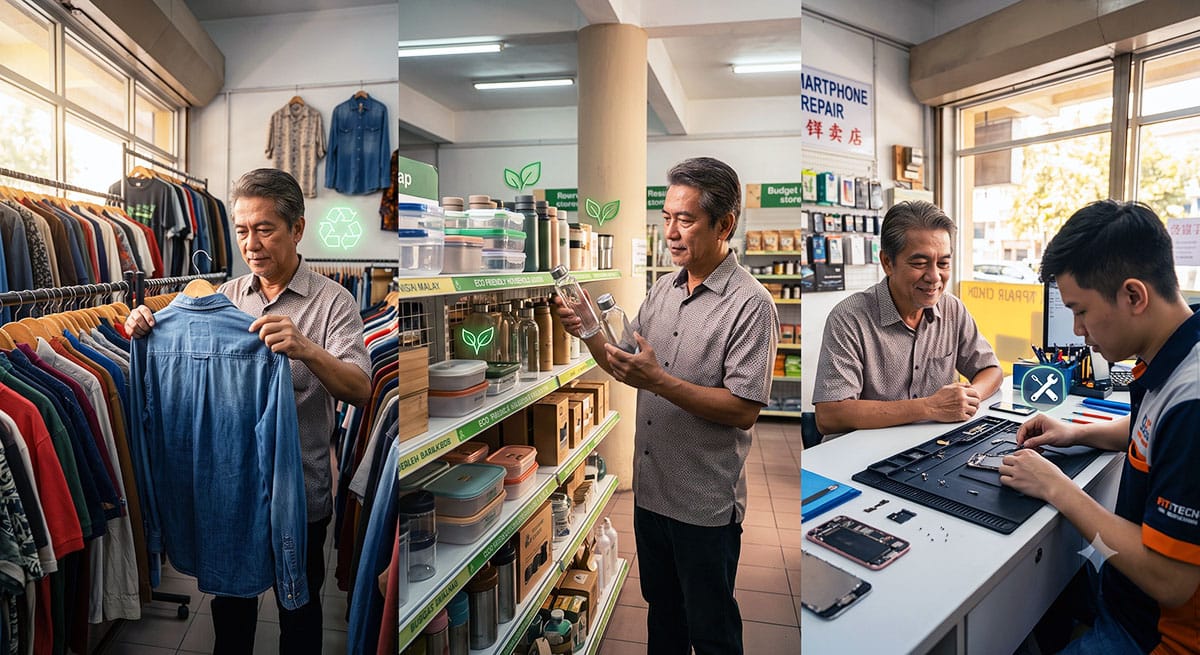
I have been living this way for a long time, well before anyone gave it a trendy name. I repair things instead of replacing them by default. I shop at Mr DIY or Eco Store for household items rather than paying a premium elsewhere. I buy less in general, keeping spending focused mostly on food and groceries, the things that are genuinely essential rather than nice to have.
I actually cancelled Netflix and Spotify before the retrenchment even happened, not purely out of necessity but because I had already started questioning whether I needed them at all. The tools I do keep, CapCut Pro and Canva, are ones I use directly for work, and even there, I have shifted toward free alternatives wherever they genuinely do the job.
I have noticed this is not just a younger generation thing either. A lot of Gen X Malaysians like myself have quietly been practicing this for years, just to make life simpler and more manageable, long before it needed a name or a TikTok aesthetic attached to it. I hope my own sons pick up that instinct naturally rather than needing a trend to teach it to them.
If I am honest about where my own discipline breaks down, it is watches. That is my one genuine obsession, and I will not pretend otherwise. Everyone seems to have that one category where the underconsumption mindset quietly steps aside. Mine just happens to be sitting on my wrist.
What I hope for long term is that this stops being a trend that fades once the economy improves and becomes a genuine shift in how we relate to spending altogether. That would mean more businesses catering properly to this lifestyle: better repair shops for everyday items, more accessible secondhand markets, less pressure dressed up as convenience. The appetite is clearly already there. It just needs the infrastructure around it to catch up.
Kamarul Azwan (k.azwan@gmail.com) is a content creator under the Newswav Creator programme, where you get to express yourself, be a citizen journalist, and at the same time monetize your content & reach millions of users on Newswav. Log in to creator.newswav.com and become a Newswav Creator now!
The User Content (as defined on Newswav Terms of Use) above including the views expressed and media (pictures, videos, citations etc) were submitted & posted by the author. Newswav is solely an aggregation platform that hosts the User Content. If you have any questions about the content, copyright or other issues of the work, please contact creator@newswav.com.