
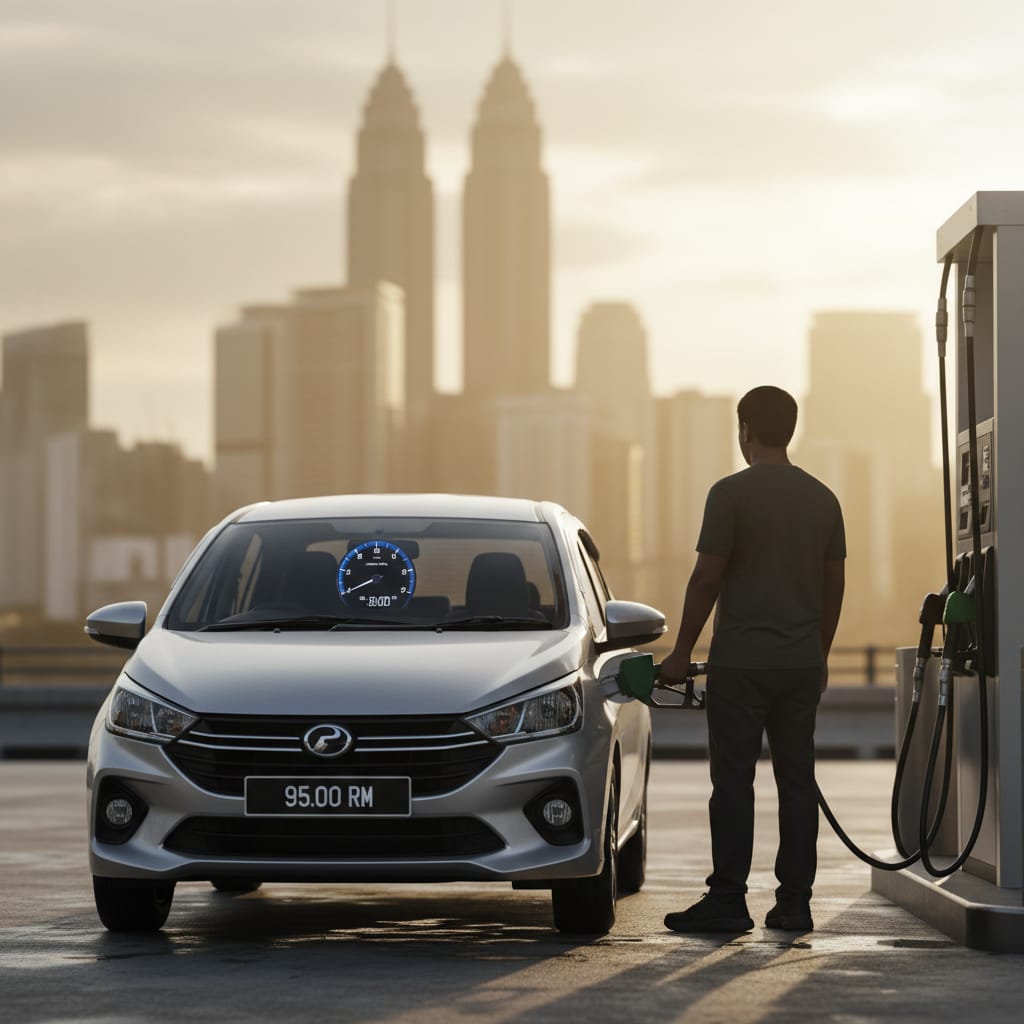
In early 2026, ordinary Malaysians sharing photos of filling up a Perodua Bezza with petrol and paying RM95 for a full tank without BUDI95 sparked a wave of online debate. At a time when the government touted fuel subsidy reforms and cost‑of‑living relief, everyday drivers were confused and alarmed to see how much fuel costs at the pump without targeted support.
This investigation traces the facts behind that RM95 fill‑up. We examine Malaysia’s fuel pricing system, the new BUDI MADANI RON95 (BUDI95) targeted subsidy scheme, economic data, voices from drivers and experts, and the broader implications for cost pressure facing Malaysian households.
Why RM95 for a Full Tank Is Shocking to Many Drivers
A Perodua Bezza, one of Malaysia’s most common compact sedans, has a fuel tank capacity of around 36–37 litres. When petrol is priced at the non‑subsidised RON95 rate of RM2.60 per litre, a full tank comes to approximately:
• 36.5 litres × RM2.60 = RM94.90
This calculation explains why many Malaysians recently posted photos of paying around RM95 for a full tank without BUDI95. That price point feels steep to everyday users, especially after years of heavily subsidised fuel.
The BUDI95 Targeted Subsidy: How It Works
In late 2025, the Malaysian government implemented BUDI95, a targeted petrol subsidy scheme that fundamentally changed how fuel subsidies are distributed. Instead of everyone paying a flat subsidised rate, only eligible Malaysians with a MyKad and valid driving licence receive a discounted RON95 price, currently RM1.99 per litre for up to 300 litres each month. Others pay the market price which is higher (e.g., RM2.60/litre). (BHPetrol)
Key features of BUDI95:
• You must be a Malaysian citizen with MyKad and active driver’s licence to qualify for the RM1.99/litre price. (PETRONAS Dagangan Berhad)
• The subsidy is limited to 300 litres per month per eligible person. (BHPetrol)
• If you are ineligible (e.g., foreigner, Malaysian without qualifying vehicle registration), you must buy fuel at the unsubsidised market price displayed at the pump. (PETRONAS Dagangan Berhad)
• Foreign‑registered vehicles cannot purchase RON95 under the subsidy even if the driver is Malaysian. (Reddit)
That means a driver without subsidy benefits could easily pay around RM95 or more for a single tank in a Bezza or similar car.
How the Fuel Price Shifted
Before BUDI95, RON95 petrol was subsidised and widely affordable. After the rollout on 30 September 2025, the market price was set at about RM2.60 per litre for those not eligible for subsidy, while the subsidised price for eligible citizens was RM1.99 per litre. (BHPetrol)
Government press briefs show that weekly petrol prices are adjusted using the Automatic Pricing Mechanism to reflect global oil price movements. In January 2026, retail prices were adjusted: non‑subsidised RON95 minutely fell to RM2.54/litre, while BUDI95 remained at RM1.99/litre. (Kewangan Portal)
Why RM95 Feels Painful for Drivers
For many Malaysians, petrol has always been one of the most visible cost pressures on household budgets. Car ownership is high, and commuting distances can be long in many urban and suburban areas.
A quick snapshot of perceptions among drivers:
• Some Malaysians share disbelief that a compact car would cost nearly RM100 to fill up, especially those accustomed to the old subsidised era.
• Others pointed out that without BUDI95, full tanks could cost much more, particularly in larger cars.
• Online forums show confusion among drivers about eligibility, quota calculations, and how monthly limits affect total cost.
These sentiments reflect broader anxiety about cost of living pressures that fall on ordinary citizens.
Who Pays More: Eligible vs Ineligible Drivers
Because BUDI95 subsidises only certain drivers, inequality in fuel costs has emerged:
Eligible Malaysians
• Pay RM1.99/litre under BUDI95.
• A full 36.5‑litre tank costs about RM72.64 (before other fees).
• Monthly subsidy applies only up to 300 litres.
Ineligible Drivers
• Pay market rate ~RM2.60/litre.
• A similar tank costs ~RM95 (or more when global prices rise).
This gap means identical fuel usage can cost 20–30% more for ineligible users. In border areas or for drivers of foreign‑registered vehicles, this policy effect is especially stark. (Reddit)
Government Rationale for BUDI95
Officials defend BUDI95 as a way to curb subsidy leakage while maintaining support for citizens who need it most. Sources close to policy discussions note:
• It prevents non‑citizens from using subsidised fuel as before.
• It reduces overall government expenditure on fuel subsidies.
• Savings are re‑directed to other welfare programs.
Prime Minister Datuk Seri Anwar Ibrahim reportedly rejected international advice to remove subsidies entirely and instead adopted targeted subsidies to balance fiscal discipline with social support. (Reddit)
Supporters say this approach can save the government billions annually while helping citizens afford fuel without full subsidy burden. Estimates suggest annual savings from this system could be in the billions if managed carefully. (Reddit)
Economic and Social Impact
Rising Cost Burden for Some Households
Households without subsidy access effectively face a “fuel penalty.” Drivers pay more for travel, which can add up over time, especially for those who commute long distances or drive frequently for work. This can squeeze budgets for food, bills and savings.
Inflation and Transport Costs
Higher fuel costs tend to raise transport costs for goods and services. Trucking, deliveries, taxis, and other transport services may pass on fuel costs to customers, contributing to inflationary pressure in other parts of the economy.
Behavioural Shifts
Some Malaysians may change travel behaviour combining errands, carpooling, using public transport if fuel costs pinch budgets. Yet such changes rely on transport alternatives that aren’t equally available everywhere.
What Drivers Are Saying
Interviews and social media posts reveal a range of views:
• Some express frustration that a basic car costs nearly RM95 to fill without subsidy.
• Others welcome targeted subsidies because they see waste and smuggling reduced.
• Forum discussions show confusion about eligibility, fuel quota calculations, and discrepancies between app estimates and pump receipts.
These everyday voices highlight a broader challenge: translating policy into practice without public confusion.
Lessons From Abroad
Countries with targeted fuel subsidies often struggle with balancing fairness and fiscal discipline. For example:
• Brazil’s fuel pricing reforms aimed to tie petrol prices to global markets, but faced public backlash when prices rose sharply.
• Indonesia reduced universal fuel subsidies in the 2010s, shifting toward targeted cash transfers to low‑income households.
Malaysia’s BUDI95 experiment sits within this broader global narrative of subsidy reform. The goal is to protect the vulnerable while curbing waste and fiscal drag.
Could This Trend Continue?
Fuel prices globally remain volatile. Factors like crude oil prices, geopolitical events, currency changes, and economic demand can push pump prices up or down. Even with BUDI95, the market price portion will fluctuate.
Policy experts suggest future adjustments may be needed:
• Review quota limits as incomes and travel patterns change.
• Consider broader transport policy that supports public transport and electrification to reduce reliance on petrol.
• Improve communication about who qualifies and how to use the subsidy system.
What Do You Think? I’d Love to Hear Your Opinion in the Comments Section.
The vivid reaction to a simple image of a Bezza full tank costing RM95 without BUDI95 reflects deeper tensions in Malaysia’s cost of living landscape. It shows how fuel prices remain a daily concern for many. It also highlights the complexities that arise when subsidy policy intersects with real lives.
Understanding these dynamics helps frame a national conversation about fairness, sustainability and economic priorities.
AM World (tameer.work88@gmail.com) is a content creator under the Newswav Creator programme, where you get to express yourself, be a citizen journalist, and at the same time monetize your content & reach millions of users on Newswav. Log in to creator.newswav.com and become a Newswav Creator now!
The User Content (as defined on Newswav Terms of Use) above including the views expressed and media (pictures, videos, citations etc) were submitted & posted by the author. Newswav is solely an aggregation platform that hosts the User Content. If you have any questions about the content, copyright or other issues of the work, please contact creator@newswav.com.
