

If Manchester City seek to justify their decision to spend nine-figure sums on two midfielders and to make them two of the most expensive footballers ever, they could point to a pair of late goals that helped cost them the title.
Elliot Anderson’s crisp 88th-minute strike for Nottingham Forest at the Etihad Stadium in March earned them a draw and came exactly two months after an even later equaliser: by Enzo Fernandez for managerless Chelsea in the 94th minute in January. If the backdrop was the departure of Enzo Maresca, it made Fernandez appear a talisman with a gift for delivering on the big stages.
Now Anderson and Fernandez could form the costliest midfield ever, a £241m double act; and yet mentions of them in connection with each other may bring other images to mind. Principally, given the recency of the World Cup, the Argentinian elbowing his new teammate in the back of his head in the second minute. Argentina’s lawlessness was to reach its nadir in the World Cup final when Fernandez was sent off for a wild lunge, his colleagues disgraced themselves after the final whistle and then the 25-year-old wrote an Instagram post in which he said the Albiceleste had conducted themselves with “pride” and “humility”.
Where Fernandez is concerned, there are other words that spring to mind before “humility”. Maresca is an old ally, however, and presumably supplied a character reference for a man who can appear petulant, selfish and undisciplined.
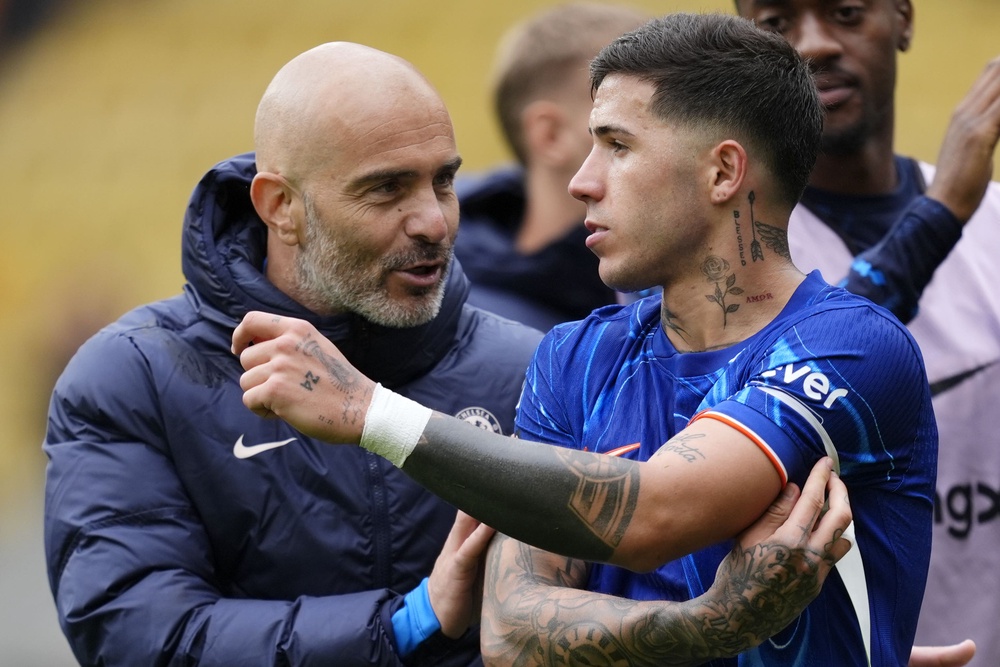
Fernandez is nevertheless also a midfielder capable of scoring 15 goals in a season for a team who finished 10th, as he did for Chelsea last year. His eye for goal and capacity to produce at pivotal moments were twice apparent in the World Cup: with his injury-time winner against Egypt and his late equaliser in the semi-final against England.
All of which could suggest he is City’s belated replacement to Kevin De Bruyne or the 2023 version of Ilkay Gundogan. And yet that illustrates there are three issues with City’s decision to buy him: the financial, the temperamental and the tactical.
Partly because of the success of Rayan Cherki, City already had a succession plan to De Bruyne. Fernandez’s best form for Chelsea, however, came as either a No 10 or a No 8 with a licence to get forward. Miscast as a defensive midfielder initially, he was then twinned with Moises Caicedo, in his first pairing of £100m midfielders. Yet it became apparent he preferred to have both Caicedo and another – sometimes Andrey Santos, Romeo Lavia or Reece James – in midfield to do more of the donkey work.
Some of his best displays for Chelsea came in the absence of Cole Palmer. While Chelsea are presenting Fernandez’s move as a consequence of his wish to move, with the Mancunian fit and Morgan Rogers joining, arguably there was no place for the Argentinian in Xabi Alonso’s 3-4-2-1 formation.
And yet City are buying Fernandez – plus Anderson and the £85m Ayyoub Bouaddi – for the roles further back in midfield, behind Cherki or Phil Foden, as the replacements to Rodri and Bernardo Silva. Arguably anyone is a downgrade on a Ballon d’Or winner and a World Cup Golden Ball winner; as the Spaniard had spells on the sidelines last season, the hugely influential Portuguese leaves a similarly large hole. An alliance of Anderson and Fernandez – Bouaddi’s youth may mean he begins fewer games – could look worse than Rodri and Silva.
Pep Guardiola loved Silva; for his technical skill, but also for his personality. And this is another reason to question City’s wisdom in committing such a colossal sum to Fernandez. Think back to City’s greatest team and it is notable how many – not just Rodri and Silva, or Gundogan and De Bruyne, but men such as Nathan Ake, Manuel Akanji and Ruben Dias – were outstanding professionals and admirable figures. Most were low maintenance.
Then there is Fernandez, who has engineered his own exit from first Benfica and then Chelsea, each when he had a long-term contract, and both seemingly for sizeable pay rises. Maresca may feel that the comments that prompted Chelsea to suspend the 25-year-old for two games showed a loyalty to his former (and, as it transpired, future) manager. They felt disloyal to others. Fernandez implied he wanted to join Real Madrid, who later took the unusual step of publicly denying they would sign him.

All of which should have been a red flag to City. It clearly was not. While Chelsea tried to set a deadline of 14 August for Fernandez’s sale, the fact they countenanced his departure on the last day of the window was an indication they had tired of him.
In its own way, it was a remarkable achievement to make a profit on him. Fernandez has excelled in his country’s colours but, while Chelsea won the Club World Cup, his three-and-a-half years in London were largely a time of underachievement. His transfer fees have been way out of kilter with his own performances for Chelsea.
He did not provide them with value for money. And so City have spent even more money on him.
Mikel Arteta fixed Arsenal’s biggest weakness to leave rivals with a major problem
How a reinvented Kobbie Mainoo could yet prove Manchester United’s midfield answer
Jeremie Frimpong exposes Liverpool fear and a major transfer oversight
Enzo Fernandez aims parting shot at Chelsea after finally getting Man City move
Rating every Premier League club’s transfer window after record deadline day
The Premier League’s obscene transfer window has broken football