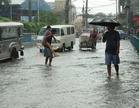
PRESIDENT Ferdinand Marcos Jr. has ordered strict compliance of laws on disaster mitigation as he underscored the need to give priority to measures that would address the impact of climate change.
The president’s directive came as 178 areas declared a state of calamity due to several tropical storms and heavy rainfall brought about by the southwest monsoon, and as the Climate Change Commission highlighted the failure of some government agencies to enforce policies to address the problem.
“The president has long been mentioning climate change because he has been studying it closely,” Presidential Communications Office Undersecretary Claire Castro said on Tuesday.
“Because of this, he is closely focused, especially on the effects of climate change, as we increasingly see and experience the harsh force of nature,” Castro said during a press briefing.
She said the Philippines has several laws and policies intended to address flooding and climate change, but their effectiveness could be undermined when they are not consistently enforced because of corruption.
“That will no longer happen because the issue of climate change will be prioritized, which is precisely what the president emphasized during yesterday’s meeting,” Castro said in Filipino.
The president on Monday met officials from the Department of National Defense, Department of the Interior and Local Government, Department of Social Welfare and Development, Department of Agriculture, Department of Health, Department of Public Works and Highways, and Department of Budget and Management to discuss flooding in Central Luzon, the Metro Manila health response, and updates from the participating agencies.
“The president emphasized the importance of our countrymen’s preparedness due to the impact of climate change,” Castro said.
She said Marcos urged the public “not to be complacent,” noting that many other countries are also experiencing intense monsoons, major storms, and severe flooding, including Nepal, China, Laos, Pakistan, India, and Kenya.
Flooding has also hit Japan and South Korea, while the Grand Canyon in the US experienced flash floods. “We must take the threat of climate change seriously. Preparedness is the key to overcoming its dangers,” she said.
“The president is pushing for the public to fully understand the effects of climate change because the intense rain, sudden downpours, and flooding we experienced aren’t the only things that can happen as a result of climate change,” she said.
“So, we must prepare for this, and all policies and laws must be implemented — that is what the president wants,” Castro added.
She also urged the public to practice proper waste disposal, noting that improperly discarded garbage can clog waterways and contribute to flooding.
State of calamity
At least 178 areas have been placed under a state of calamity as the combined effects of Tropical Cyclones Luis, Maymay and Neneng and the enhanced southwest monsoon affected 9.1 million people across 10 regions, the National Disaster Risk Reduction and Management Council (NDRRMC) reported Tuesday.
The widespread impact prompted local governments in Luzon and other affected areas to declare states of calamity, allowing authorities to mobilize resources and expedite relief, response and recovery efforts.
Pangasinan recorded the highest number of state-of-calamity declarations at 47, followed by Bulacan with 24, Cavite with 23, Pampanga with 21, Tarlac with 18, Benguet with 14, Zambales with 13 and Bataan with 12.
Dagupan City, Rodriguez in Rizal, Nasugbu in Batangas, and three municipalities in Occidental Mindoro — Sablayan, Paluan and Abra de Ilog — also declared state of calamity.
In Pangasinan, the declarations covered Santa Barbara, Mangaldan, Bugallon, Mangatarem, Bayambang, Lingayen, Infanta and the provincewide declaration covering 39 areas.
The disasters have so far left 34 people dead, 19 injured and three missing.
Flooding remained widespread, with 678 flooded areas reported.
The disasters forced authorities to establish 1,255 evacuation centers, where 39,386 families or 135,905 people were staying as of the latest assessment.
The cumulative damage included P6.27 billion in infrastructure losses and P2.32 billion in agricultural damage.
A total of 3,700 houses were damaged, including 3,300 partially damaged and 458 totally damaged.
The government has provided P1.79 billion worth of assistance to affected communities, according to the NDRRMC.
Probe sought
Senate President Pro Tempore Vicente Sotto III has filed a resolution calling for a Senate investigation into the root causes and devastating effects of the successive typhoons and southwest monsoons that battered the Philippines, with the aim of strengthening the country’s disaster mitigation efforts during natural calamities.
In the proposed Senate Resolution 631, Sotto said the Philippines experienced weekly typhoons and southwest monsoons throughout August 2026, resulting in widespread flooding, class and work suspensions, stranded commuters, business closures, and flooded homes.
The senator also raised concerns over the resilience and effectiveness of the country’s public infrastructure, particularly flood control projects intended to protect communities from flooding.
Sotto expressed concern over the Department of Health’s report of at least 5,486 cases of leptospirosis and 344 fatalities following flooding caused by the southwest monsoon.
The lawmaker said there is a need to assess the resilience of public infrastructure amid increasingly severe typhoons and monsoons, while ensuring that large-scale developments consider their potential impact on flooding and natural resources.