
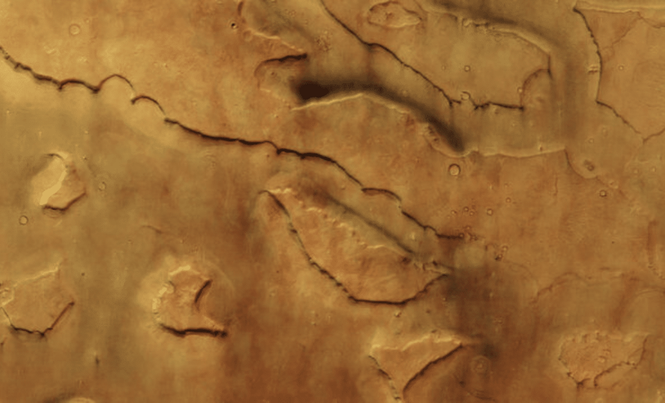
The European Space Agency (ESA) has revealed a stunning new view of Mars’s Mamers Valles, showing dozens of colossal dust devils twisting across the ancient valleys. Captured by the Mars Express High Resolution Stereo Camera, these mini tornadoes, some reaching 8 kilometers in height, provide unprecedented insight into the planet’s atmospheric dynamics and dusty landscapes.
Mars’s Dust Devils: Giants In The Red Planet’s Skies
Dust devils on Mars form when localized regions of the surface heat up under the Sun, causing the air above to spiral upward and lift dust with it. While Earth experiences similar whirlwinds in dry, desert-like regions, Mars’s dust devils are far more imposing. These atmospheric giants can stretch for several kilometers, towering over the Martian valleys, and reach top speeds of 45 meters per second, creating swirling clouds that persist long enough to leave visible tracks. They play a vital role in distributing surface dust, influencing local temperatures, and shaping the planet’s landscape over time. Observing these phenomena helps scientists understand how winds distribute material across Mars, potentially affecting future robotic missions and even human exploration, as dust can impact solar panels, instruments, and habitat designs.
How Mars Express Captured The Mini Tornadoes
The Mars Express orbiter, launched in 2003, has provided a wealth of detailed imagery through its High Resolution Stereo Camera (HRSC). This camera system captures multiple images simultaneously from different angles and color channels, which are then combined into composite views. When the Martian surface remains still, these layers align perfectly; however, moving elements like dust devils appear as distinct patterns against the static terrain. In this latest series, more than 30 dust devils are visible, circled in yellow with faint pinkish shadows trailing behind them. Scientists have analyzed the direction and speed of these dust devils using both Mars Express and ESA’s ExoMars Trace Gas Orbiter, mapping over 1,000 active storms across the planet. These insights are invaluable for understanding global wind patterns, how dust travels across Mars, and how it interacts with surface features such as valleys and mesas.
The Ancient Labyrinth Of Mamers Valles
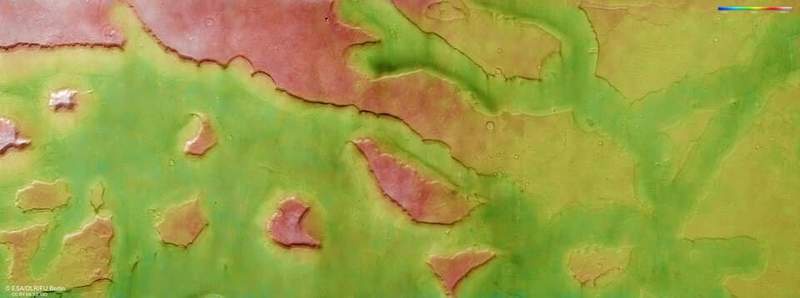
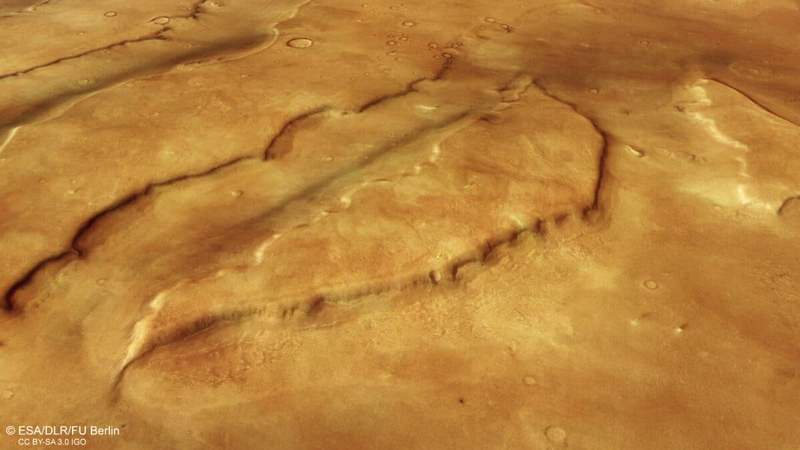
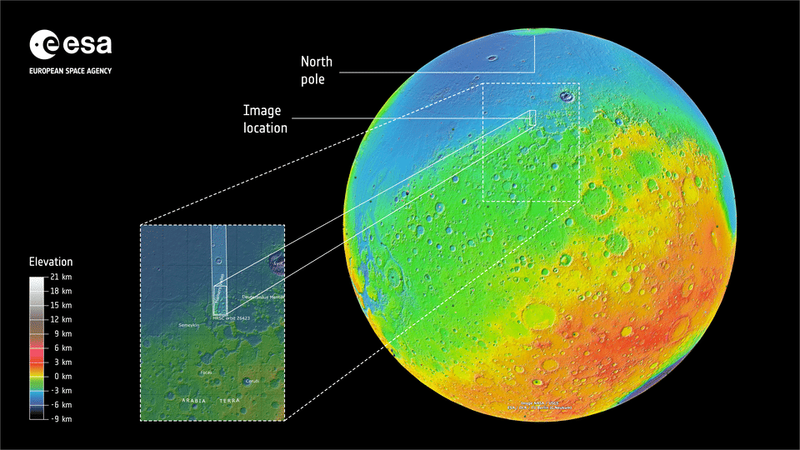
Mamers Valles is a vast and fragmented system of valleys stretching roughly 1,000 kilometers, connecting the southern highlands to the northern lowlands of Mars. Some channels are 25 kilometers wide and over 1 kilometer deep, bordered by steep cliffs, mesas, and debris-covered glaciers. The region exhibits “fretted terrain,” where valleys are broken and interrupted by flat-topped hills, cliffs, and ridged surfaces. The valley floors show long ridges and textures formed by glaciers sliding down slopes, carrying rocks and dust with them. Dark patches scattered across the valleys likely represent volcanic sands either formed in place or swept in by wind. Together, these features reveal the interplay of water, lava, and ice in shaping Mars’s landscape over billions of years, offering a rare window into the planet’s ancient, geologically active past.
Glacial Remnants And Clues To Mars’s Watery Past
Beneath rocky debris on valley floors, glaciers preserve water ice, some of which has survived for millions of years thanks to protective layers of dust and rocks. These frozen remnants provide evidence of a time when Mars was warmer and wetter, and they help scientists reconstruct the planet’s climatic history. The ridges, grooves, and textures along the valley floors indicate the movement of ice, carving channels as it flowed downhill. Cliffs and mesas also display ice-related features, showing how glaciers shaped even the steepest slopes. While liquid water is no longer stable on the surface, these glacial traces provide critical clues about Mars’s hydrologic history and the processes that transformed it into the cold, arid world we observe today.
Mars Express: Decades Of Discovery
Launched in 2003, Mars Express has radically expanded our understanding of Mars. Its HRSC camera, developed and operated by the German Aerospace Center (DLR), has produced the most detailed color and 3D maps of the Martian surface, revealing landscapes and features previously invisible from orbit. ESA scientists at the DLR Institute of Space Research in Berlin-Adlershof and the Freie Universität Berlin have processed these data to create stunning images like those showing dust devils swirling across Mamers Valles. Over two decades, Mars Express has monitored dynamic phenomena, from dust storms to seasonal ice shifts, helping scientists model Mars’s climate, geological evolution, and atmospheric behavior. These observations continue to inform future missions and improve our understanding of the Red Planet’s environment.