

Rising medical insurance premiums are hitting Malaysians hard, and the frustration is entirely justified. What we’re seeing today isn’t a sudden spike or an isolated anomaly, it’s the visible tip of deep, long-building structural pressures that have gone unaddressed for years.
Interim measures from Bank Negara Malaysia (BNM) may slow the immediate pain, but the truth is uncomfortable: incremental tweaks cannot fix what has become a systemic failure. Malaysia’s healthcare financing model is straining at every seam, and without decisive reform, the system will continue to slide toward crisis.
The system requires a hard reset.
The Red Alert Flashing Since 2018
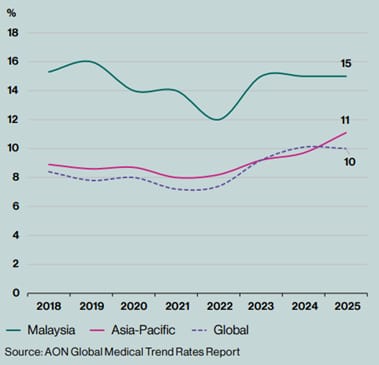
Medical inflation in Malaysia has hovered around 14% per year since 2018, far outpacing overall inflation, which is expected to remain near 2% in 2025. The compounding effect is staggering.
Take, for example, a policyholder paying RM1,000 in 2018.
- If premiums were to rise at the compounded medical inflation rate of 14% annually, that same premium would reach approximately RM2,502 by 2025, more than 2.5 times the original amount.
- In contrast, compounding at general inflation of 2% would see the premium rise to only RM1,149 by 2025.
This stark contrast illustrates why policyholders feel premiums are “exploding” and underscores the urgency for systemic reform.
The Unseen Pressures Driving up Costs
The real drivers of rising premiums are less about hospital supply pricing and more about the convergence of multiple pressures on the healthcare system.
Public hospitals, already strained by years of underfunding, were pushed to the brink during and after the COVID-19 pandemic. Non-urgent treatments were delayed, elective procedures postponed, and outpatient care backlogged.
In response, many patients turned to private hospitals.
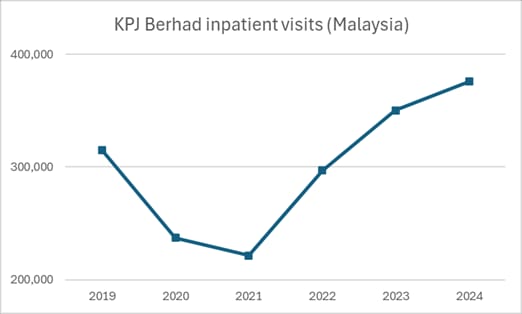
This surge is visible in KPJ Berhad’s inpatient numbers: 221,525 in 2021 jumped to 375,905 in 2024, a 70% increase in just three years.
This trend is compounded by an ageing population and the rising prevalence of non-communicable diseases (NCDs). The National Health and Morbidity Survey 2023 reports that 15.6% of Malaysian adults have diabetes, 29.2% have hypertension, and 33.3% have high cholesterol.
Specialist shortages, highlighted by the Hartal Doktor Kontrak, mean longer wait times and reduced access in public facilities, pushing patients further into private care.
The result is a systemic shutdown: demand has surged, capacity has been constrained, and claims have soared. Insurers, left to manage risk within these conditions, are forced to adjust premiums to maintain solvency.
Fragmented governance and political hesitation exacerbate the situation. Oversight is divided among multiple stakeholders: public hospitals, private providers, insurers, regulators, and policymakers.
Without coordinated action, misaligned incentives persist.
Political reluctance to tackle healthcare financing reforms leaves temporary measures as the only recourse, which merely delays the inevitable.
The consequence is unsustainable premiums, risk of insurer withdrawal from certain product lines, and the looming danger of public hospitals becoming overwhelmed.
The Call for a Hard Reset
Without decisive action, the stakes are clear. Rising premiums are not a temporary nuisance; they are a warning signal. If the current trajectory continues, more Malaysians will forgo insurance, leading to increased pressure on public hospitals and perpetuating the vicious cycle.
Temporary interventions, such as spreading premium adjustments over multiple years or pausing increases for older policyholders, can only provide short-term relief. The underlying drivers, post-COVID capacity gaps, NCD prevalence, ageing, fragmented governance, and political hesitation, demand comprehensive reform.
The system itself must be rebooted. Only with bold, coordinated reforms can we secure affordable, sustainable coverage and prevent the collapse of both private and public healthcare services.
The RESET initiatives, led by MOH, MOF, and BNM in collaboration with key stakeholders, offer a blueprint for systemic change that is both necessary and urgent. The five strategic thrusts underpinning RESET initiatives address the root causes of medical inflation. Central to this is the base MHIT product, designed to pool risks more effectively and maintain sustainable coverage for all Malaysians.
When Systems Break, Action Must Follow
History is ruthless in its lessons. In the late Roman Empire, neglecting systemic rot, crumbling infrastructure, overextended armies, and political indecision, meant that small crises cascaded into monumental collapse. Floods, famine, and internal unrest were not anomalies; they were symptoms of a system stretched beyond repair.
Today, Malaysia’s healthcare premiums, spiking medical costs, and fragmented governance are our modern warning signs. The time for piecemeal measures is over. Just as Rome could not wait for a single official to fix the empire, we cannot wait for incremental tweaks.
It is time for a hard reset – bold, coordinated, and uncompromising, to secure sustainable access to medical coverage for every Malaysian.
Teck Jin Wong (wteckjin90@gmail.com) is a content creator under the Newswav Creator programme, where you get to express yourself, be a citizen journalist, and at the same time monetize your content & reach millions of users on Newswav. Log in to creator.newswav.com and become a Newswav Creator now!
The User Content (as defined on Newswav Terms of Use) above including the views expressed and media (pictures, videos, citations etc) were submitted & posted by the author. Newswav is solely an aggregation platform that hosts the User Content. If you have any questions about the content, copyright or other issues of the work, please contact creator@newswav.com.

