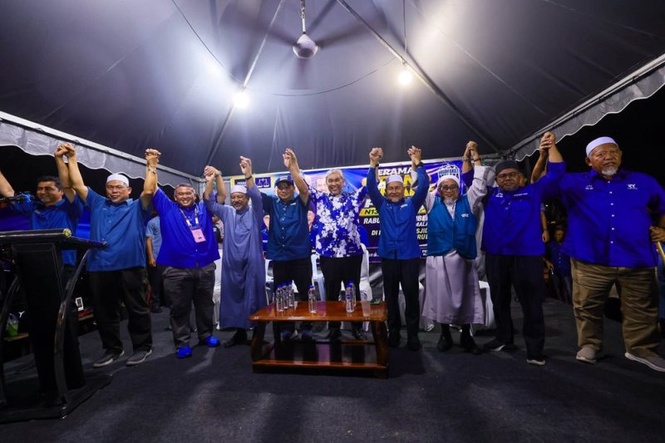
On Nov 14, the Barisan Nasional–Perikatan Nasional (BN–PN) pact captured 24 of Melaka’s 28 state seats, securing a two-thirds supermajority.
Pakatan Harapan (PH) was reduced to four urban, Chinese-majority constituencies, while Bersatu and Rafizi Ramli’s new party, Bersama, were wiped out.
Although nominally a contest over local governance, Melaka served as a dress rehearsal for the 16th General Election (GE16), due by February 2028. If this pattern holds, GE16 will be anything but competitive. Unless the BN–PN alliance fractures internally, it is on course for a federal landslide.
The collapse of split-ticket voting
With a Malay population of roughly 63 per cent, Melaka has long been an Umno heartland. Yet its decisive voting pattern makes it a crucial political barometer. Historically, Melaka voters split their tickets: in 2021, BN won the state 21–5, only to lose all six of Melaka’s parliamentary seats to PH and PN at GE15 a year later.
That firewall has now collapsed. Chief Minister Datuk Seri Ab Rauf Yusoh’s majority in Tanjung Bidara surged from 364 to 8,615, while BN’s majorities in Sungai Udang (16,214) and Serkam (11,742) were outright routs rather than narrow victories.
Turnout helps explain the shift. Malay turnout reached roughly 78 per cent, while Chinese and Indian turnout fell below 59 per cent. High Malay mobilisation, coupled with non-Malay apathy, has become the decisive electoral arithmetic in Malaysian politics.
The formula finally works
For four decades, competition between Umno and Pas split the Malay-Muslim vote, enabling PH to secure federal power in 2018 and 2022 despite having only minority Malay support.
Melaka suggests that this division has ended. BN contested 23 seats and PN five, with no overlapping contests. Crucially, voters respected the pact: Umno supporters backed Pas candidates in Bukit Katil, Paya Rumput and Bemban, while Pas supporters reciprocated elsewhere. Following strong victories in Johor in July and Negeri Sembilan in August, Melaka marks the pact’s third consecutive electoral success.
Extrapolated nationally, the implications are decisive. At GE15, BN and PN won a combined 104 seats, while PH captured dozens of mixed constituencies on pluralities made possible by the split Malay vote. Unifying that vote could flip roughly 28 PH seats, giving BN–PN around 130 seats – comfortably above the 112-seat threshold required to govern without relying on East Malaysian coalitions.
PH’s structural trap
PH’s crisis is defined not just by the scale of its losses but also by its geographic retreat. Its remaining seats – Kota Laksamana, Kesidang, Ayer Keroh and Bandar Hilir – are all DAP strongholds. PH failed to win a single Malay-majority seat, losing both its state chairman, Adly Zahari, and the Prime Minister’s political secretary, Datuk Azman Abidin, to Pas.
Meanwhile, PH’s attempt to shore up Malay support through a loose “PH Plus” arrangement with Bersatu collapsed, while Bersama failed to win any of the 16 seats it contested. This demonstrates that the anti-Anwar splinter movement has leaders but no electoral following.
PH is now trapped: DAP cannot win Malay-majority seats, Amanah has effectively vanished from the political landscape, and PKR cannot survive without DAP. Yet its alliance with DAP is also costing it Malay support.
Nationally, this trajectory threatens to reduce PH’s representation from 82 seats to roughly 54.
The federal paradox
Melaka exposes the unsustainable contradiction at the heart of Putrajaya, where Umno president Datuk Seri Ahmad Zahid Hamidi serves as Datuk Seri Anwar Ibrahim’s deputy prime minister while his party systematically dismantles PH at state level.
The result gives Ahmad Zahid maximum leverage: he can win without Anwar, while Anwar cannot govern without him. Anwar’s incentive is to delay GE16 until 2028, hoping Budget 2027 and an economic recovery will shift public sentiment. BN–PN, meanwhile, has every incentive to push for an early election while its momentum is at its peak.
Two questions Melaka cannot answer
Victory still leaves the pact with critical vulnerabilities. If Melaka’s electoral trajectory is replicated nationally, Pas would emerge as the largest party in Parliament. Yet both Ahmad Zahid and Pas covet the premiership. Negotiating seat allocations in battleground states such as Selangor and Johor will severely test their unity, making an internal quarrel within the pact its rivals’ best remaining hope.
Caution is also warranted because Melaka is not representative of the entire country. It is small, demographically skewed towards Umno and rewards strong local party machinery, whereas general elections are shaped by national narratives. BN–PN has yet to demonstrate that it can replicate this sweep in Selangor, Penang or Sabah, or govern cohesively together in Putrajaya.
A map redrawn
Even so, Melaka has redrawn Malaysia’s political map. The Umno–Pas pact is now a proven electoral machine, while PH cannot hold mixed constituencies without Malay support. If BN–PN stays intact, Malaysia is heading for a change of government; if it fractures over the premiership, another hung Parliament awaits.
Either way, the Anwar era is on borrowed time. The central question is no longer whether BN–PN can win, but whether it can govern.
The views expressed here are the personal opinion of the writer and do not represent those of Twentytwo13.
Image: Zahid Hamidi/Facebook